
Listen to this article
Download AudioAfrikaner Asylum Stats: Why Trump’s Offer Drew Interest
By Darius Spearman (africanelements)
Support African Elements at patreon.com/africanelements and hear recent news in a single playlist. Additionally, you can gain early access to ad-free video content.
A recent executive order by President Trump stirred significant debate. It focused on resettling white Afrikaner farmers from South Africa. This move came alongside a halt to most other refugee programs. From a Black perspective, this raises serious questions about fairness and priorities in U.S. policy. We need to examine the claims, the numbers, and their actual impact closely.
Trump South Africa Asylum: The Executive Order Explained
On February 7, 2025, the Trump administration took decisive action regarding South Africa. An executive order was signed, immediately halting U.S. aid to the nation. Furthermore, the order directed government agencies to prioritize refugee resettlement for Afrikaners (Addressing Egregious Actions of The Republic of South Africa). The justification cited alleged racial discrimination against this group. Specific mention was made of South Africa’s land expropriation laws.
The order didn’t stop there. It accused the South African government of “racially discriminatory property confiscation.” Interestingly, this action was also linked to South Africa’s foreign policy decisions. The order served partly as retaliation for South Africa bringing a genocide case against Israel at the International Court of Justice (The Racial Twist in Trump’s Cutoff of Refugee Admissions). Therefore, the policy intertwined domestic U.S. refugee priorities with international political disputes.
Afrikaner Refugee Program: Interest vs. Approved Applicants
Following the executive order, news surfaced about significant interest from white South Africans. The U.S. Embassy confirmed receipt of a list containing approximately 67,000 names. These individuals expressed interest in the potential resettlement program (Almost 70,000 white South Africans interested in Trump US asylum; 67,000 White South Africans Interested in Trump-Offered U.S. Refuge). It’s crucial to note, however, that this list represented expressions of interest, not formal refugee applications.
The South African Chamber of Commerce’s U.S. branch helped facilitate this list (Almost 70,000 white South Africans interested in Trump US asylum). Despite the large number showing initial interest, the actual number approved remained small initially. By April 2025, reports indicated that the first batch, consisting of 30 Afrikaners, had been approved for refugee status under the program (First batch of Afrikaners APPROVED for US refugee status). One approved applicant was reportedly a farmer who cited unemployment due to South Africa’s Black Economic Empowerment (BEE) laws. Consequently, those approved gained immediate rights to work in the U.S., though they faced travel restrictions requiring permission to return to South Africa.
Afrikaner Refugee Program: Initial Interest vs. Approvals
White Farmers Resettlement U.S.: Pushback from Afrikaner Groups
Despite the narrative of widespread Afrikaner persecution pushed by some, major Afrikaner organizations within South Africa rejected the resettlement offer. Dirk Hermann, CEO of the influential group Solidarity, stated firmly, “We are committed to build a future here. We are not going anywhere” (Afrikaner groups in South Africa decline Trump’s resettlement plan). This sentiment reflected a broader opposition among established Afrikaner community groups.
Even critics of South Africa’s affirmative action policies expressed reservations. Ernest Roets, known for his critique of Black Economic Empowerment, acknowledged Trump highlighting what he termed “144 race laws.” However, Roets opposed the idea of blanket sanctions against South Africa, indicating a nuanced view even among those critical of the current government (What’s the truth behind Trump offering White South African farmers asylum?). Meanwhile, the South African government strongly refuted the claims underpinning the U.S. executive order. The Foreign Ministry described the allegations as a “campaign of misinformation” (The Racial Twist in Trump’s Cutoff of Refugee Admissions). Thus, the reality on the ground appeared more complex than the U.S. order suggested.
Trump Executive Order Afrikaners: Examining the Discrimination Claims
The core justification for the executive order centered on alleged discrimination, particularly in the areas of land ownership and employment. South Africa’s Expropriation Act of 2024 allows the state to acquire property for public interest, including land reform. This aims to address severe racial inequalities inherited from apartheid (Expropriation Act, 2024 – Wikipedia). While critics claim this targets white landowners, the government insists it’s about redressing historical injustice. Notably, the law includes provisions for judicial oversight and negotiation, and specifically allows for potentially lower or nil compensation for land held unused purely for speculation (Explainer: South Africa Land-Reform Law; What South Africa’s new land act really says). No arbitrary seizures have occurred.
Similarly, Broad-Based Black Economic Empowerment (B-BBEE) laws aim to increase Black participation in an economy historically dominated by the white minority (South Africa: B-BBEE Guide 2023). While some white South Africans, like the farmer approved for U.S. refuge, blame B-BBEE for unemployment, these laws are designed as corrective measures against systemic apartheid-era exclusion. Furthermore, the claim of “144 race laws” often cited by critics is a misrepresentation by groups like the Institute of Race Relations; these refer to affirmative action and B-BBEE policies aimed at redress, not oppression (The “142 modern race laws that are just like apartheid” debunked). Moreover, Afrikaners and white South Africans generally remain economically privileged, owning around 70-72% of private farmland despite being only about 7% of the population (South African president misleads on land confiscation law; U.S.-South Africa Relations: Tensions Rise).
A Glaring Contrast: Afrikaner Preference vs. Broader U.S. Refugee Policy
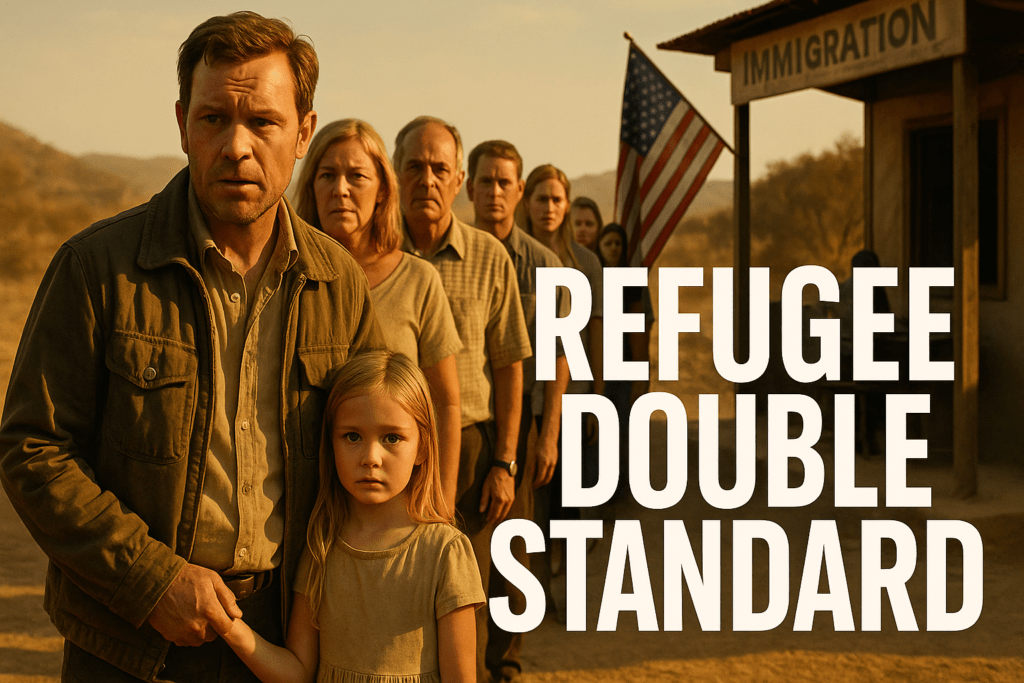
The prioritization of Afrikaners stands in sharp contrast to the administration’s simultaneous actions on broader refugee admissions. While creating this specific pathway, Trump suspended global refugee admissions generally (The Racial Twist in Trump’s Cutoff of Refugee Admissions). This left thousands of already-vetted refugees from other parts of the world in limbo. The article cites the example of Josephine, a Congolese refugee already approved for U.S. resettlement, suddenly stranded by the suspension.
This isn’t an isolated incident. Data from Trump’s first term showed a dramatic drop in U.S. refugee resettlement from predominantly Black and Brown regions. Admissions for Middle Eastern and African refugees fell to just 20% of previous levels. Conversely, admissions from white-majority European countries saw an increase during the same period (The Racial Twist in Trump’s Cutoff of Refugee Admissions). For those of us in the African diaspora, this pattern is deeply troubling. Therefore, it suggests a potential racial bias, favoring white Europeans and select groups like Afrikaners over refugees of color fleeing well-documented persecution and conflict in places like Congo, Sudan, or the Middle East.
U.S. Refugee Admission Trends (Trump First Term)
This special treatment for Afrikaners, while other groups face suspension and sharp declines, undermines social justice efforts. It diverts focus from the systemic issues faced by Black and Brown refugees globally. Furthermore, it risks reinforcing a narrative that paints white minorities as primary victims, even in contexts like post-apartheid South Africa where historical and economic data show ongoing white privilege (U.S.-South Africa Relations: Tensions Rise). Ultimately, policies like these demand scrutiny for their potential to embed racial double standards within the U.S. refugee system itself.
ABOUT THE AUTHOR
Darius Spearman is a professor of Black Studies at San Diego City College, where he has been teaching since 2007. He is the author of several books, including Between The Color Lines: A History of African Americans on the California Frontier Through 1890. You can visit Darius online at africanelements.org.
