

Sudan Civil War History: Why Millions Are Fleeing Today
By Darius Spearman (africanelements)
Support African Elements at patreon.com/africanelements and hear recent news in a single playlist. Additionally, you can gain early access to ad-free video content.
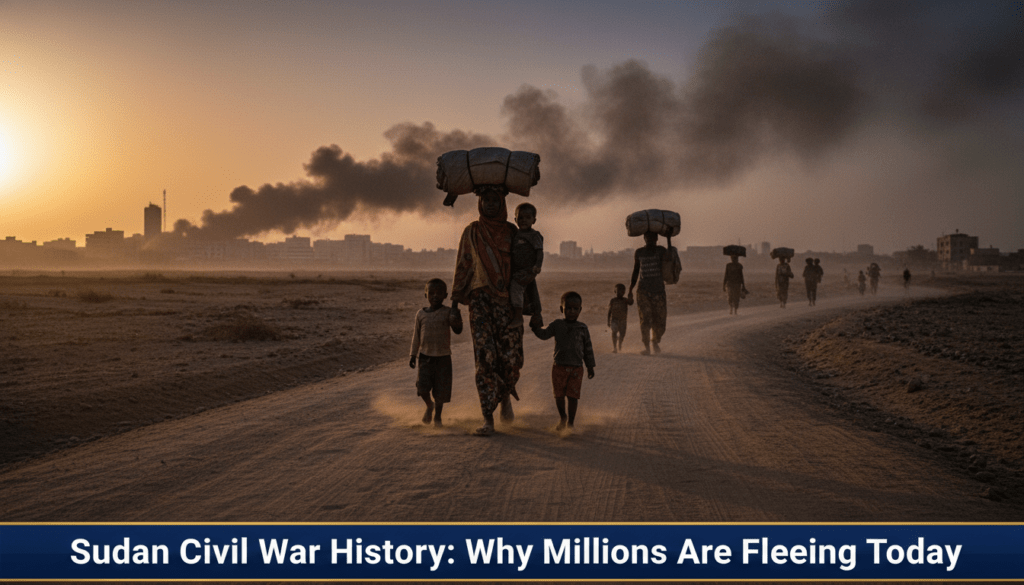
The sky over the city of el-Obeid turned dark with the smoke of a devastating drone strike on January 6, 2026. This attack hit a residential home and took the lives of 13 innocent people. Eight of the victims were children (democracynow.org). The Sudan Doctors’ Network reported that the Rapid Support Forces likely launched the strike. This tragedy is a small part of a much larger disaster that the United Nations calls the worst humanitarian crisis on the planet (unocha.org). More than 150,000 people have died in this conflict (democracynow.org). Over 11 million individuals have had to leave their homes to escape the violence (unocha.org). This crisis is a deep wound on the African continent that requires immediate attention.
To understand why this is happening, one must look at the history of the region. The current violence is a modern chapter in a long history of division and struggle for power. Sudan has faced many challenges since its time under colonial rule. These challenges include ethnic tensions and a fight over who gets to control the wealth of the land. The current war between the official army and a powerful paramilitary group is the result of decades of systemic issues. It is a story of how a nation’s resources were used to build private armies instead of public schools. This deep-dive will explore how Sudan arrived at this painful moment in time.
Mass Displacement in Sudan (2026)
Total Displaced: Over 11 Million People
This represents approximately 20% of the entire population.
Colonial Roots and the Seeds of Division
The problems in Sudan did not start with a single drone strike. They began during the time of the Anglo-Egyptian Condominium, which lasted from 1899 to 1956 (britannica.com). During this period, the United Kingdom and Egypt shared control over the land. However, the British government held the real power. They chose to invest mostly in the central Nile Valley. This area was the home of the Arab-Muslim elite. The British built schools, railroads, and telegraph lines in this center (countrystudies.us). Meanwhile, they ignored the outer regions like Darfur and the southern parts of the country.
This colonial policy created a massive gap in wealth and power. The people in the peripheries felt left behind and ignored. The British also separated the northern and southern regions of Sudan. They treated the “African” south and the “Arab” north as two different places until 1947 (britannica.com). This segregation made it hard for the country to unite after it gained independence. These actions laid the groundwork for a long history of internal struggles that continue to haunt the nation today. The elites in Khartoum maintained the same unfair systems after the British left.
The definitions of “Arab” and “African” in Sudan are often about culture and politics rather than just physical appearance. Both groups are Black Africans. However, those who identify as “Arab” usually speak Arabic and practice Islam (britannica.com). They historically held the most political authority in the country. On the other hand, the groups in the periphery often identify as “African.” They may practice indigenous religions, which are sometimes called animist traditions (leeds.ac.uk). These differences became tools for politicians to divide the people. This division led to multiple civil wars over the decades as different groups fought for their rights.
The Darfur Conflict and the Rise of the Janjaweed
The most direct ancestor of today’s war is the Darfur conflict that began in 2003. At that time, non-Arab rebel groups rose up against the government in Khartoum. They wanted a fair share of resources and political power. The government, led by dictator Omar al-Bashir, did not want to use its regular army for the whole fight. Instead, the state armed nomadic Arab tribes (britannica.com). These fighters became known as the Janjaweed, which means “devils on horseback.” They were used to attack civilian populations in Darfur.
The Janjaweed committed terrible crimes, including mass killings and arson. They used sexual violence as a way to destroy communities and clear people off the land (democracynow.org). This period saw some of the worst atrocities of the early 21st century. International groups accused the government of genocide. It was during this time that Mohamed Hamdan “Hemedti” Dagalo rose to power. He was a leader within these militias. He eventually turned his group of fighters into a more formal organization. This evolution was part of the state’s plan to maintain control through fear.
In 2013, the government officially formed the Rapid Support Forces (RSF). The state recognized them as a legal paramilitary group. Hemedti became the leader of this new force. The RSF was not like a regular army. It acted as a private military for the dictator (dgap.org). They became very wealthy by taking control of gold mines in Darfur. They also acted as mercenaries in foreign wars in Yemen and Libya. This wealth and military power turned the RSF into a “state within a state.” They were no longer just a small militia but a major power player in Sudanese politics.
Confirmed Deaths
In Need of Aid
The Revolution and the Broken Alliance
Sudan saw a glimmer of hope in 2019 when a massive civilian protest movement started. People from all walks of life marched in the streets to demand the end of Omar al-Bashir’s 30-year rule. The regular army, the Sudanese Armed Forces (SAF), and the RSF eventually joined together to remove the dictator. For a short time, it seemed like Sudan might move toward a democracy. A transitional government was formed with both civilian and military leaders. However, the military leaders were not truly ready to give up their power (emergencyalliance.org.nz).
In 2021, General Abdel Fattah al-Burhan of the SAF and Hemedti of the RSF staged a coup. They overthrew the civilian leaders and took full control of the country. This act ended the hope for a quick transition to civilian rule. However, the partnership between the SAF and the RSF did not last. They were two powerful groups led by two ambitious men. They both wanted to control Sudan’s vast resources, including gold and agricultural land. The tension grew over how to merge the RSF into the official army.
The SAF wanted the RSF to integrate within two years. Hemedti wanted ten years to complete the process. This disagreement was not just about timing. It was about who would ultimately lead the country. On April 15, 2023, the tension exploded into open warfare (dgap.org). The fighting started in the capital city of Khartoum and quickly spread across the nation. The two former allies became bitter enemies. They turned the city streets into battlefields. This conflict has brought the nation to the brink of total collapse while the world watches from a distance.
Weaponizing Violence Against the Vulnerable
The current war is marked by extreme cruelty toward civilians. The RSF has been accused of using sexual violence as a strategic weapon (amnesty.org). Recent reports from Al Jazeera include harrowing stories from women who survived attacks. A senior doctor revealed a shocking fact: fighters have raped at least 14 infants (democracynow.org). This type of violence is used to humiliate communities and force them to flee. It is a tactic that the Janjaweed used in Darfur decades ago. Now, it is happening on a massive scale across the country.
The RSF also uses drones to strike residential areas like the one in el-Obeid. These attacks target places where families live, sleep, and eat. The use of technology has made the war even more deadly for those who are not fighting. The SAF has also been accused of indiscriminate bombing from the air. Both sides seem to have little regard for the safety of the people they claim to represent. The healthcare system has almost completely failed. About 70% of medical facilities in conflict zones are no longer working (unocha.org). People are dying from preventable diseases and hunger.
The humanitarian impact on women and children is particularly severe. They often face the highest risks of displacement and violence. In these moments of crisis, we often see the efforts of courageous women who try to hold their communities together. They provide care and support even when the state has abandoned them. The international community has called for investigations into war crimes. However, the fighting continues without a clear end in sight. The lack of protection for the most vulnerable is a stain on the conscience of the world.
Gold Revenue
$6 Billion annually fuels the war economy.
Agriculture
84M hectares of fertile land are contested.
Oil Reserves
1.25 Billion barrels are at stake.
Gum Arabic
Sudan is the world’s leading exporter.
The Role of Foreign Powers and Resources
The war in Sudan is not happening in a vacuum. Several foreign nations are providing support to the different factions. This support keeps the war going. The RSF has historically received help from the United Arab Emirates. They also have a complicated relationship with foreign powers like the Russian Wagner Group (atlanticcouncil.org). These actors are interested in Sudan’s gold and strategic location. On the other side, the SAF has received support from countries like Egypt, Iran, and Turkey (aa.com.tr). They provide drones and weapons to the regular army.
The current administration of President Donald Trump faces pressure to address these foreign interventions. Sanctions have been placed on companies and individuals who fund the war through gold smuggling. However, these measures have not yet stopped the flow of weapons into the country. The fighting is profitable for some, and that makes peace very difficult to achieve. Each side believes it can win a total military victory if it gets enough help from outside. This belief prevents them from taking peace talks seriously.
Control of resources is at the heart of the power struggle. Sudan is rich in gold, oil, and fertile land. It is the leading producer of gum arabic, which is used in soda and candy around the world. These resources should be used to help the Sudanese people thrive. Instead, they are being used to buy bullets and drones. The “shadow army” of the RSF and the official SAF are fighting for the right to manage this wealth. As long as the generals can sell the country’s riches to foreign buyers, they have the money to keep fighting indefinitely.
The Resilience of the Civilian Movement
Despite the horrors of the war, the spirit of the Sudanese people remains strong. The civilian protest movement has not disappeared. Instead, it has adapted to the new reality. Neighborhood groups called Resistance Committees have changed their focus. They used to lead political protests. Now, they manage “Emergency Response Rooms” (youtube.com). These rooms act as local aid centers. They run community kitchens to feed the hungry and small clinics to treat the wounded.
These volunteers risk their lives every day to help their neighbors. They are often the only source of help in areas where international aid cannot reach. These groups still believe in the meaning of true freedom and democratic rule. They refuse to take sides between the two generals. Their slogan is often “No to the war.” They want both military groups to leave politics and return to their barracks. Their work shows that the desire for a better Sudan is still alive among the youth and activists.
The African Union and other global groups have tried to host peace talks. However, these efforts have largely failed because the generals do not trust each other. The civilian movement argues that any peace deal must include them. They believe that a deal between two warlords will not bring lasting peace. They want a government that answers to the people, not to those with the most guns. Their bravery is a reminder that the future of Sudan belongs to its citizens, not to the men who are currently destroying it.
Looking Toward a Fragile Future
The situation in Sudan as of early 2026 remains extremely grim. The death toll continues to rise, and more families are forced to flee every day. The drone strike in el-Obeid is a painful reminder that nowhere is truly safe. The international community must do more to provide humanitarian aid and pressure the warring sides to stop. The United Nations reports that the humanitarian appeal for Sudan is still not fully funded (unocha.org). Without more support, millions of people face the risk of starvation.
The history behind the headlines shows that this conflict was many years in the making. It grew out of colonial neglect, ethnic divisions, and the greed of military elites. Solving the crisis will require more than just a ceasefire. It will require a complete change in how Sudan is governed. The systems that allowed private armies to grow must be dismantled. The people in the peripheries must finally be given a fair share of the nation’s wealth and a voice in its future. Only then can the cycle of violence truly come to an end.
Sudan stands at a crossroads. One path leads to more years of war and the potential breakup of the country. The other path leads toward the democratic vision that the people marched for in 2019. The road to peace will be long and difficult. It requires the courage of the Sudanese people and the sustained attention of the world. The children of el-Obeid deserve a future where they can grow up in peace and safety. Their lives, and the lives of millions of others, depend on a solution that addresses the deep historical roots of this tragic war.
About the Author
Darius Spearman is a professor of Black Studies at San Diego City College, where he has been teaching for over 20 years. He is the founder of African Elements, a media platform dedicated to providing educational resources on the history and culture of the African diaspora. Through his work, Spearman aims to empower and educate by bringing historical context to contemporary issues affecting the Black community.
