


The Century-Old Pattern Behind LA Immigration Raid Tactics
By Darius Spearman (africanelements)
Support African Elements at patreon.com/africanelements and hear recent news in a single playlist. Additionally, you can gain early access to ad-free video content.
A New Siege on the Streets of Los Angeles
The streets of Southern California feel like a war zone for many residents today. In July 2025, several advocacy groups stepped forward to stop what they call an unconstitutional siege. The ACLU of Southern California and others filed a major lawsuit in federal court (aclusocal.org). They claim that federal agents are picking up people based on how they look rather than what they have done. This legal battle is known as Vasquez Perdomo v. Noem (courthousenews.com).
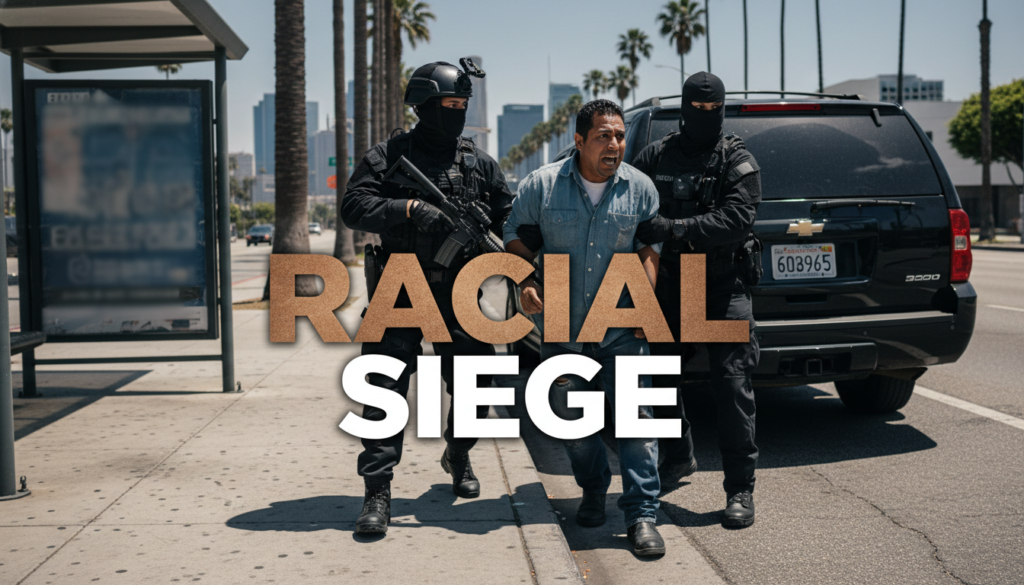
The lawsuit describes a terrifying scene that happens in broad daylight. Federal agents wear military-style gear and drive unmarked cars. They target people at car washes, bus stops, and places where day laborers look for work (thejuradofirm.com). Many times, these agents do not say who they are. They do not show warrants. Instead, they grab residents and whisk them away in what lawyers call midday kidnappings (aclusocal.org). This tension over the sharing of power between local leaders and federal agents has reached a boiling point under the current administration of President Donald Trump.
Advocates argue that these raids focus almost entirely on brown-skinned residents. It does not matter if the person is a citizen or a long-term resident. If they look a certain way, they are at risk. This practice creates a climate of fear that keeps people from going to work or school. It turns the simple act of standing on a sidewalk into a dangerous gamble with one’s freedom (lataco.com).
LA Immigration Arrest Demographics (2025)
Source: ICE Arrest Data (Jan-July 2025)
The Hidden Dungeon of Building B-18
The lawsuit does not just talk about arrests on the street. It also points to a dark place in the basement of a federal building in downtown Los Angeles. This area is known as B-18 (lataco.com). Plaintiffs describe the conditions there as dungeon-like and inhumane. The rooms have no windows and hold up to 70 people at a time. There is only one open-air toilet for everyone to share (aclusocal.org).
People held in B-18 report having very little access to water. They say they only get fed once a day, often in the middle of the night around 3 a.m. (lataco.com). These conditions are meant to break the spirit of those inside. Lawyers argue that holding people in such a place without a clear legal reason violates the basic right to due process. Every person on U.S. soil has a right to fair treatment, regardless of their citizenship status (thejuradofirm.com).
Furthermore, the secrecy surrounding B-18 makes it hard for families to find their loved ones. When an agent picks someone up without a name tag or a badge, they effectively disappear into a system that refuses to acknowledge them. This lack of transparency is a hallmark of the current enforcement strategy. It is designed to intimidate entire communities by showing that anyone can be taken at any time (theguardian.com).
The Legal Rise of the Kavanaugh Stop
A major change in the law happened in September 2025 that made these raids more common. The U.S. Supreme Court stepped in to stop a lower court from blocking the raids (scotusblog.com). In a 6-3 decision, the court allowed agents to continue using what is now called the Kavanaugh Stop. Justice Brett Kavanaugh argued that apparent ethnicity can be a factor when agents decide whom to stop (scotusblog.com).
This means that if a person looks Latino, speaks Spanish, or works a certain type of job, an agent can claim they have a reason to stop them. Critics say this is just a fancy name for racial profiling. While the court says race cannot be the only reason for a stop, combining it with things like being at a car wash makes it legal in the eyes of the government (abajournal.com). This ruling has opened the floodgates for more aggressive enforcement across the Central District of California (americanimmigrationcouncil.org).
Justice Sonia Sotomayor wrote a strong dissent against this idea. She warned that this rule allows the government to seize almost anyone who looks a certain way or works a low-wage job (scotusblog.com). She argued that the government is using a weak statistic to justify targeting millions of people. The Department of Justice claimed that ten percent of the local population is undocumented. However, researchers say this number is unsourced and misleading (justice.gov). This struggle highlights the ongoing racial inequality that continues to haunt the American legal system.
A Century of Pain at La Placita
The raids of 2025 are not a new invention. They are part of a long and painful history in Los Angeles. One of the most famous incidents happened on February 26, 1931, at a park called La Placita (zinnedproject.org). At that time, federal agents surrounded the park and trapped hundreds of people. They demanded to see papers from everyone there. This park was a major cultural hub for the Mexican community (reimaginingmigration.org).
While only a few people were deported that day, the raid sent a shockwave of terror through the city. It was the start of what is known as the Mexican Repatriation. During the Great Depression, the government blamed Mexican people for the lack of jobs. Over the next few years, nearly two million people of Mexican descent were forced to leave the country (racism.org). Surprisingly, about 60 percent of those people were actually U.S. citizens (reimaginingmigration.org).
This history shows that the government has used skin color as a shortcut for legal status for nearly a hundred years. The tactics used in 1931 were remarkably similar to those used today. Both relied on public spaces, intimidation, and the assumption that anyone with a certain appearance did not belong in the country. The pain of the La Placita raid still lingers in the memories of families in Los Angeles (zinnedproject.org).
Operation Wetback and the Militarization of the Border
In 1954, the government launched another massive effort called Operation Wetback. This campaign used military-style tactics to round up Mexican immigrants (wikipedia.org). Agents set up roadblocks and fanned out across farms and factories. They did not just look for people who had crossed the border recently. They swept up anyone they thought looked like they might be undocumented (leitf.org).
Los Angeles was once again a primary target for these sweeps. Thousands of people were loaded onto buses and planes. In many cases, families were torn apart without a chance to say goodbye. This operation showed how easily the government could turn the entire region into a police state based on ethnicity (wikipedia.org). The use of military equipment and aggressive tactics during this time set a precedent for the “roving patrols” we see today.
These historical events prove that immigration enforcement has often focused more on demographics than on actual law-breaking. During the 1950s, the goal was to satisfy political pressure by showing high numbers of deportations. The human cost—the citizens deported and the families destroyed—was often ignored by those in power. This cycle of aggressive enforcement continues to repeat itself in the modern era (leitf.org).
The 1975 Compromise and Modern Profiling
A key moment in the legal history of profiling happened in 1975 with the case United States v. Brignoni-Ponce. In this case, agents stopped a car near the border because the passengers looked Mexican (mevorahlaw.com). The Supreme Court ruled that a person’s appearance alone is not enough to justify a stop. However, the court did something that caused problems later. They said appearance could be one of several factors used to justify a stop (reason.com).
This 1975 ruling created a loophole that agents have used for decades. It allowed them to say they stopped someone because of their appearance AND because they were near the border or a workplace. This compromise forms the legal foundation for the Kavanaugh Stops we see today. It effectively made it legal to use race as a starting point for police investigation (mevorahlaw.com).
Consequently, the promise of the Fourth Amendment—to be free from unreasonable searches and seizures—has become hollow for many. When the law allows appearance to be a “factor,” it gives agents the power to target specific communities. This has led to the 16,000 street arrests reported in the Los Angeles region in the first half of 2025 alone (latimes.com). Many of those arrested had no criminal history, proving that the raids are not about public safety (laist.com).
A Century of Racial Enforcement
Double Jeopardy for Black Immigrants
While the headlines often focus on the Latino community, Black immigrants face their own set of unique challenges. They are caught in a double jeopardy. They face the racial over-policing that affects Black Americans and the aggressive tactics used by immigration agents (stanford.edu). Data shows that Black immigrants are more likely to be detained and deported for minor issues than any other group (racism.org).
When a Black immigrant lives in a neighborhood that is already heavily policed, any small interaction with a local officer can lead to a transfer to federal agents. Even if they have legal status, the assumption of criminality often leads to detention. Reports from cities like Minneapolis show that federal agencies have targeted specific groups, such as the Somali community, using similar “apparent ethnicity” logic (stanford.edu).
Furthermore, Black migrants in detention often report worse treatment and higher rates of abuse. They struggle against a system that combines anti-Black racism with anti-immigrant bias. This intersection makes them particularly vulnerable to the “military-style” raids being conducted today. Their stories are a crucial part of the larger fight for justice and equity in Southern California (racism.org).
The Impact on United States Citizens
One of the most shocking parts of the 2025 raids is how many U.S. citizens are getting caught in the net. Investigative reports have found that at least 170 citizens were detained or even physically harmed by agents in the first nine months of the year (propublica.org). Some of these individuals were held for hours or even days before they could prove they belonged in the country.
In one case, a 79-year-old citizen had his ribs broken by officers during a 12-hour detention. Another case involved a teenager who was tackled over an expired ID card. These stories contradict the government’s claim that citizens are “promptly” released (propublica.org). When agents rely on how a person looks, they inevitably make mistakes that violate the rights of those they are sworn to protect.
The lawsuit argues that these mistakes are not accidents. They are the natural result of a policy that prioritizes skin color over individual suspicion. When the government treats an entire demographic as “presumptively suspect,” no one is truly safe. This is why the class-action lawsuit is such a powerful tool. it seeks to change the system for everyone, ensuring that appearance is never again used as a reason to take away a person’s freedom (allrisenews.com).
Conclusion: Breaking the Cycle
The 2025 federal lawsuit in Los Angeles is more than just a legal case. It is a stand against a cycle of history that refuses to die. From the 1931 raids at La Placita to the Kavanaugh Stops of today, the core issue remains the same. The government is using race as a proxy for legal status. This practice undermines the very foundation of the American legal system (aclusocal.org).
While the tactics have evolved from physical batons to masked “roving patrols,” the fear they instill is identical. Advocates are pushing for a future where every person is judged by their actions, not their appearance or language. The outcome of Vasquez Perdomo v. Noem will decide if the United States continues down the path of racial profiling or if it finally breaks the century-long cycle of ethnic-based enforcement. As the legal battle moves forward, the eyes of the nation are on the streets of Los Angeles (courthousenews.com).
About the Author
Darius Spearman is a professor of Black Studies at San Diego City College, where he has been teaching for over 20 years. He is the founder of African Elements, a media platform dedicated to providing educational resources on the history and culture of the African diaspora. Through his work, Spearman aims to empower and educate by bringing historical context to contemporary issues affecting the Black community.
