


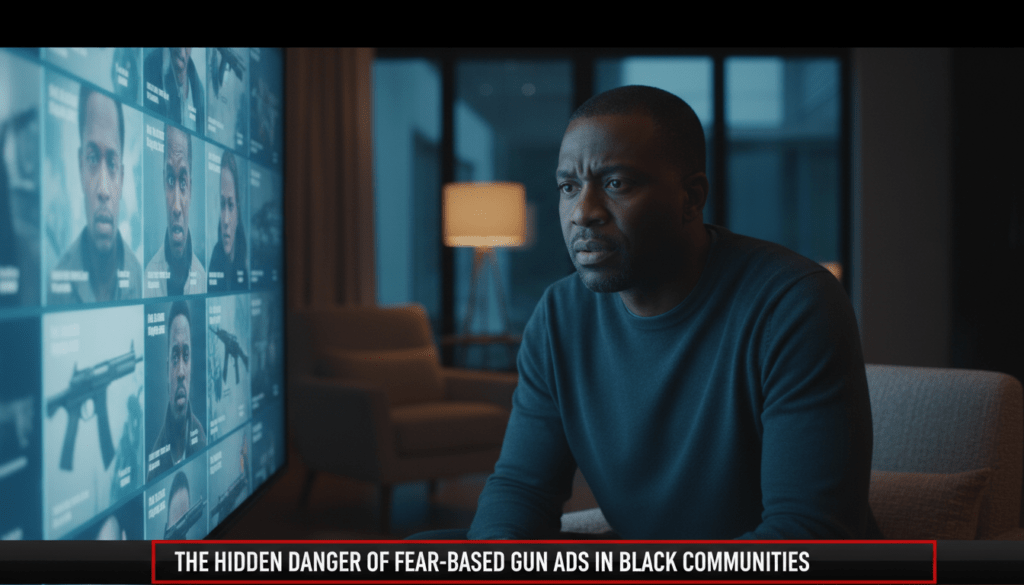
The Hidden Danger of Fear-Based Gun Ads in Black Communities
By Darius Spearman (africanelements)
Support African Elements at patreon.com/africanelements and hear recent news in a single playlist. Additionally, you can gain early access to ad-free video content.
A major report released on January 5, 2026, details a troubling trend in American firearm sales. This report combines data from public health experts and hospital records. It suggests that a decade of new marketing strategies has changed the safety of Black neighborhoods. These advertisements often sell firearms as a way to find safety and peace of mind. However, the data shows that more guns in these areas actually lead to more injuries. This shift in marketing is not accidental. It is the result of a long history of changing sales tactics and political moves (kffhealthnews.org).
Current President Donald Trump continues to oversee a nation where gun debates remain central to public life. The report highlights how fear-based messaging targets specific groups of people. For many Black residents, the promise of safety is very appealing. Historical failures in protection by the state have left a gap. The firearm industry has stepped into that gap with aggressive sales pitches. These ads claim that a gun is the only way to protect one’s home and family. Yet, the outcome in many neighborhoods tells a very different story (americanprogress.org).
The Long Shift from Tools to Personal Defense
For a long time, firearms were not marketed for personal defense in the way they are today. During the 1800s and early 1900s, manufacturers focused on hunting and farming. This period is often called Gun Culture 1.0. Companies like Winchester sold guns as tools for the “sturdy man” in rural areas. They focused on sport and the utility of the weapon on a farm. Most people did not view handguns as everyday items for urban survival (americanprogress.org).
This focus began to change as America became more urbanized. By the late 1970s, the number of hunters began to drop. The industry needed a new way to sell its products. Marketing experts turned toward the idea of “personal protection.” They began to focus on concealable handguns. This shift was fueled by stories of rising crime in cities. These stories were often used to scare people into buying weapons for their own safety. This new era became known as Gun Culture 2.0 (latimes.com).
The Rising Risk: Ownership vs. Safety
Data indicates ownership nearly doubled as marketing pivoted to Black communities. (kffhealthnews.org)
The Irony of the Mulford Act
The history of gun laws and the Black community is full of contradictions. In 1967, California passed a law called the Mulford Act. This law stopped people from carrying loaded guns in public. At the time, members of the Black Panther Party were using open-carry laws to patrol their own neighborhoods. They wanted to protect residents from police misconduct. This act of self-reliance made many politicians nervous. Governor Ronald Reagan signed the bill to disarm the Panthers (americanprogress.org).
This moment is ironic because many of the groups that supported the Mulford Act now support “constitutional carry.” Back then, the National Rifle Association (NRA) helped write the law to restrict gun rights. Today, the same industry uses the memory of those restrictions to sell guns. They argue that gun control is a way to keep Black people weak. By framing gun ownership as a form of shaping political dynamics, they have turned the act of buying a gun into a political statement. This message has been very effective in changing how people view their own safety (americanprogress.org).
The Cincinnati Revolution and a New Identity
A major turning point for the gun industry happened in 1977. This event is known as the “Cincinnati Revolution.” Before this time, the NRA focused mostly on hunting and sportsmanship. During their annual meeting, a group of activists took control of the organization. They wanted the NRA to become a powerful political force. They moved away from outdoor recreation and toward hardline lobbying. This change ensured that the industry would fight against almost any new gun regulation (americanprogress.org).
After this revolt, the messaging became much more aggressive. The new leaders used walkie-talkies to organize their votes on the floor. They successfully ousted the old guard. From that night on, the focus was on the Second Amendment as a shield for personal defense. The industry started to use “fear-based” tactics. They told Americans that the world was becoming more dangerous. This helped create a new identity for gun owners. It also paved the way for the industry to look for new groups of customers outside of their traditional base (latimes.com).
Targeting New Markets to Survive
By the early 2010s, the gun industry faced a business problem. Their main customers were white men, and that group was getting older. Industry leaders referred to this as the “pale, male, and stale” crisis. They knew they needed to reach younger and more diverse groups to stay profitable. They began to identify Black and Latino communities as “untapped markets.” This led to a deliberate shift in how they advertised their products (latimes.com).
Companies started using Black influencers and spokespeople to reach these new audiences. They framed gun ownership as a modern way to protect the traditions of kinship resilience. They claimed that owning a firearm was a path to empowerment. This marketing worked well. Between 2015 and 2021, the rate of gun ownership among Black Americans jumped significantly. It rose from 14 percent to 25 percent in just a few years. This surge in sales brought millions of new weapons into urban neighborhoods (kffhealthnews.org).
The “Safety” Paradox Animation
2X Homicide Risk
3X Suicide Risk
Public health data shows that the presence of a firearm increases risk regardless of intent. (kffhealthnews.org)
Pandemic Fears and the 2020 Surge
The year 2020 brought a perfect storm for gun sales. The pandemic created a lot of uncertainty. At the same time, the death of George Floyd led to widespread social unrest. Many people felt that the police could not protect them. The gun industry used these events to push their “safety” narrative even harder. They targeted people who were afraid of slow police response times. They told consumers that they were solely responsible for their own security (kffhealthnews.org).
This led to a massive spike in purchases. One in five American households bought a gun during the first two years of the pandemic. For many, this was their first time owning a firearm. The National Shooting Sports Foundation (NSSF) played a big role here. They represent the business interests of gun makers. They worked to make sure gun stores stayed open as “essential businesses.” This effort ensured that the industry could capitalize on the fear of the moment. However, the report shows that weapons bought during this time often ended up at crime scenes very quickly (latimes.com).
The Reality of the “Safety” Promise
The advertisements promise safety, but the statistics show a different reality. Having a gun in the home actually increases the risk of death. Public health data indicates that it doubles the risk of homicide for everyone in the house. It also triples the risk of suicide. These risks are even higher in neighborhoods with few resources. When more guns enter a community, the chance of accidental shootings goes up. Domestic violence cases also become more likely to end in a death (kffhealthnews.org).
The surge in sales has also led to a tragic rise in youth suicides. Between 2011 and 2020, firearm suicides among Black youth increased by 115 percent. This trend is linked to more unsecured guns being kept in homes. Many of these weapons were purchased by people who wanted to feel safe. Instead, the presence of these firearms has created new dangers for children. This is a heavy price to pay for the promise of security that the ads sell (latimes.com).
Systemic Failures Drive More Sales
One reason these ads work so well is because many people feel the system has failed them. In cities like Chicago, the clearance rate for homicides is very low. This means that many murders in Black neighborhoods never result in an arrest. Only about 21 percent of these cases are solved. In white neighborhoods, the rate is much higher at over 45 percent. When people do not believe the police will find killers, they often feel they must arm themselves (americanprogress.org).
This creates a cycle of “street justice” and retaliation. People buy guns because they are afraid, but the guns make the neighborhood feel less safe. This environment is part of the struggle for Black freedom and safety in a country that often neglects urban areas. The industry takes advantage of this lack of trust. They sell a “dangerous solution” to a problem that requires better public services and justice. The result is a community that is more heavily armed but also more vulnerable (kffhealthnews.org).
Trafficking and the Iron Pipeline
The report also looks at how guns move from legal stores to the street. This path is often called the “Iron Pipeline.” It describes how guns are bought in states with loose laws and moved to states with strict laws. For example, many “crime guns” in New York come from the South. Traffickers use “straw purchasing” to get these weapons. This happens when someone with a clean record buys a gun for someone else who cannot legally have one (latimes.com).
Data from the ATF shows that many guns found at crime scenes were purchased recently. This “short time-to-crime” suggests that the weapons were bought specifically to be sold illegally. The industry’s push for more sales often ignores how these weapons spread. As more guns enter the market, more guns are stolen or sold illegally. This keeps the underground market supplied with fresh weapons. This flow of firearms directly impacts the safety of Black neighborhoods across the country (americanprogress.org).
Homicide Disparity Index
Black Americans are 12.8 times more likely to be victims of gun homicide than white Americans. (kffhealthnews.org)
Legal Challenges and the Path Forward
As of 2026, many states are fighting back against these marketing tactics. New York, California, and Illinois have passed laws to hold gun makers accountable. These laws allow people to sue companies for “predatory marketing.” This strategy seeks to bypass federal protections for the gun industry. Families from the Sandy Hook shooting used a similar path to reach a major settlement with a gun manufacturer. They argued that the company used unfair ads to sell dangerous weapons (americanprogress.org).
The Mexican government is also suing U.S. gun makers for billions of dollars. They claim that American companies knowingly help the illegal flow of weapons to cartels. These legal battles are part of a larger effort to change how guns are sold in America. Advocates hope that by hitting companies in their pockets, they can stop the use of fear-based ads. The goal is to focus on public health rather than just industry profits. Until these tactics change, the neighborhoods targeted by these ads will continue to bear the heaviest burden of injury and loss (latimes.com).
Conclusion
The report from January 5, 2026, serves as a wake-up call for many. It shows that the “danger in Black neighborhoods” is not just about crime. It is also about a century-long plan to sell as many guns as possible. By turning a tool into a symbol of safety, the industry has successfully expanded its reach. However, the promise of safety has not come true for many families. Instead, the influx of firearms has led to more death and heartache (kffhealthnews.org).
Understanding the history behind these headlines is essential for finding real solutions. It is not enough to look at individual actions. We must also look at how these products are pushed onto vulnerable communities. The relationship between marketing, policy, and safety is complex. True security will likely come from solving the root causes of fear rather than selling more weapons. The data is clear: the current path is making the most vulnerable communities even less safe (americanprogress.org).
About the Author
Darius Spearman is a professor of Black Studies at San Diego City College, where he has been teaching for over 20 years. He is the founder of African Elements, a media platform dedicated to providing educational resources on the history and culture of the African diaspora. Through his work, Spearman aims to empower and educate by bringing historical context to contemporary issues affecting the Black community.
