

The Hidden Fight Behind D.C. Street Organizing and Self Rule
By Darius Spearman (africanelements)
Support African Elements at patreon.com/africanelements and hear recent news in a single playlist. Additionally, you can gain early access to ad-free video content.
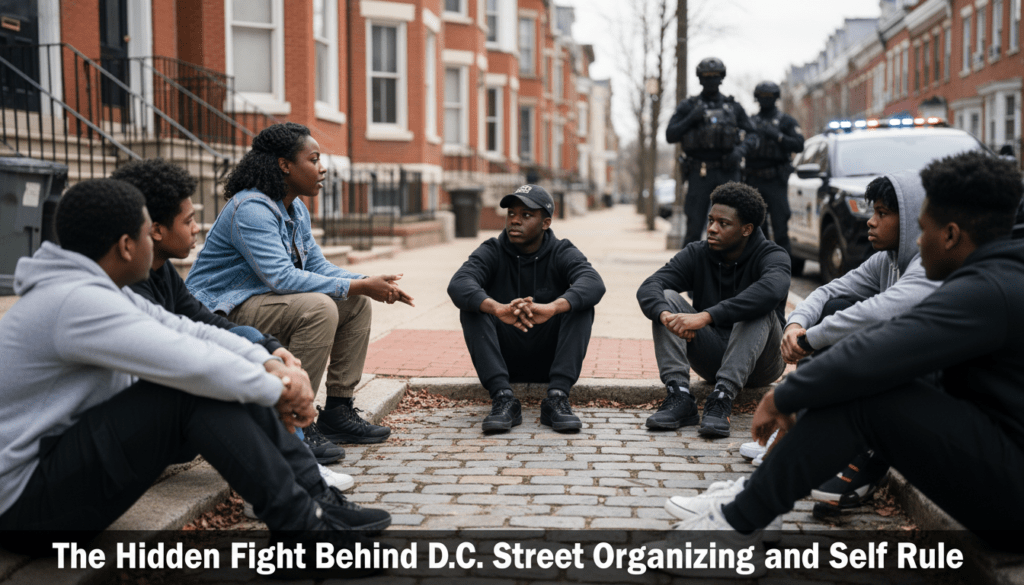
The streets of Washington, D.C., have become a battleground for basic rights. Residents are no longer simply asking for a seat at the table. Instead, they are training their neighbors to survive a federal takeover of their city. This shift from polite lobbying to intense street-level organizing marks a new chapter in a 200-year struggle (wikipedia.org). Youth groups are now at the center of this movement. They are teaching children how to handle police contact and the fear of immigration raids.
Throughout 2025, the legal status of the District has shifted dramatically. What was once a fight for statehood has become a desperate scramble to save local control. Federal mandates now override local laws with increasing frequency. This pressure has forced community leaders to change their tactics. They focus on protecting the most vulnerable people in the city. The history of this struggle shows that the current crisis is a modern version of an old problem (britannica.com).
The Long Shadow of the Organic Act
The lack of power for D.C. residents started over two centuries ago. In 1801, Congress passed the Organic Act. This law officially took away the right of residents to vote for the president (wikipedia.org). It also removed their representation in Congress. The federal government wanted to ensure no single state had too much influence over the capital. This decision created a massive deficit in civil rights that exists to this day (britannica.com).
For decades, activists fought to regain their voice. The struggle for self-determination was a key part of the Civil Rights Movement. Black residents in the District demanded the right to govern themselves. They saw similarities between their struggle and those who faced sharecropping and domestic service after the Civil War. They wanted more than just freedom; they wanted political power (wikipedia.org). In 1973, they finally won a small victory with the Home Rule Act.
The Home Rule Act was a fragile compromise signed by President Richard Nixon. It allowed residents to elect their own Mayor and a 13-member Council (wikipedia.org). However, the law came with strings attached. Congress kept the power to review every local law and control the city budget (senate.gov). This “leash” has allowed the federal government to block local policies on health and safety for years. The current crisis proves that Home Rule is not a right but a delegated power that can be taken back (dcbar.org).
ICE Arrest Surge (2025)
■ Jan-July
■ Aug-Oct
Data shows a triple-increase in arrests following the federal takeover (washingtonpost.com).
The 2025 Emergency and Federal Control
The current tension exploded in August 2025. President Trump invoked Section 740 of the Home Rule Act. This specific provision allows the President to take command of the Metropolitan Police Department (MPD) during emergencies (dc.gov). He declared a “crime emergency” to justify the move. This was the first time in history that a president used this “trapdoor” to seize control of the local police force (cbs8.com).
Under federal control, the mission of the police changed. Officers were ordered to cooperate fully with federal agencies like Immigration and Customs Enforcement (ICE). This order directly violated local “sanctuary” laws that had been in place for years (ilrc.org). The D.C. Council was powerless to stop it. The DC CRIMES Act of 2024 had already stripped the Council of its ability to change sentencing laws (congress.gov). The city was effectively under federal occupation.
The impact on the community was immediate. Federal officials like Attorney General Pam Bondi took authority over police operations (justice.gov). Routine patrols now include federal agents from the DEA and ICE. This has led to a climate of fear in many neighborhoods. Residents see the takeover as a political move rather than a safety measure. They point to data showing that violent crime was actually at a 30-year low before the emergency began (washingtonpost.com).
Street-Level Resistance and Youth Power
In response to the takeover, residents have organized at the block level. Organizations like Free DC and the Black Swan Academy lead this resistance. These groups believe that traditional lobbying is no longer enough (blackswanacademy.org). They are focusing on “Know Your Rights” trainings. These sessions are specifically designed for young people who face the highest risk of police contact. The goal is to build power from the ground up.
The Black Swan Academy is a visionary leader in the movement to remove police from schools. They argue that armed officers in schools contribute to the school-to-prison pipeline (blackswanacademy.org). Instead of police, they want more mental health professionals and counselors. Their work has become even more urgent since the federalization of the MPD. They teach youth how to film police safely and how to de-escalate tense situations (washingtoninformer.com).
Other groups, such as Son La Lucha, focus on the immigrant community. They use music and neighborhood meetings to prepare for ICE raids. They teach families how to designate emergency caretakers for their children. They also set up “neighborhood watches” to alert people when federal agents arrive (ilrc.org). This type of organizing is a direct response to the suspension of local protections. Residents are learning that they must rely on each other for safety.
Nature of ICE Arrests (2025)
■ 80% Non-Criminal History
■ 20% Criminal History
The vast majority of detainees have no prior criminal record (ilrc.org).
The Reality of the ICE Surge
The fear of ICE is not based on rumors. It is based on a sharp increase in arrests. Between August and October 2025, over 1,100 people were arrested by immigration agents in the D.C. area (washingtonpost.com). This is a massive jump compared to previous years. Most of these arrests are “collateral arrests.” This means federal agents detain anyone they find during a search, even if that person was not the original target (ilrc.org).
The data shows a troubling trend. About 80 percent of those arrested in the 2025 crackdown had no criminal record (ilrc.org). These are often people who were simply going to work or staying at home with their families. The Guatemalan community has been hit especially hard. They make up a small portion of the population but a large portion of the arrests (elpais.com). This disproportionality has led to accusations of racial profiling by federal agents.
Local leaders argue that these tactics make the city less safe. When people are afraid of the police, they do not report crimes. They do not come forward as witnesses. D.C. sanctuary laws were designed to build trust between the community and the police (dc.gov). By forcing local police to assist ICE, the federal government has broken that trust. The street-level organizing today is an attempt to rebuild that community safety through mutual aid and education.
The Statehood Movement and the Path Forward
The crisis of 2025 has given new life to the statehood movement. For years, the phrase “Taxation Without Representation” has been on D.C. license plates. Residents pay more in federal taxes per capita than people in any state (dcbar.org). Yet, they have no voting member in the House of Representatives. Eleanor Holmes Norton serves as a Delegate, but she cannot vote on the final passage of bills (senate.gov). She is often forced to watch as Congress dismantles the laws she helped create.
Statehood would provide the District with two U.S. Senators and a voting House member. It would also grant the city the protections of the 10th Amendment. This amendment reserves powers not given to the federal government for the states (wikipedia.org). Without statehood, D.C. remains a “federal district” under the ultimate control of Congress. The 2025 takeover has shown residents that Home Rule is too weak to protect them from a hostile federal executive.
The fight for statehood is also a fight for racial justice. D.C. was once known as “Chocolate City” because of its large Black population. Many believe that the refusal to grant statehood is rooted in a desire to suppress Black political power (washingtoninformer.com). These activists see their work as part of shared struggles against oppression around the world. They are fighting for the right to live without fear in their own homes.
Violent Crime Trend (Pre-Takeover)
Crime decreased by 35% in 2024, reaching a 30-year low before federal intervention (washingtonpost.com).
A New Era of Resistance
Washington, D.C., is entering a new era. The physical presence of federal agents on street corners has changed daily life. However, it has also sparked a powerful response from the people. Residents are no longer waiting for permission to be free. They are building their own systems of protection and education. This street-level organizing is the latest chapter in a very long story of resistance (blackswanacademy.org).
The youth of the District are leading the way. They understand the stakes of this struggle better than anyone. They are the ones who will inherit the city, and they are determined to make it a place where everyone can live with dignity. Whether through “Know Your Rights” trainings or protests for statehood, they are making their voices heard. The headlines may talk about crime and emergencies, but the real story is the strength of the community (washingtoninformer.com).
The struggle for D.C. is far from over. As long as the federal government maintains its “exclusive jurisdiction,” the tension will remain. However, the residents have shown that they are not easily defeated. They will continue to organize, train, and fight for the right to govern themselves. The history behind the headlines proves that the desire for self-determination cannot be suppressed forever (wikipedia.org).
About the Author
Darius Spearman is a professor of Black Studies at San Diego City College, where he has been teaching for over 20 years. He is the founder of African Elements, a media platform dedicated to providing educational resources on the history and culture of the African diaspora. Through his work, Spearman aims to empower and educate by bringing historical context to contemporary issues affecting the Black community.
