

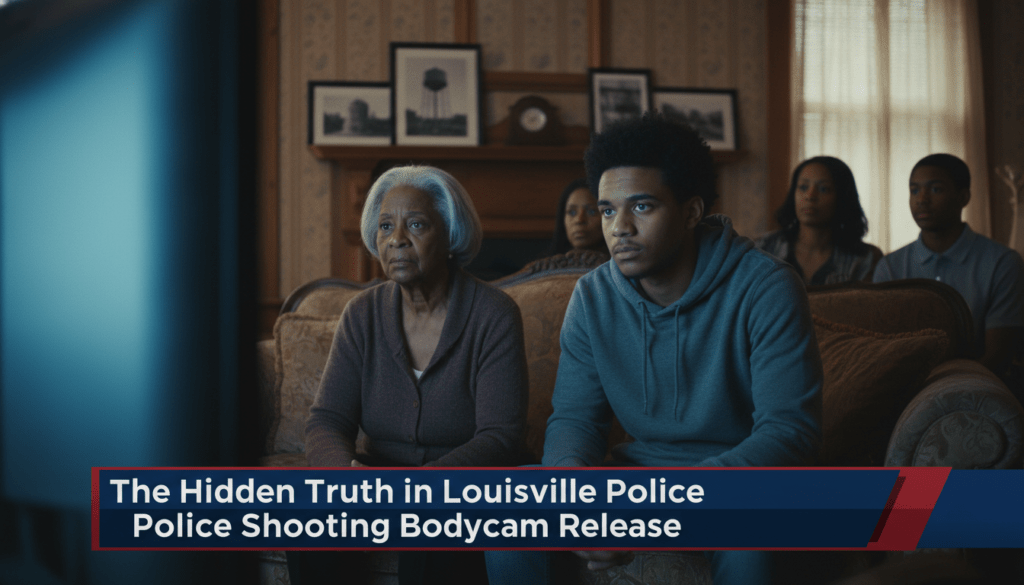
The Hidden Truth in Louisville Police Shooting Bodycam Release
By Darius Spearman (africanelements)
Support African Elements at patreon.com/africanelements and hear recent news in a single playlist. Additionally, you can gain early access to ad-free video content.
On January 5, 2026, the city of Louisville faced a familiar and heavy ritual. The Louisville Metro Police Department, known as the LMPD, shared video footage from two different police shootings. These events happened within one day of each other back in December 2025. For the people living in these neighborhoods, the videos were more than simple evidence. They were part of a long and painful story about who gets to tell the truth in Kentucky (whas11.com).
The shootings involved two men named Asa McNeely and Winthrop Taylor. The police department said both men were armed during their encounters with officers. However, the release of this footage did not quiet the voices of the community. Instead, it sparked more questions about how the police handle these cases and how they share information with the public. To understand why these videos caused such a stir, we must look at the history that led to this moment (lpm.org).
A Deadly December and a Quest for Clarity
The end of 2025 was a violent time in Louisville. There were ten officer-involved shootings over the course of the year. Three of those shootings happened in December alone (govdelivery.com). This rise in violence occurred even though the overall violent crime rate in the city had dropped by 58 percent since its peak in 2021 (govdelivery.com). The gap between lower crime and more police shootings created a sense of confusion among the residents.
Louisville Violent Crime Trend (2021-2025)
Asa McNeely was shot on December 18 in an alleyway. This happened in the Russell neighborhood, which is a place filled with deep Black history. The police claimed McNeely reached for a handgun in his waistband. He was rushed to the hospital in critical condition. He later faced charges of first-degree wanton endangerment (lpm.org). The community watched the video to see if the police narrative matched the actions on the screen.
The very next day, Winthrop Taylor was involved in a three-hour spree that included carjackings and a shootout with officers. One civilian was hurt during this time, but they survived. Taylor was eventually arrested and charged with attempted murder of a police officer (youtube.com). While these cases seem clear to some, many families in Louisville feel that the police use these videos to tell a one-sided story before all the facts are out.
The Ghost of Breonna Taylor and No-Knock Raids
The current lack of trust did not start in 2025. It reached a boiling point in March 2020. That was the year Louisville police killed Breonna Taylor. She was a young Black woman who was shot in her own apartment during a “no-knock” raid. This type of raid allows police to enter a home without knocking or identifying themselves first. In that case, the officers were not wearing body cameras because they were part of a special unit that did not require them at the time (wikipedia.org).
A “no-knock” raid is very dangerous because people inside might think they are being robbed and try to defend themselves. That is exactly what happened with Breonna Taylor. Her death became a national symbol of the need for reform. Following massive protests, the city paid her family $12 million and banned no-knock warrants (pbs.org, congress.gov). This legacy of freedom in black and white remains a core issue for every family trying to stay safe in their own homes.
The raid on Taylor was later called “botched.” Investigations showed that the police planning was very poor. The main person they were looking for was already in custody somewhere else when they broke down Taylor’s door. Furthermore, the warrant was based on false information. Officers fired 32 shots blindly into the dark apartment. One officer was even convicted later for firing into a neighbor’s home (wikipedia.org). This history makes the community very skeptical whenever the police release “curated” video packages today.
The Russell Neighborhood: A Legacy Under Pressure
The shooting of Asa McNeely happened in the Russell neighborhood. This area is often called “Louisville’s Harlem.” Back in the 1940s, it was a beautiful and busy place for Black-owned businesses and theaters. It was the heart of the community’s enduring kinship networks and cultural pride (visionrussell.org, historiclouisville.com). However, things changed after the 1960s.
During a time called “urban renewal,” the city demolished much of the commercial heart of Russell. This led to decades where the neighborhood did not get the money or help it needed. Today, while there are efforts to rebuild the area through the “Vision Russell” project, the people who live there often feel over-policed. They see a high level of police activity compared to other parts of the city. When seven officers fire their weapons in a single incident, as happened in early 2024, the neighbors feel more like they are in a war zone than a community (lpm.org, visionrussell.org).
The Battle Over the 10-Day Rule
Another point of conflict is how fast the police must show the videos. Kentucky state law usually says that public records must be shared within five business days. However, in 2024, Mayor Craig Greenberg and the LMPD set a new rule. They decided that bodycam footage would be released within ten business days instead (lpm.org, lpm.org). This doubled the time that families have to wait for answers.
(5 Days)
(10 Days)
Comparison of Video Release Windows
Critics like the Kentucky Open Government Coalition argue that this policy breaks the law. They believe the police are using that extra time to create “curated” videos. These videos often have a police officer narrating the events and showing only specific clips before the raw footage is ever seen. Attorneys like Sam Aguiar say this “pre-frames” how the public thinks about the shooting (lpm.org). This is a key part of how the city is shaping political dynamics around police reform.
The city claims that ten days is a commitment to being open. They say it takes time to review the video and protect the privacy of people who were not involved. However, the neighbors who are pressing for clear answers see it as a way to control the story. When the police hold press conferences and do not take live questions from reporters, as they did during the Jan 5 release, the feeling of secrecy only grows (whas11.com, lpm.org).
Federal Oversight and the Sudden Exit
For a few years, it looked like the United States government would force the LMPD to change. In March 2023, the Department of Justice (DOJ) released a report. It said the LMPD routinely violated the rights of citizens. The report found evidence of excessive force and racial discrimination. To fix this, the city was supposed to enter a “consent decree,” which is a legal agreement where a federal judge watches over the police department (apnews.com).
However, everything changed on December 31, 2025. Just five days before the McNeely and Taylor videos came out, a federal judge dismissed the plan for a consent decree. This happened because the DOJ, under the leadership of President Donald Trump, withdrew its support for the deal. The federal government argued that these decrees cost too much money and were a form of “micromanagement” that hindered local leaders (govdelivery.com). This was a major blow to the activists who were hoping for outside help to fix the system.
Now, Louisville must follow its own “Community Commitment” plan. This is a self-regulated plan where the city hires its own monitors to check on the police. The plan includes a new “Community Safety Commission” and a goal to reduce shootings by 15 percent every year (govdelivery.com, govdelivery.com). Many neighbors worry that without a federal judge watching, the police will go back to their old ways.
The Question of Officer Conduct
The history behind the headlines also includes the records of the officers themselves. Some officers involved in recent shootings have had serious disciplinary problems in the past. For example, Officer Patrick Norton was praised by the department for being calm during a recent shooting. However, records show he was suspended for 35 days in the past (wdrb.com).
In 2019, a previous police chief actually recommended that Norton be fired. He had purposely turned off his body camera before using force that hurt someone. He also had a history of using demeaning language toward citizens. Even though he stayed on the force and received many awards later, these past mistakes make it hard for the community to trust his actions now (wdrb.com). When the department praises an officer with a history like that, it sends a confusing message to the public.
68
LMPD Shootings Since 2003
Moving Toward an Uncertain Future
Since 2003, there have been 68 recorded shootings by LMPD officers. Some independent reviews suggest the number might be even higher because some cases were not counted properly (govdelivery.com). This long list of incidents shows that the struggle for transparency is not a new fight. It is a part of the daily life for many Black families in Louisville who are just trying to live in peace.
The return of investigations to the LMPD’s own Public Integrity Unit (PIU) is another change. For a while, the Kentucky State Police handled these cases to ensure there was no bias. However, the city brought the investigations back to the LMPD in 2024 because the state police were taking too long to release information (lpm.org). Now, the city promises “layers of oversight,” but many people still worry about “police policing themselves.”
As the city moves through 2026, the demand for clear answers remains. The release of bodycam footage on January 5 was a step toward transparency, but it was a step taken with many strings attached. For the neighbors in the Russell area and the families of those shot, the video is just the beginning of the search for truth. They will continue to press for open records and a system that treats every citizen with dignity and respect. The history behind the headlines proves that until there is real accountability, the videos will only show half the story.
About the Author
Darius Spearman is a professor of Black Studies at San Diego City College, where he has been teaching for over 20 years. He is the founder of African Elements, a media platform dedicated to providing educational resources on the history and culture of the African diaspora. Through his work, Spearman aims to empower and educate by bringing historical context to contemporary issues affecting the Black community.
