
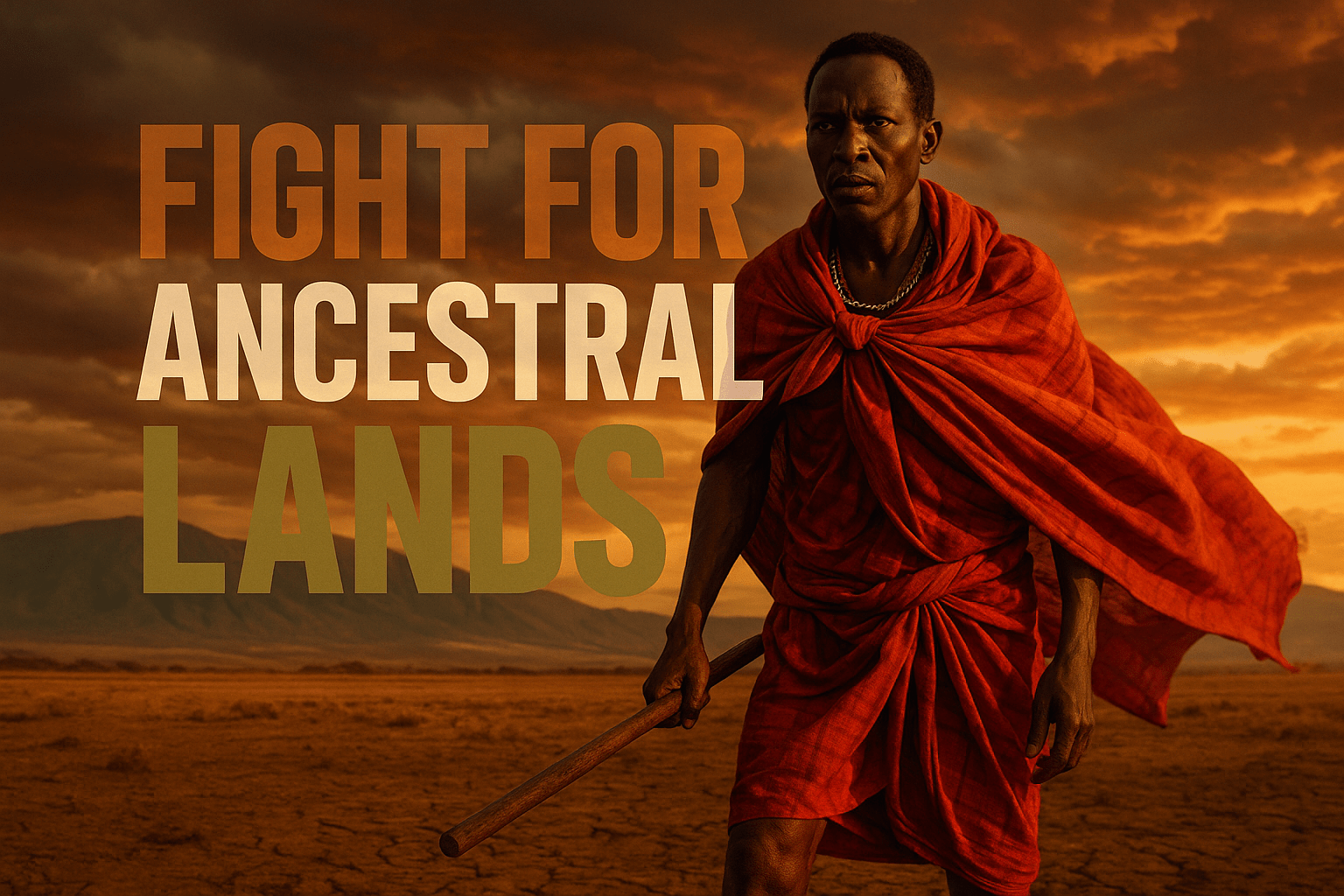
The Maasai’s Fight for Ancestral Lands
By Darius Spearman (africanelements)
Support African Elements at patreon.com/africanelements and hear recent news in a single playlist. Additionally, you can gain early access to ad-free video content.
The Ngorongoro Conservation Area: A Sacred Home Under Threat
The Ngorongoro Conservation Area (NCA) in Tanzania stands as a unique and vital UNESCO World Heritage Site. It is celebrated for its breathtaking natural beauty and its deep historical roots, holding significant archaeological treasures such as Olduvai Gorge, often called the “Cradle of Humankind.” This area possesses a dual identity, serving both as a critical conservation zone dedicated to protecting diverse wildlife and ecosystems, and as the ancestral homeland for Indigenous communities, most notably the Maasai (Oakland Institute).
This dual role, however, frequently creates a difficult tension between the goals of conservation and the fundamental rights and traditional ways of life of the Maasai people. For generations, the Maasai have lived in harmony with this land, their pastoralist practices deeply intertwined with the rhythms of nature. Their presence has been a testament to a sustainable coexistence, where humans and wildlife thrive together. Yet, this delicate balance is now under severe pressure, as the Tanzanian government’s actions threaten to dismantle centuries of Indigenous stewardship.
Understanding “Fortress Conservation” and Its Impact
The current crisis in Ngorongoro is a stark example of what is known as the “Fortress Conservation Model.” This approach to environmental protection prioritizes safeguarding natural areas by actively excluding human populations, often through forced displacement. It operates on the belief that human presence, especially that of Indigenous communities, is inherently harmful to wildlife and ecosystems. This model stands in sharp contrast to more inclusive conservation strategies that acknowledge the crucial role Indigenous peoples play as stewards of their lands and integrate their traditional knowledge and practices into conservation efforts (Oakland Institute).
Historically, the establishment of African wildlife sanctuaries, such as Serengeti National Park, focused solely on protecting land without considering the profound cost to the communities who had preserved these areas for centuries (Acontrario ICL). The dominant narrative from international conservation agencies and the Tanzanian government often presents a false choice: either conservation or Indigenous livelihoods. This perspective ignores compelling evidence that empowering Indigenous communities is, in fact, highly effective for environmental sustainability. The Ngorongoro Multiple Land Use Model itself was initially a compromise, born from Maasai resistance to eviction and the persistent efforts of conservationist lobbyists who sought to dispossess them (Acontrario ICL). Today, this model is being undermined, leading to the forced relocation of the Maasai under the guise of conservation, a move that many see as a profound betrayal of their rights and their historical role as guardians of the land.
The Deceptive Nature of “Voluntary” Relocation
Since 2022, the Tanzanian government has initiated a program to relocate Indigenous Maasai residents from their ancestral lands in the Ngorongoro Conservation Area. The plan aims to move over 82,000 people to Msomera village, a location approximately 600 kilometers away (hrw.org). While the government asserts these relocations are “voluntary” and necessary for conservation, human rights organizations strongly contend that they are forced and represent a grave violation of the Maasai’s fundamental rights (hrw.org).
The government has deliberately reduced essential public services within the Ngorongoro Conservation Area to coerce Maasai residents into relocating. Since 2021, there has been a significant reduction in the availability and accessibility of schools and health centers (hrw.org). This downsizing of infrastructure and services, coupled with restrictions on access to cultural sites and grazing areas, and a ban on growing crops, has made life increasingly difficult for residents. These harsh conditions have effectively forced many to relocate (hrw.org). Furthermore, government rangers have reportedly attacked and harassed residents who did not comply with rules restricting movement in and around the conservation area (hrw.org). This systematic pressure paints a clear picture of coercion, not voluntary movement.
Forced Relocation of Maasai from Ngorongoro
Key Relocation Figures
Violations of Rights and International Law
The relocation process flagrantly violates numerous rights of the Maasai residents, rights that are firmly established in regional and international treaties ratified by Tanzania. These violations include fundamental rights to property and land, the right to participate in decisions affecting their lives, access to information, freedom of expression and assembly, education, and the highest attainable standard of health (hrw.org). The Tanzanian government’s actions raise serious questions about accountability, justice, and the remedies required under international, regional, and national law (hrw.org).
A critical principle violated in this process is Free, Prior, and Informed Consent (FPIC). This is a cornerstone of international human rights law, requiring governments and other entities to obtain the consent of Indigenous peoples before undertaking any project or measure that affects their lands, territories, or resources. “Free” means consent is given voluntarily, without any form of coercion. “Prior” means it is sought sufficiently in advance of any activities, allowing ample time for communities to understand and deliberate. “Informed” means Indigenous communities are provided with all relevant information about the proposed activities, including potential impacts, in a culturally appropriate and accessible manner. The Tanzanian government has not sought the free, prior, and informed consent of the Indigenous Maasai residents regarding the resettlement plan (hrw.org). Residents did not have access to information on matters related to the relocation process, compensation, or conditions in Msomera (hrw.org).
The Maasai are protected by several key international legal frameworks. These include the African Charter on Human and Peoples’ Rights, a regional human rights instrument for Africa. Additionally, they are covered by the International Covenant on Civil and Political Rights (ICCPR) and the International Covenant on Economic, Social and Cultural Rights (ICESCR), which are core United Nations human rights treaties protecting a wide array of civil, political, economic, social, and cultural rights. The UN Declaration on the Rights of Indigenous Peoples (UNDRIP) specifically affirms the collective and individual rights of Indigenous peoples, including rights to self-determination, lands, territories, resources, and free, prior, and informed consent (hrw.org). Furthermore, even Tanzanian laws, such as the Ngorongoro Conservation Area Ordinance of 1959 and subsequent amendments, the Land Acquisition Act of 1967, the Land Act of 1999, and the Village Land Act of 1999, recognize their legal status within the NCA, their rights to customary land, consultation, and compensation (hrw.org). The disregard for these obligations underscores the severity of the human rights crisis unfolding.
Maasai Rights Under Threat
Key Rights Reportedly Violated
- Rights to property and land
- Right to participation and information
- Freedom of expression and assembly
- Right to education
- Right to the highest obtainable standard of health
- Right to Free, Prior, and Informed Consent (FPIC)
The Harsh Reality of Msomera Village
Msomera village, the designated relocation site for the Maasai, is proving to be ill-equipped to support their traditional way of life, leading to significant hardship. The land in Msomera is described as dry, with no adequate pastures for grazing, and features contested plots already claimed by existing residents. Furthermore, the water sources are often salty and insufficient for the needs of a large population and their livestock. These conditions directly contradict the promises of fertile, uninhabited land that were used to lure families into relocating (hrw.org).
Cattle, which are central to Maasai livelihood, culture, and social status, have died in large numbers due to the unsuitable conditions in Msomera. The limited access to adequate pasture and water sources leads to reduced herd sizes, directly impacting their wealth, food security, and ability to maintain their cultural identity tied to their livestock. Beyond the economic impact, the imposed housing structures in Msomera, consisting of identical three-room concrete houses, strip the Maasai of their communal social structure. The Maasai social structure is deeply communal, characterized by extended family units, shared responsibilities, and a strong sense of collective identity. Their traditional housing, known as *enkaji*, are often arranged in compounds that facilitate close-knit community living and support their pastoralist lifestyle, allowing for easy movement of livestock and communal activities. This imposed standardization disrupts their traditional spatial organization, leading to the fragmentation of family units and the erosion of communal support systems. This “stripping” of their social structure undermines their ability to practice their culture, share resources, and maintain their unique way of life, which is built on interdependence and collective well-being. Additionally, health clinics in Msomera are barely functional, and schools are overcrowded, further exacerbating the challenges faced by relocated families (hrw.org).
The discrepancy in the reported relocation distance to Msomera village, cited as both approximately 600 kilometers and about 400 kilometers in different sources, highlights a concerning lack of clear and consistent information provided to the Maasai communities and the public (hrw.org). This inconsistency can cause confusion and distrust regarding the government’s relocation plans. A precise and verified distance is crucial for the Maasai to understand the true scope of their displacement and the logistical challenges involved in moving their families and livestock over such vast distances, impacting their ability to prepare and make informed decisions. The lack of transparency surrounding this basic fact further underscores the coercive nature of the relocation process.
Prioritizing Tourism Over Indigenous Communities
The Tanzanian government’s justification for relocation, citing overpopulation and conservation, is directly contradicted by its actions, which clearly prioritize tourism and investors over Indigenous communities. While Maasai homes are being dismantled and their traditional livelihoods restricted, tourist lodges are multiplying within the Ngorongoro Conservation Area. Roads leading to investor compounds are paved and meticulously maintained, while roads to Maasai villages are neglected (undisciplinedenvironments.org). This stark contrast reveals that the true motive behind the relocations may not be ecological preservation, but rather the expansion of tourism revenue and the accommodation of private interests.
International conservation bodies, such as the World Wide Fund for Nature (WWF) and the Frankfurt Zoological Society, have faced criticism for allegedly benefiting from Maasai displacement (undisciplinedenvironments.org). The Tanzanian government’s plan was developed to address the concerns of international conservation agencies and generate tourism revenue for the country (Oakland Institute). This suggests that the economic benefits from increased tourism, potentially through new infrastructure and expanded protected areas, are being prioritized over the traditional land use and rights of the Maasai. This situation is not new for the Maasai; they have historically been forced to relocate for conservation purposes, including the creation of Serengeti National Park (grist.org). The Ngorongoro Multiple Land Use Model was itself a compromise between Maasai resistance against the Serengeti eviction and the demands of conservationist lobbyists (Acontrario ICL). There were even sentiments that the colonial government should honor its pledge to the Maasai that they would not be disturbed again following the Serengeti eviction (Acontrario ICL). This historical pattern of displacement under the guise of conservation reveals a deeply troubling legacy that continues to impact the Maasai today.
Challenges Faced by Maasai in Msomera
ABOUT THE AUTHOR
Darius Spearman has been a professor of Black Studies at San Diego City College since 2007. He is the author of several books, including Between The Color Lines: A History of African Americans on the California Frontier Through 1890. You can visit Darius online at africanelements.org.
