

Timbuktu Manuscripts Return Home
By Darius Spearman (africanelements)
Support African Elements at patreon.com/africanelements and hear recent news in a single playlist. Additionally, you can gain early access to ad-free video content.
Timbuktu Manuscripts: A Legacy Preserved
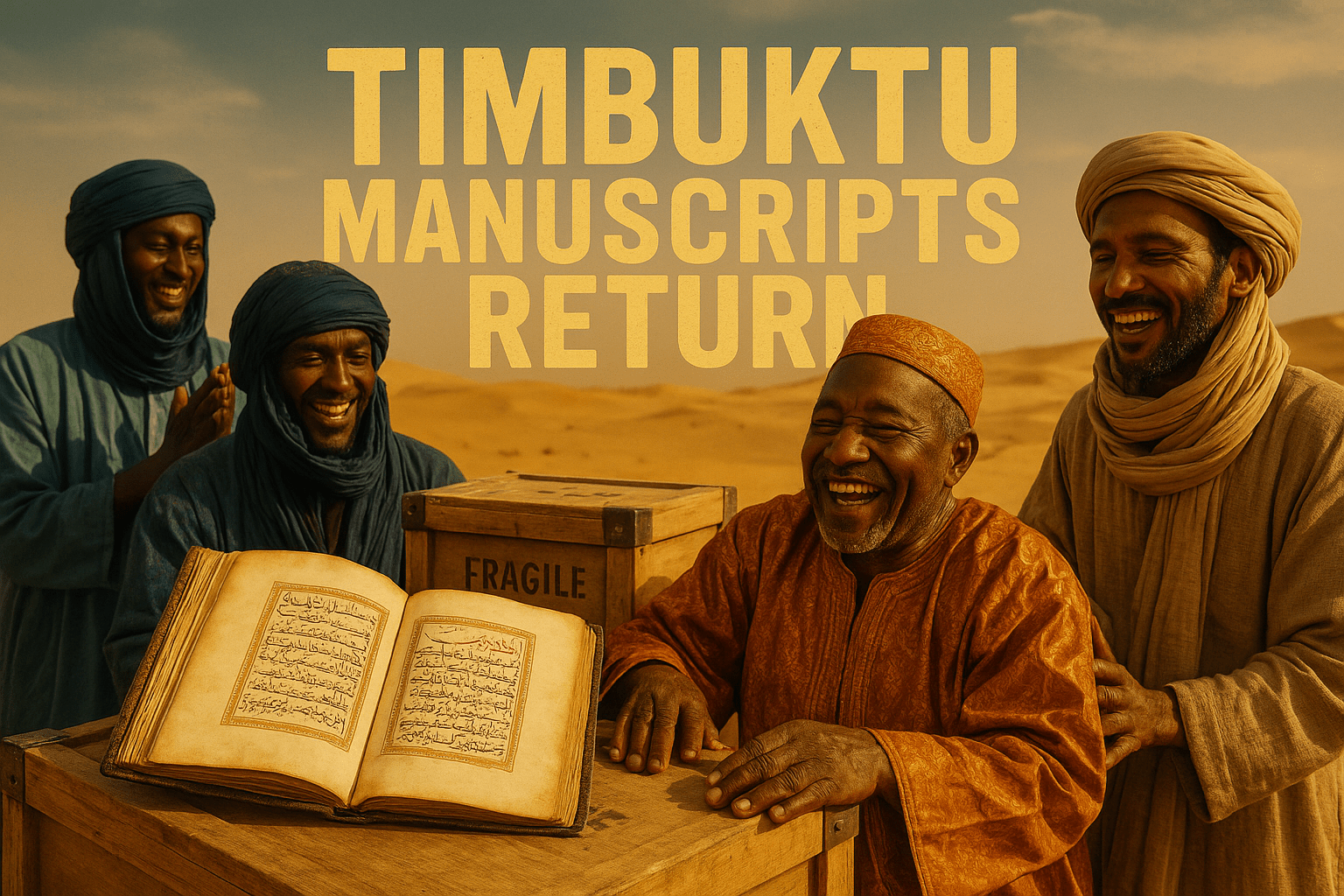
The historic Timbuktu manuscripts, saved from destruction by al-Qaeda-linked militants over a decade ago, have begun their journey home to Timbuktu from Mali's capital, Bamako (pbs.org). This return marks a significant moment for cultural preservation and a testament to the resilience of the Malian people. The Malian military government initiated the return on Monday, 13 years after these precious documents were spirited out of Timbuktu during its occupation by militants (pbs.org).
The Timbuktu manuscripts are a collection of handwritten documents, with some dating back to the 13th century. They cover a vast array of subjects, including Islamic theology, jurisprudence, astronomy, medicine, mathematics, history, and geography (pbs.org). These texts are a testament to the rich intellectual tradition of West Africa and the interconnectedness of African and Islamic cultures. They provide a wealth of information on the scholarly and cultural practices of historical West Africa, offering insights into subjects as diverse as astrology, poetry, jurisprudence, and theology (thearchaeologist.org). Furthermore, they capture an intellectual tradition of inquiry into subjects as diverse as astronomy, ethics, jurisprudence, geography, and philosophy, showcasing a rich written record in Africa whose value is often overlooked outside the continent (hyperallergic.com).
What are the Timbuktu Manuscripts?
Timbuktu Manuscripts: A collection of handwritten documents, some dating back to the 13th century, covering subjects like Islamic theology, jurisprudence, astronomy, medicine, mathematics, history, and geography. They are a testament to West Africa's rich intellectual tradition and the interconnectedness of African and Islamic cultures.
Why the Manuscripts Returned
The return was deemed necessary to protect the manuscripts from the humidity in Bamako (pbs.org). Timbuktu, located on the edge of the Sahara desert, has a dry climate that is more suitable for their long-term preservation (abcnews.go.com). Humidity can cause significant damage to ancient paper and ink, leading to mold growth, deterioration of the paper fibers, and fading of the text. The dry desert air of Timbuktu naturally helps to keep the manuscripts in a stable condition, preventing these types of damage. The first batch of manuscripts arrived in Timbuktu by plane from Bamako, consisting of over 200 crates weighing approximately 5.5 tons (pbs.org). The remaining manuscripts are expected to be shipped in the coming days, ensuring their continued safety in their original, more appropriate environment.
Diahara Touré, Timbuktu’s deputy mayor, emphasized the importance of these documents to the local people, stating they “reflect our civilization and spiritual and intellectual heritage” (pbs.org). Bouréma Kansaye, the Malian Minister of Higher Education, described the manuscripts as a “legacy that bears witness to the intellectual greatness and crossroads of civilization” of Timbuktu, calling them “a bridge between the past and the future” (abcnews.go.com). UNESCO has designated these manuscripts as part of the World Cultural Heritage (pbs.org). They cover diverse subjects, including Islamic theology, jurisprudence, astronomy, medicine, mathematics, history, and geography, showcasing the rich cultural heritage of the Mali and Songhai empires in West Africa (pbs.org).
The Heroic Rescue of Timbuktu's Treasures
The majority of the manuscripts were heroically saved from destruction by local custodians during the militant occupation. While Islamic radicals destroyed over 4,000 manuscripts, some dating back to the 13th century, more than 27,000 documents were saved (pbs.org). The Al-Qaeda-linked militants, specifically Ansar Dine, were an extremist group that occupied Timbuktu. Their motives for targeting the manuscripts were rooted in their fundamentalist ideology, which views historical and cultural artifacts that do not align with their strict interpretation of Islam as idolatrous or heretical, and therefore subject to destruction.
The Timbuktu library's Malian custodians demonstrated immense devotion by smuggling the manuscripts out of the occupied city using various means, including rice sacks, donkey carts, motorcycles, boats, and four-wheel-drive vehicles (pbs.org). This heroic effort was spearheaded by individuals like Abdel Kader Haidara, a librarian and founder of SAVAMA-DCI (hyperallergic.com). He, along with a network of volunteers, risked their lives to smuggle hundreds of thousands of manuscripts out of Timbuktu during the militant occupation. This involved secretly transporting the fragile texts by boat, donkey, and car to safer locations, often under the cover of darkness and with immense personal danger. These clandestine operations highlight the deep commitment of the custodians to protect their cultural heritage (thearchaeologist.org). A PBS NewsHour report from 2018 highlighted that thousands of ancient manuscripts were smuggled away and saved, with efforts underway to digitize them (pbs.org). A 2015 report from PBS NewsHour detailed how one man organized a mission to smuggle out most of the manuscripts when jihadists invaded the city and sought to destroy its cultural treasures (youtube.com).
Manuscript Statistics
Commitment to Preservation and Access
The Malian military government committed to the return of the manuscripts in February, recognizing the ongoing responsibility to protect and promote these treasures (abcnews.go.com). Bouréma Kansaye emphasized the ongoing responsibility to “protect, digitize, study, and promote these treasures so that they continue to enlighten Mali, Africa, and the world” (pbs.org). Digitization involves converting the physical manuscripts into digital formats, such as high-resolution images. This process is crucial for both preservation and access. Digitization creates digital copies that can be stored securely, protecting the information from further physical degradation or loss due to conflict or environmental factors. It also allows for global access to these invaluable texts, making them available to researchers, scholars, and the public worldwide without needing to handle the fragile originals.
International support has been crucial in the preservation, return, and digitization of the Timbuktu manuscripts. Organizations like UNESCO have designated the manuscripts as World Cultural Heritage, raising global awareness and facilitating support (pbs.org). Collaborations with entities like Google Arts & Culture, Timbuktu Renaissance, and Instruments 4 Africa have been instrumental in digitizing a significant portion of the collection (hyperallergic.com). Furthermore, organizations like HMML (Hill Museum & Manuscript Library) have provided ongoing support for preservation projects (hmml.org). This international collaboration underscores the global recognition of the manuscripts' importance and the collective effort to safeguard them. The Ahmed Baba Institute, also known as the Ahmed Baba Centre for Documentation and Research, is a significant institution in Timbuktu dedicated to the preservation, study, and promotion of the city's ancient manuscripts (pbs.org). It serves as a central repository and research center, playing a crucial role in safeguarding Mali's intellectual heritage.
Ongoing Challenges and Community Impact
Despite the return of the manuscripts, the security situation in Mali remains precarious due to ongoing militant insurgency. Mali, along with neighboring Burkina Faso and Niger, has been battling an insurgency by armed militants, including groups allied with al-Qaeda and the Islamic State (abcnews.go.com). Even 13 years after the occupation of Timbuktu, analysts note that the security situation in Mali remains precarious and has worsened in recent months (pbs.org). Although Timbuktu is back under government control, militants continue to attack its surroundings, with incidents reported as recently as last month (pbs.org).
The return of the Timbuktu manuscripts has a profound impact on the local community, extending beyond official statements. For the people of Timbuktu, these manuscripts are not just historical artifacts but living symbols of their rich intellectual heritage and identity. Their presence fosters a sense of pride and continuity, reinforcing Timbuktu's historical status as a center of learning. This can inspire local education, encourage cultural revival, and strengthen community bonds, reminding residents of their unique contribution to global knowledge and resilience in the face of adversity (pbs.org). The manuscripts, primarily written in Arabic and local African languages using Arabic script, span several centuries, with some texts dating back to the 13th century. Their content is incredibly diverse, reflecting a sophisticated intellectual tradition. They include works on Islamic sciences like theology, jurisprudence, and Sufism, but also secular subjects such as astronomy, mathematics, medicine, history, geography, poetry, ethics, and even astrology (thearchaeologist.org). This breadth of knowledge underscores Timbuktu's historical role as a major center of learning and scholarship.
Diverse Subjects of Timbuktu Manuscripts
ABOUT THE AUTHOR
Darius Spearman has been a professor of Black Studies at San Diego City College since 2007. He is the author of several books, including Between The Color Lines: A History of African Americans on the California Frontier Through 1890. You can visit Darius online at africanelements.org.
