
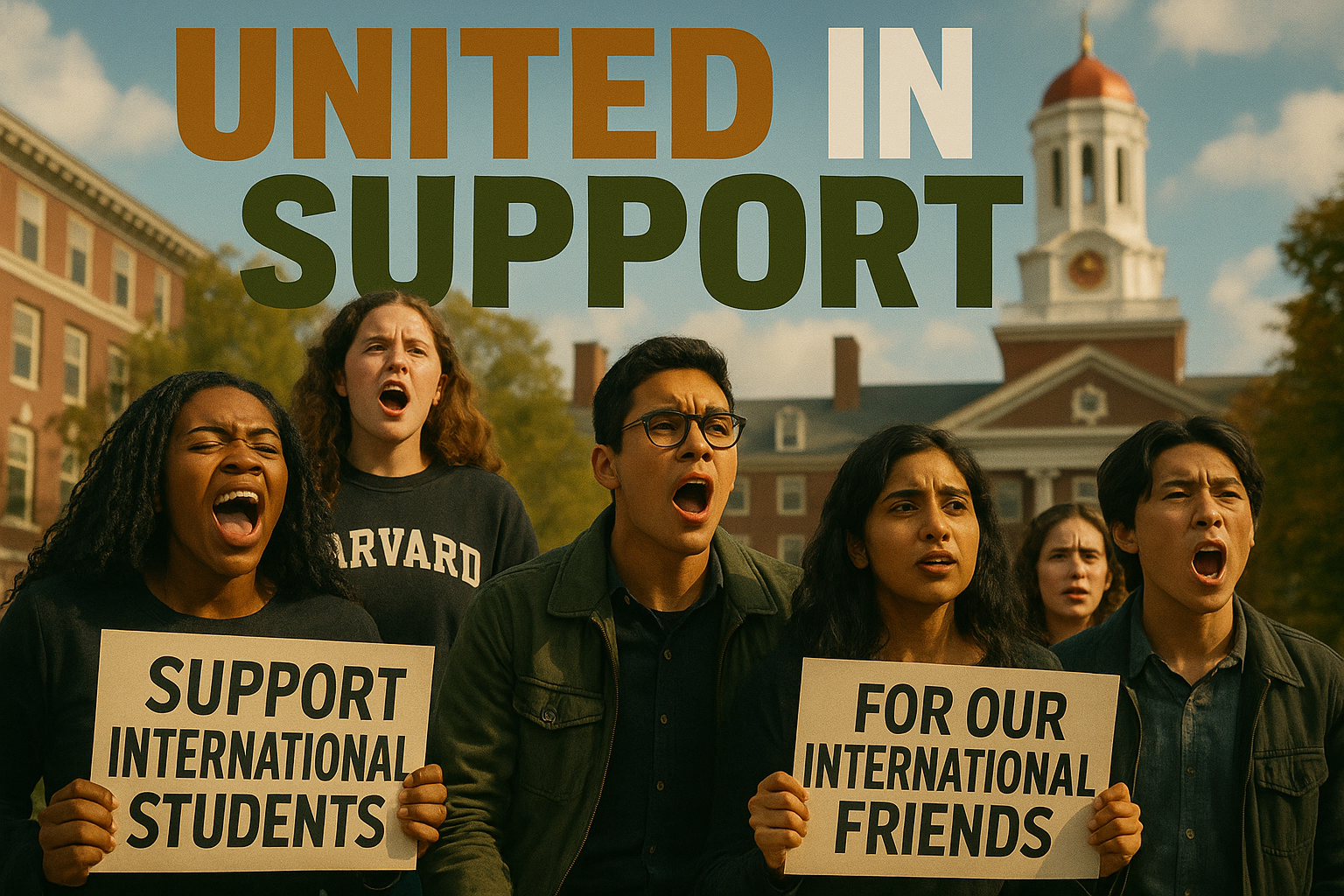
 Harvard students rallied for international classmates facing enrollment threats under a Trump administration directive, showcasing unity and legal resistance to protect academic freedom and diversity. (AI Generated Image)
Listen & Share
Harvard Rally Stands for International Students
By Darius Spearman (africanelements)
Support African Elements at patreon.com/africanelements and hear recent news in a single playlist. Additionally, you can gain early access to ad-free video content.
A United Stand for International Students
Students gathered at the Harvard Science Center Plaza to show robust support for their international classmates. This was a response to a directive from the Trump administration that threatened the enrollment of thousands of scholars. Such rallies are a crucial demonstration of community solidarity, especially when policies impose hardships on vulnerable student populations. For communities of color, including those within the African Diaspora, policies that restrict immigration or access to education often echo historical struggles for equity and belonging. Furthermore, these events highlight how shared experiences of adversity can forge powerful bonds across diverse backgrounds within a university setting.
The atmosphere at the rally was charged with a sense of purpose and collective resolve. Chants echoed through the plaza, and news helicopters hovered overhead, drawing attention to the students’ cause (International Student Ban Casts a Shadow on Harvard Commencement). Support extended beyond Harvard’s immediate campus, with students from other universities joining the demonstration. This widespread participation underscored the deep concern across academic institutions regarding the policy’s potential impact on higher education. Moreover, the rally was part of a broader mobilization that included over 2,000 Harvard alumni registering for a related webinar, demonstrating a strong, unified front from the Harvard community (International Student Ban Casts a Shadow on Harvard Commencement).
The Policy’s Deep Impact on Global Scholars
The Trump administration’s directive posed a significant challenge to Harvard University, directly affecting its ability to enroll international students. This directive impacted over 6,800 scholars, creating widespread uncertainty and distress (Daily Maverick Top Read Summaries). International students constitute a substantial portion of Harvard’s academic community, making up approximately 27 percent of its total enrollment (Harvard Students Rally For International Classmates Whose Status Remains Uncertain). Consider that this large number of students brings a wealth of diverse perspectives, global insights, and critical research contributions to the university. The racial impact of such policies can be severe, particularly for international students from the African Diaspora and other minority groups, who may face compounded challenges due to historical prejudices and systemic barriers.
Many international students faced immense uncertainty regarding their immediate future, including their ability to participate in graduation ceremonies (Harvard Students Rally For International Classmates Whose Status Remains Uncertain). This situation highlighted the personal toll of policy decisions on students’ academic journeys and life milestones. The prospect of being unable to celebrate years of hard work with peers and faculty was a source of profound anxiety. Furthermore, the directive also prompted the Trump administration to announce cuts in contracts with Harvard University, signaling a broader conflict between the government and academic institutions (Harvard Students Rally For International Classmates Whose Status Remains Uncertain).
International Student Enrollment at Harvard
Protecting Academic Freedom Through Legal Action
In the face of the directive, Harvard University took decisive legal and administrative actions. Harvard sued the Trump administration, making a resolute statement against what it considered an overreach of executive power. This legal challenge quickly bore fruit when a federal judge temporarily blocked the order, halting its immediate implementation (Harvard Students Rally For International Classmates Whose Status Remains Uncertain). When a federal judge blocks a government order, it means the policy is suspended pending further legal review. This often occurs when legal challenges contend that the policy violates constitutional rights or broader legal principles. Such actions serve as a protective measure to prevent potential harm while the legality of the policy is thoroughly assessed.
The university’s actions were not merely about legal precedent; they represented a broader defense of academic freedom and institutional autonomy. The community came together, through both rallies and webinars, to stand up for these fundamental principles (International Student Ban Casts a Shadow on Harvard Commencement). For African Americans and other historically marginalized groups, the fight for academic freedom is deeply interwoven with their own struggles for access, representation, and the unfettered pursuit of knowledge. Policies that constrict academic activities or promote political agendas can jeopardize this essential freedom. Therefore, resistance to such measures is not an isolated incident; instead, it is part of an ongoing commitment to ensuring equitable access to education and protecting the rights of all scholars, regardless of their background or origin.
What is a Webinar?
A webinar is a digital platform employed for educational presentations and insightful discussions. It enables participants to engage remotely, fostering learning and knowledge sharing across various fields. Over 2,000 Harvard alumni registered for a related webinar to discuss support for international students (International Student Ban Casts a Shadow on Harvard Commencement).
The Power of Public Support and Collective Voices
The rally and accompanying events showcased significant public support for international students, transforming concerns into visible demonstrations of solidarity. The chants from the rally, such as “First our funding, now our friends! We will fight until this ends!”, highlighted the sentiment of betrayal and determination among students (International Student Ban Casts a Shadow on Harvard Commencement). This powerful message reflected not only concerns about financial impacts such as cuts in contracts, but also anxieties about potential losses within the tightly-knit academic community. The slogan vividly expressed a profound sense of unity and resistance, underscoring the deep impact of policies on both institutional resources and cherished human connections within the student body.
While the overwhelming sentiment was one of support, it is important to acknowledge that diverse perspectives did exist among students regarding the policy (International Student Ban Casts a Shadow on Harvard Commencement). Understanding these varying viewpoints is crucial for a complete picture of public reaction. Different stakeholders may have different opinions on the policy’s influence on academic freedom, social justice, and economic implications. These perspectives are frequently shaped by individual experiences, institutional roles, or broader societal concerns. The effectiveness of student activism, such as this rally, often depends on factors such as community support, strategic planning, and unwavering persistence. History shows that sustained efforts by students, sometimes in alliance with broader social movements, can indeed lead to significant social and political changes.
Community Response to Policy Changes
This visualization highlights the broad community engagement against the policy targeting international students.
Key Figures in Community Support
International Scholars: Enriching Our Shared Future
International students contribute significantly to universities like Harvard, offering more than just diversity in numbers. They participate actively in research, bringing new perspectives and expertise from around the globe. This participation enriches the academic environment and leads to groundbreaking discoveries that benefit everyone. They enhance cultural diversity on campus, fostering a more inclusive and globally aware community (Harvard Students Rally For International Classmates Whose Status Remains Uncertain). The presence of international students introduces new viewpoints and experiences, broadening the understanding of complex global issues. Moreover, their economic contributions, through tuition and local spending, also support university operations and local economies.
The racial impact of policies affecting international students is a complex but vital issue. Policies might disproportionately affect international students from the African Diaspora or other minority groups. Understanding the racial and ethnic diversity within the international student body is essential for addressing intersectional concerns. The African American community, for instance, might view policies affecting international students through the lens of social justice and equity. Their response could involve advocating for affected international students as part of broader efforts for equity and inclusion. This stance aligns with historical struggles for civil rights and racial equality within the academic community, highlighting a shared commitment to justice for all. The long-term consequences of policies that restrict international students could include reputational damage for universities, a loss of academic diversity, and broader implications for U.S. global influence and soft power. Ultimately, supporting international students is about supporting the very principles of academic excellence, global collaboration, and equitable opportunity.
ABOUT THE AUTHOR
Darius Spearman has been a professor of Black Studies at San Diego City College since 2007. He is the author of several books, including Between The Color Lines: A History of African Americans on the California Frontier Through 1890. You can visit Darius online at africanelements.org.
