

Why Abdoul Aziz Goma Faces Death in a Togolese Prison
By Darius Spearman (africanelements)
Support African Elements at patreon.com/africanelements and hear recent news in a single playlist. Additionally, you can gain early access to ad-free video content.
The situation for human rights in West Africa has reached a critical point. In late December 2025, Mary Lawlor, who is the United Nations Special Rapporteur on human rights defenders, made a desperate plea. She called on the government of Togo to release Abdoul Aziz Goma immediately (miragenews.com). Goma is a human rights defender who has been in prison for years. His health is failing fast after a long hunger strike. This case is not a simple legal matter. It is a window into a decades-long struggle for freedom in a country ruled by a single family for over fifty years.
Abdoul Aziz Goma is an Irish citizen of Togolese descent. He has become a symbol of the fight against authoritarian rule. His story began with a simple act of kindness toward protesters. Now, it ends with a man who can no longer walk and is near death (jurist.org). To understand why this is happening, one must look at the history of Togo. The struggle for justice in Togo mirrors the broader [African liberation] efforts seen across the continent and the diaspora (https://www.africanelements.org/news/the-black-arts-movement-and-black-liberation-struggle/). The current crisis is a direct result of a system that punishes dissent with extreme violence and long-term imprisonment.
The Legacy of the Gnassingbé Dynasty
Togo is home to the longest-running political dynasty in Africa. This history of power began in 1967 when General Gnassingbé Eyadéma took control of the country in a military coup (wikipedia.org). He ruled the nation with an iron fist for thirty-eight years. During his time in power, he created a system where one party held all the control. He even changed the constitution in 2002 to make sure he could rule for his entire life (wikipedia.org). His government faced many accusations of torture and killings to stay in power.
When Eyadéma died in 2005, the military did not follow the constitution. Instead, they quickly installed his son, Faure Gnassingbé, as the new president (wikipedia.org). This sparked massive protests across the country. The people were angry that power was being passed down like a family inheritance. The government responded with a brutal crackdown. Reports suggest that between 400 and 500 people were killed during those protests (wikipedia.org). This established a pattern where the family uses the military to keep their grip on the nation. This long history of [Black nationalism] and resistance continues to shape the political landscape today (https://www.africanelements.org/news/civil-rights-and-black-nationalism-karenga-black-nationalism-and-conflicting-ideologies/).
Togo Prison Crisis: Capacity vs. Reality
Designed Capacity: 3,129 inmates
Actual Population (2025): 6,949 inmates
222% Overcrowding Rate
The Spark of the 2017 Protests
The current legal battle for Abdoul Aziz Goma can be traced back to 2017. In August of that year, a new political force emerged. Tikpi Atchadam and his Panafrican National Party, known as the PNP, organized huge marches (icilome.com). Their logo is a rearing white horse. This horse is a symbol of strength and the spirit of the people from northern Togo (graphic.com.gh). Thousands of people marched in the streets under the slogan “50 years is too long.” They wanted the government to bring back the 1992 Constitution.
The 1992 Constitution was very important to the people. It was created after a national conference aimed at ending one-party rule (constitutionnet.org). It originally had a limit of two terms for the president. Protesters believed that returning to this law was the only way to end the Gnassingbé dynasty. However, the government saw these protests as a threat to state security. They sent the army into cities like Sokodé. Many people were arrested, and the leader of the PNP was forced to flee the country (icilome.com). The state began to treat any help given to protesters as a crime against the government.
Who is Abdoul Aziz Goma?
Abdoul Aziz Goma was not a political leader or a famous activist. He was a businessman living in the diaspora. He held Irish citizenship and spent much of his time in Ireland and the United Kingdom. In December 2018, he was visiting Togo for business (jurist.org). While he was there, he did something that the government claimed was a crime. He provided food, money, and a place to stay for eight young people who were traveling to a protest (miragenews.com). Goma did not even participate in the march himself.
Despite his limited involvement, the police arrested him. They charged him with criminal conspiracy and trying to undermine the security of the state (jurist.org). He spent over six years in prison before he even had a trial. During those years, his health began to fail. Reports from the United Nations state that he was kept in secret places and tortured with electric shocks (miragenews.com). These actions show a [narrative of imprisonment] that many activists in the diaspora fear when they return home (https://www.africanelements.org/news/the-political-shift-from-civil-rights-to-mass-incarceration/).
The Brutal Reality of Togolese Prisons
Prisons in Togo are known for being very dangerous and overcrowded. By 2025, the prison system was at 222 percent of its planned capacity (state.gov). More than 6,000 people are held in buildings meant for only 3,000. In these crowded spaces, diseases spread easily and food is scarce. Between 2012 and 2016, at least 180 people died while in custody (cglj.org). For someone like Abdoul Aziz Goma, these conditions were a death sentence for his physical health.
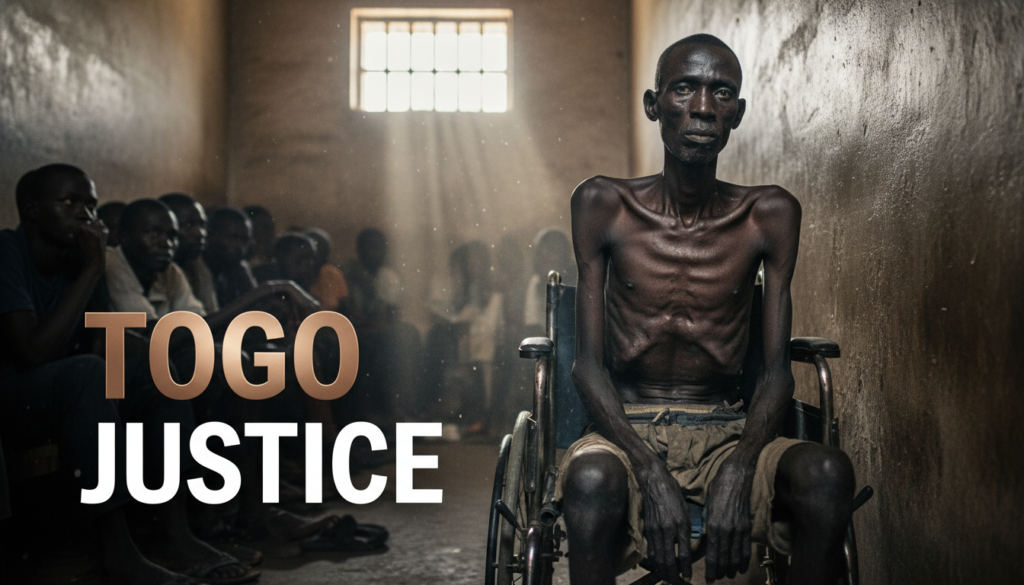
Goma has suffered greatly during his time behind bars. He has lost the use of his legs because of the neurological damage caused by torture (miragenews.com). His weight has dropped to only 50 kilograms. He has been on a hunger strike for forty-four days to protest his treatment. The United Nations experts say that his condition is now life-threatening (jurist.org). The level of suffering he faces is a reflection of a system that uses the prison as a tool to break the spirit of anyone who dares to challenge the status quo.
Systemic Repression: Arrests (2017-2022)
Human Rights Defenders and Activists Arrested
Source: Human Rights Records
The 2024 “Constitutional Coup” Explained
While Abdoul Aziz Goma was suffering in his cell, the government of Togo changed the rules of the game. In early 2024, the National Assembly passed a new constitution. This change moved Togo from a presidential system to a parliamentary system (constitutionnet.org). On the surface, this might sound like a simple change in how the government works. However, critics call it a “constitutional coup.” It allows the ruling family to stay in power indefinitely without the people ever voting for them directly.
Under the new rules, the public no longer votes for the president. Instead, the leader of the majority party in parliament becomes the “President of the Council of Ministers” (loc.gov). This new role has almost all the executive power. There are no term limits for this position. Faure Gnassingbé was sworn into this role in May 2025 (news.cn). Because his party controls almost all the seats in parliament, he can stay in power for as long as he wants. This move effectively destroyed the hope for term limits that the protesters fought for in 2017.
The International Fight for Justice
The international community has not stayed silent about Goma’s case. Members of the European Parliament, or MEPs, have been very active. Because Goma is an Irish citizen, he is also a citizen of the European Union. In September 2025, the European Parliament passed a resolution (jurist.org). They called for his immediate release and criticized his trial as a “mockery of justice.” The trial lasted only one day, and he was sentenced to ten years in prison (miragenews.com).
The United States government has also taken note of the situation. Under the administration of President Donald Trump, the State Department has released reports on the human rights abuses in Togo (state.gov). These reports highlight the arbitrary arrests and the lack of judicial independence in the country. International pressure is one of the few tools left to help political prisoners. The fight for [racial justice] and human rights is a global one that requires people to stand together across borders (https://www.africanelements.org/news/how-the-fbi-weaponized-homophobia-in-the-civil-rights-movement/).
Goma’s Critical Timeline
- Dec 2018: Arrested for providing food and shelter.
- 2018-2024: Held in pre-trial detention without a lawyer.
- Feb 2025: Convicted in a one-day trial; 10-year sentence.
- Dec 2025: Day 44 of hunger strike; UN issues urgent plea.
The Clock is Ticking for Goma
As 2025 comes to an end, there is a small glimmer of hope. On December 2, President Faure Gnassingbé announced new rules for prisoner clemency (miragenews.com). These rules say that prisoners who are very old or very sick can be considered for release. UN experts have pointed out that Abdoul Aziz Goma fits these criteria perfectly. He is in severe ill health and has already spent seven years in prison (jurist.org). The government now has a legal way to release him without admitting they were wrong.
However, time is running out. Goma is extremely weak and could die at any moment. His case shows the world that the struggle for democracy in Togo is a matter of life and death. The “history behind the headlines” is a story of a people who refuse to give up, even when faced with a powerful dynasty. Whether the government will show mercy or continue its path of repression remains to be seen. The international community continues to watch, hoping that this human rights defender will finally be allowed to go home and receive the medical care he needs.
About the Author
Darius Spearman is a professor of Black Studies at San Diego City College, where he has been teaching for over 20 years. He is the founder of African Elements, a media platform dedicated to providing educational resources on the history and culture of the African diaspora. Through his work, Spearman aims to empower and educate by bringing historical context to contemporary issues affecting the Black community.
