

Why African Women in the Diaspora Demand Justice at UN CSW70
By Darius Spearman (africanelements)
Support African Elements at patreon.com/africanelements and hear recent news in a single playlist. Additionally, you can gain early access to ad-free video content.
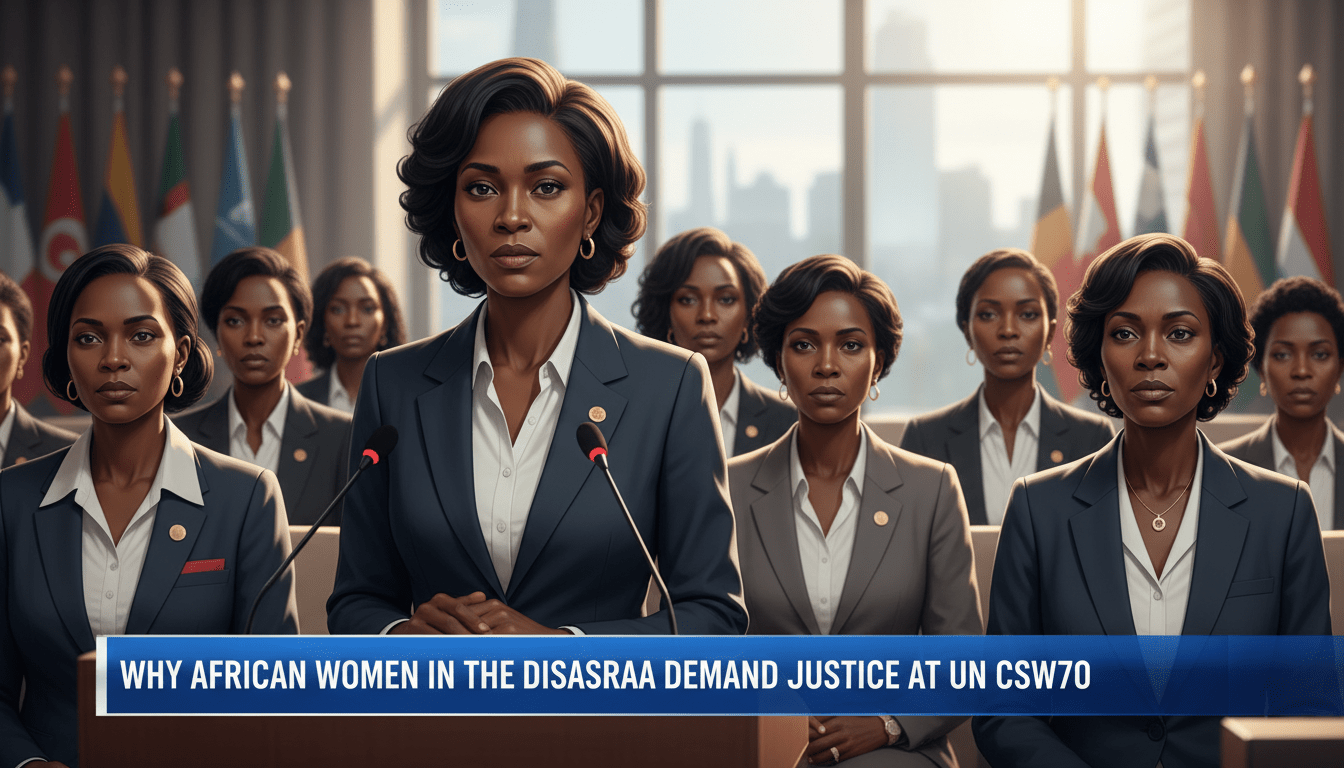
The 70th Session of the Commission on the Status of Women (CSW70) opened at the United Nations today with a clear and urgent mission. Leaders from across the African continent and the global diaspora gathered to address a fundamental problem. This year, the primary focus is on strengthening access to justice. African leaders are calling for an end to discriminatory laws that keep women from seeking legal help. These barriers affect women living in Africa and those residing in the global diaspora. The movement seeks to ensure that legal rights are more than just words on paper (unwomen.org).
The push for justice at CSW70 is part of a long history of institutional growth. It represents decades of organizing by women who want to change how the world views their rights. Historically, the Commission on the Status of Women has worked to set global standards. Today, the focus shifts toward the actual practice of law. Leaders argue that a law is only useful if a woman can actually use it in a courtroom. For many African women, structural barriers like high costs and distant courtrooms make justice impossible to reach (unwomen.org).
This session is particularly important for the African diaspora. The African Union considers people of African descent living outside the continent as its “Sixth Region.” This includes African Americans whose ancestors survived the transatlantic slave trade. Justice initiatives now aim to bridge the gap between continental Africa and its children abroad. By focusing on “intersectional invisibility,” leaders are highlighting how Black women are often overlooked by the legal system. This invisibility occurs because they face both racial and gender-based discrimination at the same time (unwomen.org).
The Global Justice Gap (2024-2026)
Women’s Legal Rights (64%)
Men’s Legal Rights (100%)
Source: UN Women (unwomen.org)
A Legacy of Advocacy from Nairobi to New York
The journey to CSW70 began shortly after the United Nations was formed. In 1946, the Commission on the Status of Women was created to eliminate discrimination in law. During its very first session in 1947, a small group of 15 women made a massive impact. They successfully lobbied to change the language in the Universal Declaration of Human Rights. They replaced the word “men” with “everyone” to ensure women were included. This early work set the stage for all future gender equality efforts at the international level (unwomen.org).
As the decades passed, the focus of the commission expanded. During the 1960s and 1970s, many African nations gained their independence from colonial rule. This shift brought new voices to the table. These leaders pointed out that poverty and discriminatory laws hit women in the Global South the hardest. This era of advocacy led to the 1979 Convention on the Elimination of All Forms of Discrimination against Women, or CEDAW. Many people refer to this treaty as the “International Bill of Rights for Women.” It remains a primary tool for legal reform today (unwomen.org).
A major turning point for African advocacy happened in 1985. The Third World Conference on Women took place in Nairobi, Kenya. This event brought together 12,000 women from around the world. It created the “Nairobi Forward-looking Strategies,” which linked women’s rights to economic and social development. This history of resilience mirrors the enduring strength of families who have adapted through various forms of oppression. The “Spirit of Nairobi” still inspires African leaders as they push for restorative justice at the United Nations (unwomen.org).
Regionally, Africa has some of the most progressive laws in the world. The Maputo Protocol of 2003 is a landmark agreement that protects women across the continent. It explicitly bans harmful practices like Female Genital Mutilation. It also guarantees rights to land ownership and inheritance. However, the current “headline” at CSW70 reflects a deep frustration. Despite these progressive laws, millions of women still cannot access the legal system. Leaders are now moving beyond writing laws to ensuring those laws are actually enforced (unwomen.org).
Breaking Down Structural Walls in the Legal System
Access to justice is often blocked by what experts call “structural barriers.” These are not just individual acts of bias. Instead, they are obstacles built into the very fabric of society. For many women, the cost of filing a legal claim is far too high. In many regions, the price of a lawyer exceeds what a woman earns in an entire year. Additionally, many courts are located only in big cities. This forces rural women to travel long distances at great risk and expense (unwomen.org).
Another major hurdle is known as “legal pluralism.” This term describes a situation where different types of laws exist at the same time. A country might have constitutional law, customary law, and religious law all working together. While this reflects cultural history, it often creates a “justice gap.” Customary or religious laws sometimes favor patriarchal traditions over the constitutional rights of women. This leaves many women confused about which set of laws applies to their specific situation (unwomen.org).
These challenges are deeply rooted in the history of economic justice struggles that have faced African people for centuries. At CSW70, African leaders are highlighting “clawback clauses” in national constitutions. These are tricky legal provisions that seem to grant a right but then take it away. For example, a constitution might say all citizens are equal. However, it might then include a clause stating this equality does not apply to matters of marriage or inheritance. These loopholes frequently disadvantage women and prevent them from seeking recourse in court (unwomen.org).
Language also serves as a barrier to justice. In many African countries, legal proceedings are conducted in colonial languages like English or French. Many women speak local languages and may not fully understand the technical terms used in court. This prevents them from participating effectively in their own legal defense. African leaders at CSW70 are calling for gender-sensitive legal units and translation services. They believe that justice should be understandable and available to everyone, regardless of the language they speak (unwomen.org).
The 286-Year Countdown
At the current rate of progress, how long will it take to close the justice gap?
Progress is too slow. CSW70 seeks to accelerate this timeline. (unwomen.org)
The African Diaspora as the “Sixth Region”
The 70th Session is breaking new ground by prioritizing the African diaspora. This focus recognizes that the struggle for justice does not stop at national borders. Women of African descent in the West often face a unique set of challenges. They experience “intersectional invisibility,” a term that explains why their specific needs are ignored by both racial justice and feminist movements. Because they do not fit the “prototype” of a typical woman or a typical person of color in the legal system, their claims for justice are often dismissed (unwomen.org).
African American women have long played a central role in these global movements. Historically, Black women contributed significantly to liberation struggles even when facing internal sexism. Today, that legacy continues as diaspora women lobby the UN for better legal protections. Migrant African women in Western countries often lack access to legal aid. They may fear deportation if they report domestic violence or labor exploitation. These women fall into a “justice gap” where they are legally invisible (unwomen.org).
In response, African feminists recently organized the “Africa Disrupt” initiative in Accra, Ghana. This strategy space was designed to create a unified “Common Africa Position” for the UN. Instead of simply reacting to international agendas, these leaders are setting their own. They are demanding restorative justice for the diaspora. This includes holding Western legal systems accountable for the systemic racism that prevents Black women from receiving a fair trial. The goal is to ensure that a woman’s right to legal protection follows her across every border (unwomen.org).
The current United States administration, led by President Donald Trump, has a complex relationship with these international treaties. While the US has signed CEDAW, it has not yet ratified it. This refusal to ratify is often based on concerns about state-level sovereignty. However, African leaders argue that global standards are necessary to protect the most vulnerable. They believe that international pressure can help dismantle the structural racism that persists in Western legal systems. By linking the continent with the diaspora, they hope to create a global force for change (unwomen.org, pbs.org).
Evaluating the Power of the UN Commission
It is important to understand what the Commission on the Status of Women can and cannot do. The CSW is a policy-making body, but it does not have the power to pass binding laws. It cannot override the sovereignty of any nation. Instead, its primary power lies in “norm-setting.” It establishes global standards that member states agree to work toward. These standards are recorded in a consensus document called the “Agreed Conclusions.” Governments then use these conclusions to guide their own national law reforms (unwomen.org).
While the CSW cannot “police” nations, it provides a vital platform for advocacy. Non-governmental organizations (NGOs) use CSW sessions to pressure their governments. They submit “Shadow Reports” that highlight where their countries are failing to protect women. This public accountability is a powerful tool for change. It forces leaders to address issues like the spike in sexual violence in conflict zones. In 2024, reports indicated an 87 percent increase in such violence, affecting millions of women (unwomen.org).
The drive to modernize these systems is also linked to the effort of decolonizing institutional frameworks across the globe. Just as universities seek to shed colonial influences, the legal systems in many African nations must be reformed to serve their own people better. This means moving away from colonial-era “clawback clauses” and embracing African-centric justice models. The “Common Africa Position” emphasizes that gender equality is essential for the continent’s economic development (unwomen.org).
Data shows that closing the justice gap has tangible benefits. Family law reforms since 1970 have expanded economic opportunities for over 600 million women. When women can own land and inherit property, they are more likely to invest in their families and communities. This creates a ripple effect of prosperity. African leaders at CSW70 are making the case that justice for women is not just a moral issue. It is a necessary foundation for a stable and prosperous global economy (unwomen.org).
Violence in Conflict Zones (2024)
Spike in reports of sexual violence in conflict zones during 2024. (unwomen.org)
A Reckoning for Global Gender Justice
The 70th Session of the CSW is more than just an anniversary celebration. It is a “reckoning” for the oldest functional commission in the United Nations. For African leaders, the focus on justice for women in the diaspora represents the latest evolution of the Pan-African movement. This movement recognizes that the struggles of Black women in New York, London, and Accra are interconnected. They are all fighting against structural barriers that keep them from full legal protection (unwomen.org).
As the session continues, the focus will remain on turning “laws on paper” into “justice in practice.” This requires significant investment in legal aid and court accessibility. It also requires a cultural shift in how legal systems treat women. The goal is to move beyond the current rate of progress, which would take 286 years to close the justice gap. African leaders are demanding that this timeline be accelerated through immediate structural reform (unwomen.org).
The advocacy seen today at the UN is built on a foundation of resilience. It is a continuation of the work started by those 15 women in 1946. Today, however, the voices are more diverse and the demands are more specific. By centering the experiences of the diaspora and addressing the “justice gap,” CSW70 is setting a new course for the 21st century. The outcome of these negotiations will determine if the legal system can finally become a tool for liberation for all women (unwomen.org).
About the Author
Darius Spearman is a professor of Black Studies at San Diego City College, where he has been teaching for over 20 years. He is the founder of African Elements, a media platform dedicated to providing educational resources on the history and culture of the African diaspora. Through his work, Spearman aims to empower and educate by bringing historical context to contemporary issues affecting the Black community.
