

Why Child Recruitment by Armed Groups in Haiti Tripled
By Darius Spearman (africanelements)
Support African Elements at patreon.com/africanelements and hear recent news in a single playlist. Additionally, you can gain early access to ad-free video content.
A Crisis for the Youngest Generations
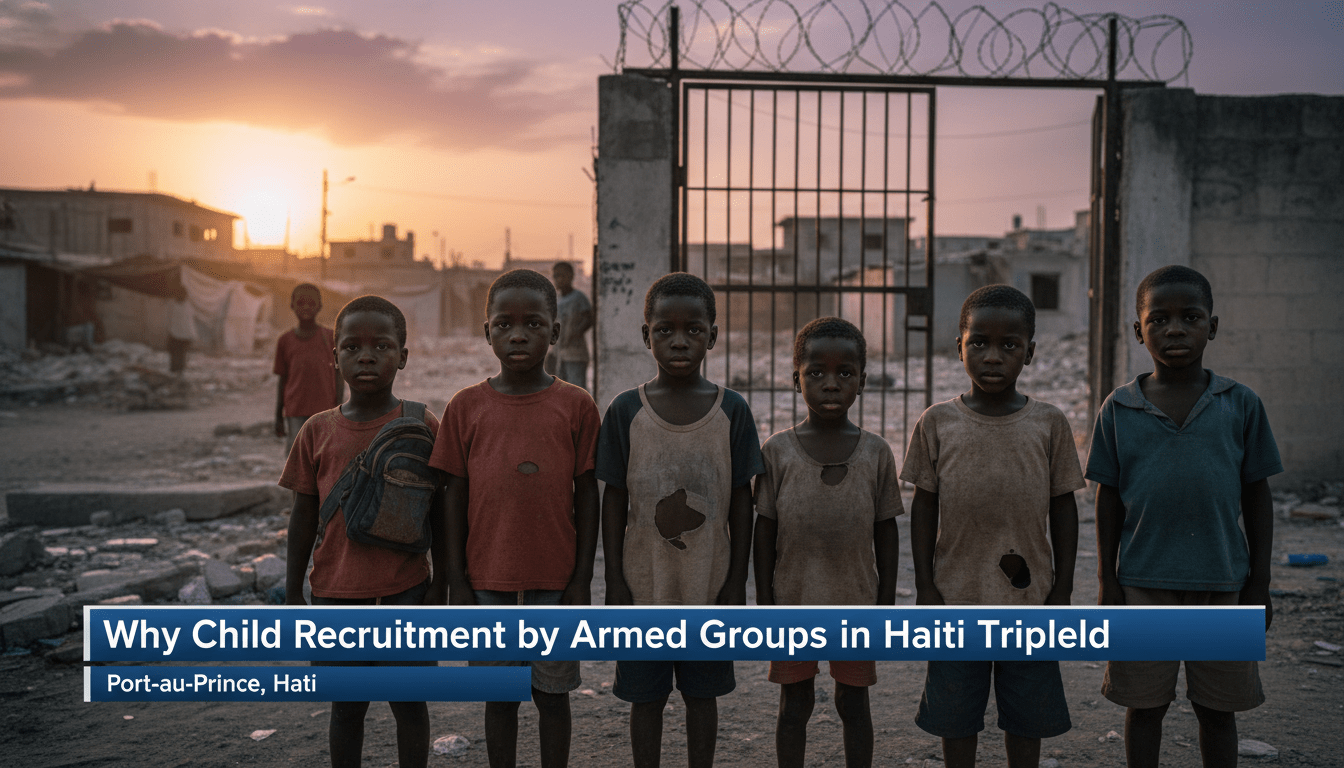
The situation in Haiti has reached a point of extreme danger for the nation’s children. Recent reports indicate that the number of children joining armed groups increased by 200 percent in the last year alone (unicef.org). This tripling of child recruitment shows how the state has failed to protect its most vulnerable citizens. Many of these children are as young as nine or ten years old. They are no longer bystanders in the violence but are active participants in a conflict they did not create (reliefweb.int).
Armed groups now control nearly 90 percent of the capital city, Port-au-Prince. In these neighborhoods, gangs have replaced the government as the primary source of food and protection. When the state disappears, children must look elsewhere for survival. Joining a gang becomes a tactical choice for those who face starvation every day. This shift from accidental victims to essential tools of warfare marks a dark new chapter in the history of the country (unicef.org.au).
Haiti Child Crisis: 2025 Statistics
Recruitment Increase: 200%
Port-au-Prince Control: 90%
Displaced: 1.4 Million
The Roots of Modern Militias
The current gang culture in Haiti did not appear by magic. It is the result of a seventy-year history where political leaders used armed civilians to keep power. President François “Papa Doc” Duvalier started this trend in 1958 with the creation of the Tonton Macoutes (blackpast.org). This personal militia operated outside the regular military to crush any opposition. They were given total freedom to act with violence, which set a dangerous example for future groups (wikipedia.org).
After the Duvalier dynasty fell, other leaders continued this practice. In the 1990s and 2000s, Jean-Bertrand Aristide relied on youth groups known as Chimères (researchgate.net). These units were based in poor neighborhoods like Cité Soleil. They were often young people who felt ignored by the elite. These groups eventually blurred the lines between political activism and criminal activity. This long history of the Haitian Revolution and its aftermath shows how political desperation leads to the arming of the youth.
The Power Vacuum of 2021
The assassination of President Jovenel Moïse in July 2021 destroyed what was left of the Haitian state. Without a president, parliament, or working courts, the country fell into a deep power vacuum (yenisafak.com). Gangs that were once used as political pawns became their own bosses. They stopped taking orders from the elite and started taking over territory for themselves (aa.com.tr). This period allowed gang leaders to become the “state” in their own areas.
As of early 2026, the political situation remains extremely unstable. The Transitional Presidential Council dissolved in February 2026 without holding the promised national elections (passblue.com). This left Prime Minister Alix Didier Fils-Aimé as the main leader, but his authority is challenged everywhere. President Donald Trump and other world leaders have faced pressure to respond to this vacuum. However, the lack of a clear government makes international aid very difficult to deliver (diplomatie.gouv.fr).
Survival in the Polycrisis
Haiti is currently trapped in what experts call a “polycrisis.” This means many different disasters are happening at the same time and making each other worse. There is a political collapse, extreme gang violence, a food crisis, and health epidemics (humanrightsresearch.org). When these issues combine, the result is a total breakdown of society. For many families, the struggle for a daily meal is more urgent than the threat of a bullet.
The economic paralysis is partly due to the fact that gangs control the main roads used for farming. Nearly six million people face high levels of hunger because they cannot get food from the countryside (unicef.org). Furthermore, historical exploitation by foreign powers left the nation with no financial safety net. This lack of resources means that when a hurricane or a disease hits, the state cannot help. In this environment, the gang becomes the only employer left for a child.
Escalation of Displacement
1.4 Million People Uprooted
A 36% increase in displacement over 12 months (iom.int).
The Destruction of Education
Schools used to be a safe place for children, but that is no longer true in Haiti. Since early 2024, armed groups have closed or destroyed over 1,000 schools (unicef.org). Many other schools have been turned into crowded shelters for displaced families. Without the structure of a classroom, children are left on the streets. This makes them easy targets for gang recruiters who offer them money, food, or a sense of belonging (reliefweb.int).
The loss of education creates a gap that the gangs are happy to fill. When children are not in school, they lose their path to a better future. This situation is similar to the challenges faced by online learning barriers in other regions, where the lack of access to school leads to poor outcomes. In Haiti, the lack of school often leads directly to the front lines of gang warfare. These children are used as spies, lookouts, and even as active soldiers (humantraffickingsearch.org).
The Tactics of Armed Groups
Gang leaders like Jimmy “Barbecue” Chérizier have changed how they use children. These groups no longer just use kids for small jobs. Children are now used for heavy combat and as forced labor. Reports show that girls are also in great danger. Sexual violence against minors increased by 1,000 percent between 2023 and 2025 (reliefweb.int). Gangs use this violence as a tool to control neighborhoods and punish those who do not obey.
The G9 Family and Allies coalition is one of the most powerful groups in the country. Chérizier, a former police officer, claims to be a revolutionary hero for the poor. However, international bodies like the UN and the United States identify him as a leader of massacres (hrw.org). His group provides water and food to some people while attacking others. This mix of “charity” and violence makes it very hard for children to see the gang as the enemy (moderninsurgent.org).
Record Levels of Displacement
More than 1.4 million Haitians are now internally displaced (iom.int). This is the highest number ever recorded in the country. Over half of these people are children who have lost their homes and everything they own. They live in “spontaneous sites” that were never meant for people to live in. These sites are often just camps in public squares or school yards. They lack clean water, toilets, and safety (newsonair.gov.in).
The violence has also spread beyond the capital city. Gangs are now fighting for control of the Artibonite and Centre departments. These areas are important for growing food and for trade with the border. In 2025, nearly 69 percent of new displacements happened in these rural areas (reliefweb.int). This shows that the conflict is no longer just a city problem. It is a national disaster that affects the entire food supply of the country.
Sexual Violence Increase
1,000% RISE
Targeting Minors (2023-2025)
The Sensitivity of International Aid
The history of international help in Haiti is very complicated. In 2010, UN peacekeepers accidentally brought cholera to the country. This led to a massive epidemic that killed thousands of people (stimson.org). This history of betrayal makes many Haitians suspicious of foreign troops. There is a deep fear that new missions, like the current Gang Suppression Force, might cause more harm than good. The UN took six years to admit its mistake, which created a huge “accountability gap” (passblue.com).
Today, cholera has returned because the gangs control the ports. This prevents clean water and medical supplies from reaching the people who need them. For the African Diaspora, this crisis is a reminder of how the world has treated the first Black republic. Haiti’s struggle against the “independence debt” to France crippled its economy for over 100 years (bu.edu). This history of being punished for liberation is central to why the state is so fragile today.
State Fragmentation in Practice
State fragmentation is what happens when the central government breaks into small pieces. In Haiti, this means different gang leaders rule different streets. Each gang has its own rules and collects its own “taxes.” The Haitian National Police has also suffered because many officers have left to join the gangs or vigilante groups (hscentre.org). This makes it impossible for the average citizen to know who is in charge or who to call for help.
Public services like electricity and water are no longer managed by the government. Instead, people must negotiate with gang leaders to get these basic needs. This environment of mass incarceration and systemic violence has torn apart the fabric of the community. When the state fails to provide a future, the gangs provide a rifle. This transition from a functioning nation to a collection of fiefdoms is the greatest threat to the next generation.
A Generational Threat to the Future
The tripling of child recruitment is not just a statistic. It is a sign that the very foundation of childhood in Haiti has been dismantled. For many children, the gang is the only family they have left. The G9 and other groups use this to build loyalty that the state cannot match. If children are raised in a world where the only way to eat is to hold a gun, the violence will continue for many decades to come.
Haiti’s story as the first nation to defeat slavery is a proud one (blackpast.org). However, the current situation shows the cost of centuries of external and internal pressure. The “history behind the headlines” is one of resilience in the face of constant retaliation. Solving this crisis will require more than just security forces. It will require rebuilding the schools and homes that have been lost to the fire. Without a safe place for children to grow, the cycle of recruitment will be impossible to break (reliefweb.int).
About the Author
Darius Spearman is a professor of Black Studies at San Diego City College, where he has been teaching for over 20 years. He is the founder of African Elements, a media platform dedicated to providing educational resources on the history and culture of the African diaspora. Through his work, Spearman aims to empower and educate by bringing historical context to contemporary issues affecting the Black community.
