

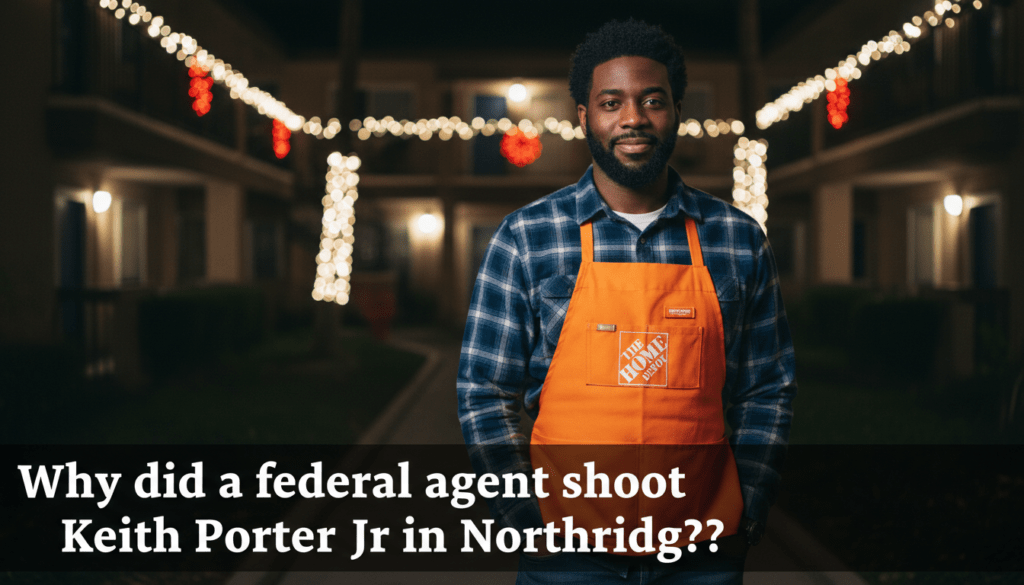
Why did a federal agent shoot Keith Porter Jr in Northridge?
By Darius Spearman (africanelements)
Support African Elements at patreon.com/africanelements and hear recent news in a single playlist. Additionally, you can gain early access to ad-free video content.
The night of December 31, 2025, should have been a time for celebration. Instead, the Village Pointe apartment complex in Northridge became a scene of tragedy. Keith Porter Jr. was a 31-year-old man from Compton who worked at Home Depot. He died that night after an off-duty agent from Immigration and Customs Enforcement (ICE) shot him (latimes.com). The details of the event have sparked a massive outcry in the community. Neighbors and activists are now asking why a festive night ended in gunfire.
On January 4, 2026, about 50 people gathered for a candlelight vigil. They stood in the very spot where Porter lost his life. The air was thick with grief and a demand for the truth. Groups like Project Islamic Hope and Black Lives Matter-Los Angeles led the gathering (latimes.com). These organizations want the California Attorney General to take over the investigation. They do not trust the official story coming from federal agencies. This tension highlights a long history of conflict between law enforcement and the communities they serve.
The Clash of Narratives
There are two very different stories about what happened that night. The Department of Homeland Security (DHS) claims the off-duty agent was a hero. They say the agent responded to an “active shooter situation” to protect lives (latimes.com). According to federal officials, the agent acted defensively when faced with a direct threat. They argue that the intervention prevented further violence during the New Year’s Eve festivities. This narrative portrays the agent as a brave officer who did his duty even while off the clock.
Witnesses and civil rights activists tell a much different tale. They state that Keith Porter Jr. was participating in celebratory gunfire (latimes.com). This is a practice where people fire guns into the air to mark the new year. While this is illegal in California, witnesses say Porter did not point his weapon at anyone. They argue that he was not an “active shooter” in the traditional sense. These activists believe the agent was overzealous and used lethal force without a valid reason. The community is now demanding to see body-camera footage to find the truth.
This conflict is not new to the streets of Los Angeles. For decades, Black and Brown residents have faced heavy policing. The struggle for justice often feels like an uphill battle against a system built on lasting forms of involuntary servitude and control. When a federal agent is involved, the walls of secrecy seem even higher. The Northridge community feels that the “active shooter” label is being used as a shield to hide the truth about a tragic mistake.
The Evolution of Active Shooter Protocols
The term “active shooter” has a specific history in law enforcement training. Before 1999, the standard police response was to wait for specialized teams like SWAT. This changed forever after the massacre at Columbine High School (alicetraining.com). Police realized that waiting cost lives. Training programs like ALERRT began teaching patrol officers to move toward the sound of gunfire immediately. They are trained to “neutralize the threat” as quickly as possible (alerrt.org).
While these protocols were designed for schools and malls, they are now applied in many settings. In the Northridge case, the agent likely relied on this training. He heard gunfire and decided to engage. However, critics argue that this “immediate intervention” mindset can lead to errors. If an officer perceives every gun discharge as an active shooter, they may skip the step of assessing the actual danger. This creates a dangerous environment where celebratory acts are met with deadly federal force.
The history of these protocols shows a shift toward aggressive engagement. The goal is to stop a killer, but the definition of a “killer” has become broad. In neighborhoods with high levels of surveillance, this shift can be deadly. The “active shooter” label can be applied after the fact to justify a shooting. This makes it difficult for families like Porter’s to get a fair investigation. They are fighting against a tactical definition that was never meant for their specific situation.
Racial Disparity in Police Fatalities
White Residents
Black Residents
Black Californians are three times more likely to be killed by police.
ICE Agents and the Gray Zone of Off-Duty Conduct
Immigration and Customs Enforcement was created in 2003 as part of the DHS (ice.gov). Its main job is to enforce immigration laws, but its agents have broad police powers. ICE Directive 19009.2 allows these officers to carry personal firearms even when they are not working. This policy creates a “gray zone” for their behavior. They are acting as private citizens but still carry the authority and weapons of federal agents (dhs.gov).
When an off-duty agent shoots someone, the legal lines get blurry. Are they acting as a federal officer or a regular person? Federal policy says they can use any weapon to defend themselves or others in an emergency. This gives them a level of protection that ordinary citizens do not have. In the Keith Porter Jr. case, the agent was living in the apartment complex. He was at home when he decided to step into his role as a federal enforcer.
This lack of clear boundaries is a major concern for civil rights groups. They argue that off-duty agents often lack the oversight of their supervisors. There are no dispatchers or partners to help de-escalate a situation. Instead, a single person makes a life-or-death decision in seconds. This history of off-duty intervention has led to many controversial shootings across the country. The community in Northridge is now witnessing the consequences of this federal policy firsthand.
The Legal Shield of Qualified Immunity
The quest for answers is often stopped by a legal doctrine called Qualified Immunity. This doctrine was established by the Supreme Court to protect government officials from lawsuits (guestandgray.com). It means that an official cannot be sued unless they violate a “clearly established” right. For a layperson, this means you must find a previous court case with almost identical facts. If no such case exists, the officer is often immune from being held liable.
This legal bar is incredibly high for victims of police violence. It creates a “catch-22” situation. You cannot win a case unless there was a previous winning case. If the specific details of the Porter shooting are unique, the agent might never face a civil trial. The Supreme Court has made this doctrine even stronger over the last few decades (dynamisllp.com). This is why neighbors are calling for more than just a local investigation. They know the legal system is designed to protect the person behind the badge.
In August 2025, some members of Congress tried to change this. They introduced the “Ending Qualified Immunity for ICE Agents Act” (govtribe.com). This shows that the public is tired of federal agents operating without accountability. However, under the leadership of President Donald Trump, these efforts face a difficult path (whitehouse.gov). The current administration often emphasizes “law and order,” which frequently translates into more protection for agents. This political climate makes the fight for Keith Porter Jr. even more vital.
The Maze of Federal Lawsuits
Suing a federal agent is much harder than suing a local police officer. If an LAPD officer shoots someone, the family can sue the city. When a federal agent is involved, they must navigate the Federal Tort Claims Act (FTCA). This 1946 law allows citizens to sue the government for negligence (wisc.edu). However, the process is long and full of complicated rules. The claimant must first file a claim with the DHS before they can even go to court.
There is also a legal path known as a Bivens claim. This comes from a 1971 Supreme Court case that allowed people to sue federal agents for constitutional violations. But over the years, the courts have narrowed this path significantly (lawfaremedia.org). It is now almost impossible to use Bivens for new types of situations. This means that if the law does not perfectly match the Porter case, his family may have no way to seek justice in federal court.
The complexity of these laws often discourages families from seeking the truth. They are faced with expensive lawyers and years of waiting. This is why groups like Project Islamic Hope are so important. They provide the public pressure needed to keep the case in the spotlight. Without community support, the legal hurdles of the FTCA and Bivens would likely bury the story of Keith Porter Jr. forever.
Assaults Against ICE Agents (2025 Spike)
Source: DHS Official Statement (dhs.gov)
Jurisdictional Supremacy and the Wall of Silence
One of the biggest obstacles in the Northridge case is the Supremacy Clause of the U.S. Constitution. This clause states that federal law is the “supreme law of the land.” In practice, this means federal agents often take precedence over local police (lawfaremedia.org). When an ICE agent shoots someone, federal agencies like the FBI or DOJ often take over the investigation. The LAPD might be pushed to the side, even if the shooting happened in their city.
This jurisdictional hierarchy creates a “wall of silence.” Local prosecutors often feel they lack the power to charge a federal agent. In a 2018 case in Virginia, local authorities stopped investigating an ICE shooting for this very reason. They claimed they had no jurisdiction over a federal officer (latimes.com). This history of “supremacy” makes it very hard for local communities to get transparent answers. It feels like the federal government is investigating itself, which rarely leads to a conviction.
Currently, the LAPD’s Robbery-Homicide Division is leading the investigation (latimes.com). However, they have been slow to release information. They often cannot interview the agent for several days due to federal protections. This delay frustrates the neighbors who want to know why Porter was killed. The “Supremacy” of the federal government often acts as a barrier to local justice. It reinforces the idea that federal agents are above the laws that govern everyone else.
Celebratory Gunfire: A Cultural Conflict
To understand this shooting, one must understand the history of New Year’s Eve in Los Angeles. Celebratory gunfire is a long-standing tradition in many communities. People fire shots into the air to mark the passage of time (patch.com). While it is a felony in California, many see it as a ritual rather than a crime. The LAPD even has a “Gunfire Reduction Task Force” to handle the hundreds of calls they get every year.
The conflict in Northridge is a clash between this community habit and a federal “active shooter” mindset. Law enforcement warns that “what goes up must come down.” They cite tragic cases where falling bullets killed innocent people. However, activists argue that firing into the air is not the same as being an “active shooter” (latimes.com). The intent is totally different. An active shooter wants to harm people, while a reveler is just being reckless.
This cultural gap is where the tragedy happened. The agent heard shots and assumed the worst. Keith Porter Jr. was likely just following a tradition he had seen many times before. In a city with such a deep history of gun culture, this misunderstanding turned fatal. The “history behind the headlines” here is about how different groups perceive danger. For the agent, it was a combat situation. For the community, it was a holiday celebration gone wrong.
The Political Fever of 2025
The year 2025 has been a time of extreme tension for federal agents. Under President Trump, ICE has been very active in carrying out enforcement operations (whitehouse.gov). This has led to a massive increase in political violence and riots. The DHS reported a 1,153% spike in assaults against their personnel in early 2025 (dhs.gov). This heightened state of alert likely influenced the agent in Northridge. He may have been expecting an attack because of the political climate.
This “siege mentality” makes federal agents more likely to use force. When you feel like the whole world is against you, every sound of a gun feels like a personal threat. The DHS narrative focuses on the “bravery” of the agent because they want to support their staff during these hard times. They are trying to combat what they call “inflammatory rhetoric” from politicians and activists (presidentialprayerteam.org). This political backdrop explains why the official story is so defensive.
However, the Black community in Los Angeles knows that this “heightened alert” often leads to the death of innocent Black men. The vigil for Keith Porter Jr. is part of a larger movement that gained steam in 2020. People are tired of being the “collateral damage” in a political war between federal agencies and activists. They want to be seen as human beings, not as targets for an over-alert agent. The history of 2025 will be defined by this struggle for humanity in a time of political fever.
The Role of Community Advocacy
Project Islamic Hope and Najee Ali have played a huge role in the Los Angeles civil rights landscape. They act as a bridge between different racial and religious groups to fight for justice. In the Porter case, they were the first to challenge the “active shooter” narrative (latimes.com). By bringing witnesses forward, they forced the media to look at the other side of the story. This kind of advocacy is essential when dealing with powerful federal agencies.
These groups are not just asking for a trial. They are asking for a change in how we treat our neighbors. They want the truth about the rifle at the scene and whether Porter was actually a threat. The lack of body-camera footage from the off-duty agent makes their work even harder. They have to rely on bystander videos and the brave voices of the neighbors (latimes.com). This grassroots effort is the only thing standing between Keith Porter Jr. and a forgotten police report.
The vigil in Northridge was a powerful reminder that the community will not be silent. They are following in the footsteps of those who fought against the failings of the post-emancipation era to demand true freedom. True freedom includes the right to a fair investigation and the right to live without fear of federal overreach. As the investigation continues, the people of Northridge will keep standing in the spot where Keith Porter Jr. fell. They will keep asking for the answers they deserve.
About the Author
Darius Spearman is a professor of Black Studies at San Diego City College, where he has been teaching for over 20 years. He is the founder of African Elements, a media platform dedicated to providing educational resources on the history and culture of the African diaspora. Through his work, Spearman aims to empower and educate by bringing historical context to contemporary issues affecting the Black community.
