

Why Did Black Liberator Tributes Vanish From Margraten Cemetery?
By Darius Spearman (africanelements)
Support African Elements at patreon.com/africanelements and hear recent news in a single playlist. Additionally, you can gain early access to ad-free video content.
The Sudden Disappearance of Black History at Margraten
In the spring of 2025, visitors to the Netherlands American Cemetery and Memorial in Margraten noticed something missing. Two large display panels had once stood in the visitor center to honor Black American soldiers. These soldiers were part of the force that liberated the Netherlands from Nazi occupation. However, the American Battle Monuments Commission (ABMC) removed these tributes without a public explanation (militarytimes.com). The removal occurred as the current administration of Donald Trump began a series of executive orders. These orders aimed to end Diversity, Equity, and Inclusion (DEI) programs across all federal agencies (militarytimes.com).
The disappearance of the panels caused immediate concern among local Dutch citizens and international historians. One panel described the “Double V” campaign, which sought victory over fascism abroad and victory over racism at home. The other panel told the story of Technician Fourth Class George H. Pruitt. He was a Black soldier who died while saving a fellow serviceman (ap.org). Internal emails from the ABMC later revealed that officials ordered the removal to avoid political trouble. They described the historical content as a problem that needed to stay in storage (nltimes.nl). This event raises serious questions about how the United States remembers its heroes on foreign soil. The struggle to maintain these stories reflects a larger debate regarding black politics and anti-Black politics in the modern era.
The Bitter Reality of the Hunger Winter
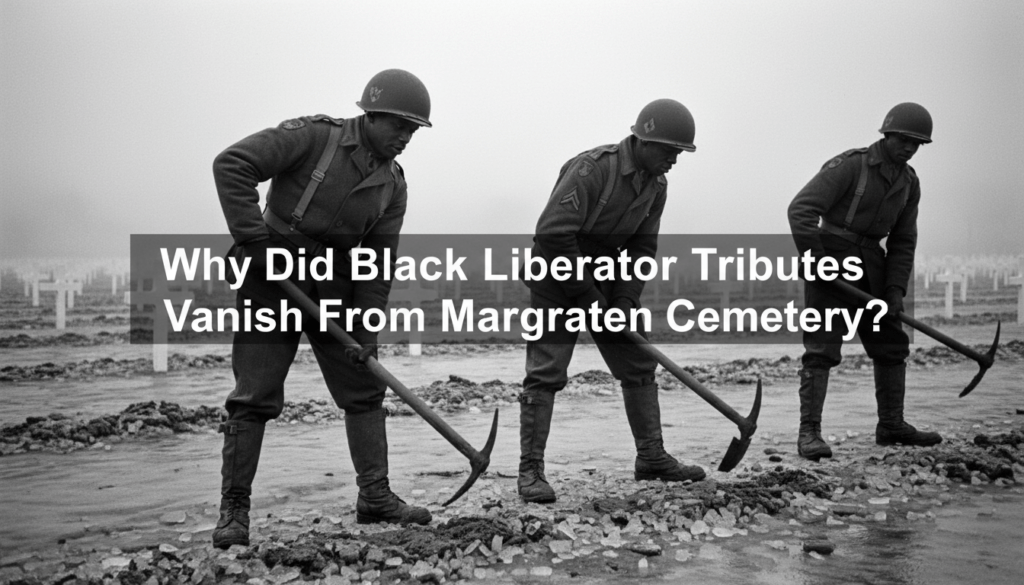
To understand the importance of these panels, one must look back to the winter of 1944. The Netherlands suffered through a period known as the Hunger Winter. Nazi forces cut off food and fuel supplies to the Dutch people. Thousands of civilians died from starvation and cold (environmentandsociety.org). During this time, the 960th Quartermaster Service Company arrived at Margraten. This unit consisted entirely of Black soldiers under the command of white officers. Their task was to build a cemetery for the thousands of American dead (army.mil). They worked in the freezing mud and used pickaxes to break the frozen ground. These men were the ones who buried the fallen liberators of Europe (trtafrika.com).
The Black soldiers of the 960th worked under brutal conditions. They were the primary labor force responsible for the initial construction of the cemetery at Margraten. First Lieutenant Jefferson Wiggins recounted the heavy emotional toll of the job. He noted the deep irony of his situation. He and his men buried white soldiers in the same ground where they could not have shared a meal when they were alive (samueldekorte.com). These soldiers were essential to the war effort but lived under a strict system of racial segregation. This history of labor and sacrifice is often overlooked in traditional military narratives. For many, the removal of the panels feels like a return to the days when [newly emancipated Blacks continued to face involuntary servitude] (https://www.africanelements.org/news/3-ways-the-civil-war-failed-to-end-slaveryand-3-things-black-fol/) through systemic labor exploitation.
Logistics as the Engine of Liberation
The role of Black soldiers in the Netherlands went beyond digging graves. They were the backbone of the Allied supply lines. The Red Ball Express was a famous truck convoy system that operated after the invasion of Normandy. Nearly 75 percent of the drivers in this system were Black (militarytimes.com). They moved thousands of tons of ammunition and fuel to the front lines every day. Without their tireless work, the Allied advance would have stopped (militarytimes.com). They drove through dangerous conditions and often worked without sleep to ensure the infantry had what it needed to fight (aaregistry.org).
In the Netherlands, these service units were a symbol of hope. They brought food and medical supplies to a starving population. The Dutch people viewed these Black GIs as heroes who saved them from death. Historians note that the liberation was a result of both combat and logistics (theforeignburialofamericanwardead.com). While the infantry took the cities, the Black service units provided the resources to keep those cities free. However, the U.S. military command often categorized this work as menial labor rather than heroic action. This bias has long shaped how the story of the war is told. The removal of the panels at Margraten is seen as another attempt to minimize the role of Black soldiers as true liberators (amsterdamnews.com).
The Heroism of Technician George H. Pruitt
One of the removed panels featured the specific story of George H. Pruitt. He served in the 43rd Signal Construction Battalion (ap.org). In June 1945, Pruitt saw a fellow soldier struggling in a freezing, fast-moving river in Germany. Without hesitation, Pruitt dove into the water while still in his full uniform. He managed to reach his comrade but was swept away by the strong current. Pruitt drowned during the rescue attempt (binnews.com). For his bravery, the U.S. Army posthumously awarded him the Soldier’s Medal. This is the highest honor a soldier can receive for heroism in a non-combat situation (militarytimes.com).
Pruitt is buried at Margraten among the 172 Black soldiers honored at the site (abmc.gov). His story is vital because it challenges the idea that Black soldiers only performed labor roles. He was a hero who gave his life for a fellow American. The ABMC claimed the panel was part of a routine rotation to feature a white soldier named Leslie Loveland (nltimes.nl). However, critics argue that the two stories do not have to be mutually exclusive. They suggest that removing Pruitt’s story erases a clear example of Black valor. This erasure makes it harder to teach the full history of the war. Students of Black Studies often find that such removals are part of a long-standing pattern in American history.
The Dutch Tradition of Grave Adoption
The removal of the panels sparked a unique form of resistance in the Netherlands. Since 1945, Dutch families have participated in a tradition called grave adoption. Local citizens volunteer to care for a specific grave at the Margraten cemetery. They bring flowers and research the life of the soldier buried there. Every single one of the 8,301 graves at Margraten is currently adopted (dutchreview.com). This includes the graves of the 172 Black soldiers. The Dutch adopters consider these men to be part of their own family history (wikipedia.org).
When the panels vanished, the grave adopters were the first to voice their anger. They filled the cemetery guestbook with messages of protest. To the Dutch, these Black soldiers were not just names on a stone; they were the men who brought freedom to their ancestors (face2faceafrica.com). Mayor Alain Krijnen and other local leaders have formally demanded that the panels be returned. They argue that the history of the “Black Liberators” belongs to the Dutch people as much as it belongs to the United States (nltimes.nl). This deep local connection shows that the memory of the war is an international responsibility. It is not something that one government should be able to change for political reasons.
The Battle Over Memory and Federal Policy
The controversy highlights the power of the American Battle Monuments Commission. The ABMC is a federal agency of the United States. It manages military cemeteries in 17 different countries (abmc.gov). Because Margraten is on land granted to the U.S. in perpetuity, American law and policy apply there. This means that shifts in Washington D.C. can change what visitors see in a Dutch cemetery (alm.com). The head of the ABMC, Charles Djou, reportedly ordered the panels removed to satisfy the Trump administration. He expressed a desire to avoid the “ire” of the president (jta.org, militarytimes.com).
This situation creates a conflict between national policy and historical truth. Historians from the Black Liberators Foundation argue that the ABMC is whitewashing the past. They believe the agency is trying to hide the reality of segregation and the struggle for civil rights (risingnepaldaily.com). Furthermore, 34 members of the U.S. Congress have sent letters to the ABMC. They are demanding answers about why these specific stories were targeted (jta.org). The debate is not just about two panels in a visitor center. It is about whether the United States will acknowledge the full diversity of its military history. It also brings up difficult questions about Black soldiers and the ongoing search for true freedom.
Conclusion: Protecting the Legacy of the Fallen
As of late 2025, the panels remain in storage. The Black Liberators Foundation is now looking for a new place to display the history. They want to find a site near the cemetery that the U.S. government does not control (nltimes.nl). This would ensure that the stories of men like George H. Pruitt and the 960th Quartermaster Company remain accessible to the public. The Dutch community continues to support these efforts. They remain committed to honoring every soldier, regardless of the political climate in the United States (wikipedia.org).
The events at Margraten serve as a reminder that history is often fragile. It requires constant effort to protect the truth from being erased. The Black soldiers who served in the Netherlands were liberators in every sense of the word. They fought against fascism while facing discrimination from their own government. Their legacy is a vital part of the story of World War II. Honoring them is a matter of historical justice. As the world moves forward, the “gravediggers of Margraten” must not be forgotten again (trtafrika.com, amsterdamnews.com).
About the Author
Darius Spearman is a professor of Black Studies at San Diego City College, where he has been teaching for over 20 years. He is the founder of African Elements, a media platform dedicated to providing educational resources on the history and culture of the African diaspora. Through his work, Spearman aims to empower and educate by bringing historical context to contemporary issues affecting the Black community.
