

Why Do LAPD Pretext Stops Still Target Black Drivers?
By Darius Spearman (africanelements)
Support African Elements at patreon.com/afreon.com/africanelements and hear recent news in a single playlist. Additionally, you can gain early access to ad-free video content.
The city of Los Angeles has a long memory when it comes to the flashing lights of a patrol car. For many residents, those lights represent more than a simple traffic ticket. They symbolize a history of tension and unequal treatment. Recent data from early 2026 shows that these feelings are backed by hard numbers. Black Angelenos are still being stopped at rates far higher than their share of the population. This gap exists despite new rules meant to limit these interactions. The practice of using minor violations to go on “fishing expeditions” for bigger crimes is under fire once again (latimes.com, catalystcalifornia.org).
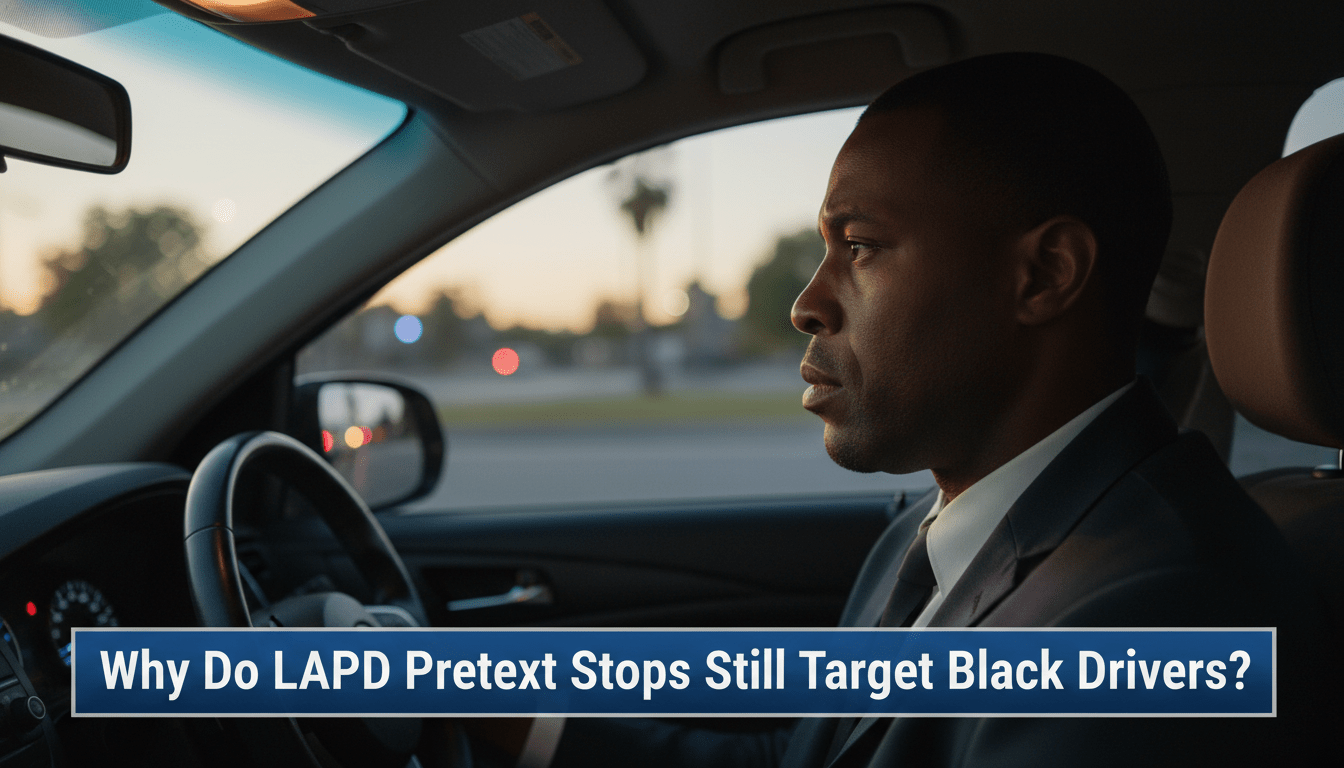
Journalists and activists call these “pretext stops.” An officer sees a broken taillight or an expired tag. They use that minor issue as a legal excuse to stop a car. Once the car is pulled over, the officer looks for drugs or weapons. However, the data reveals a painful reality. These stops rarely lead to arrests for serious crimes. Instead, they often result in awkward or tense encounters for innocent drivers. Understanding why this happens requires a look at the history of policing in Los Angeles (latimes.com, latimes.com).
Los Angeles Population vs. Pretext Stops (2026 Data)
The Spark of the 1965 Watts Riots
The story of traffic stops in Los Angeles began long before the modern era of body cameras. On August 11, 1965, a young Black man named Marquette Frye was pulled over. He was driving in the Watts neighborhood when the California Highway Patrol stopped him for erratic driving. What started as a roadside sobriety test quickly turned into a struggle. Bystanders watched as police used force against Frye and his family members. This single traffic stop sparked six days of intense rioting. It resulted in 34 deaths and millions of dollars in property damage (britannica.com, wikipedia.org).
After the smoke cleared, the McCone Commission investigated the causes of the unrest. The commission found that police-community ties were badly broken. It suggested that traffic stops were a major source of friction. Despite these warnings, the city did not move away from aggressive traffic enforcement. Instead, the police department continued to view the street as a primary battleground for crime control. This mindset shaped black politics and anti-black politics for the decades that followed. The traffic stop remained a tool for keeping tabs on marginalized communities (britannica.com, latimes.com).
Operation Hammer and the 1990s Uprising
By the late 1980s, the LAPD launched a new initiative called Operation Hammer. The goal was to combat the rise of gang violence and the crack cocaine epidemic. Officers conducted massive sweeps in Black and Latino neighborhoods. Thousands of people were arrested in a single weekend. Most of these arrests were for minor violations, like jaywalking or traffic infractions. The department used these stops to build a massive “gang database.” Historians note that by 1992, almost half of the Black men in the city were listed in police files (latimes.com, latimes.com).
The brutal beating of Rodney King in 1991 also began with a high-speed traffic stop. The world saw the video of officers striking King repeatedly. The acquittal of those officers in 1992 led to another massive uprising. This era solidified the image of the traffic stop as a potential site of violence. It also highlighted the “proactive” policing strategy of the department. This strategy prioritized high volumes of stops over building community trust. It created a cycle of resentment that is still visible today (latimes.com, psrmemphis.org).
The Rampart Scandal and Federal Reform
In the late 1990s, the LAPD faced another crisis known as the Rampart Scandal. It involved the CRASH unit, which was an anti-gang division. Officers in this unit were found to be planting evidence and framing residents. They often used pretextual traffic stops to target people they suspected of being in gangs. This corruption was so widespread that it forced the federal government to step in. A federal consent decree was placed on the department from 2001 to 2013 (latimes.com, latimes.com).
This court-ordered reform required the LAPD to track racial data on every stop. It was the first time the city had a clear picture of the disparities. However, even after federal oversight ended, the culture of pretext stops remained. The current political climate under President Donald Trump has brought new questions about federal oversight. Many wonder if the Department of Justice will continue to push for local police reforms. Without strong federal pressure, the burden of oversight falls back on local commissions and activists (latimes.com, iheart.com).
The “Fishing Expedition” Success Rate
Only about 2 out of every 100 pretext stops result in an arrest. This highlights the inefficiency of these stops in catching serious criminals.
The Supreme Court Rules on Pretext
The legal backbone of these stops comes from a 1996 Supreme Court case called Whren v. United States. The court ruled that if an officer sees a traffic violation, the stop is legal. It does not matter if the officer has a hidden motive. This ruling made it very difficult to challenge racial profiling in court. As long as a taillight is out, the officer has the power to pull the car over. This legal standard is a major hurdle for those seeking liberation and freedom from biased policing (hazzardfirm.com, northstarcriminaldefense.com).
Critics argue that traffic laws are so numerous that everyone violates one eventually. This gives police the power to single out almost anyone. Because the law focuses on the traffic violation, the officer’s internal bias is ignored. For decades, the LAPD defended this tactic as a vital crime-fighting tool. They claimed it helped them get guns and drugs off the street. However, the low arrest rates tell a different story. Most stops result in no evidence of a serious crime being found (northstarcriminaldefense.com, catalystcalifornia.org).
Restricting Stops with Special Order No. 3
In March 2022, the Los Angeles Police Commission took a major step. They passed a policy called Special Order No. 3. This rule changed the standard for pretextual stops. Officers now need “articulable information” about a serious crime before they can use a minor traffic violation as a pretext. This is a higher standard than what the Supreme Court requires. The policy also mandates that officers state their reasons on camera before they start the interaction (latimes.com, laist.com).
Initially, the number of stops for minor issues plummeted. The department reported a 60% drop in these stops shortly after the rule began. This change was seen as a victory for civil rights groups. It aimed to reduce the “historical echo” of exploitation that has long haunted black communities. However, the latest data suggests that the initial success might be fading. The number of stops has started to climb back up to old levels (laist.com, catalystcalifornia.org).
The 2026 Data: A Troubling Rebound
Recent reports released in early 2026 have shocked many observers. The data shows that the share of stops for minor violations has returned to about 20%. This is the same level seen before the 2022 policy change. Even more concerning is the persistent racial gap. Black drivers make up 31% of pretext stops but only 8% of the population. Latino drivers are also stopped at rates higher than their population share (catalystcalifornia.org, iheart.com).
Activists from groups like Catalyst California argue that the 2022 policy had a major loophole. It relied on officers to decide what “significantly interferes with public safety.” This allowed many minor stops to continue under the guise of safety. The “rebound” in stop numbers suggests that the policy is not being strictly enforced. Without consequences for violating the rule, officers have returned to old habits. This trend has put fresh pressure on the city to find stronger ways to handle traffic (catalystcalifornia.org, iheart.com).
Minor Infraction Stops Trend
Data reflects the “rebound” effect observed by Catalyst California.
The Case for Unarmed Traffic Enforcement
One proposal gaining steam is the use of unarmed civilian teams. This idea is captured in Council File No. 20-0875. It suggests moving traffic duties from the LAPD to the Department of Transportation. Unarmed workers would handle things like expired tags or broken lights. This would remove the threat of violence from thousands of daily interactions. It would also allow armed officers to focus on violent crime (laist.com, catalystcalifornia.org).
Supporters say this is a common-sense solution to racial profiling. If the person stopping you is not looking for drugs, the “pretext” disappears. However, the plan has hit roadblocks in the state capital. Current California law requires certain violations to be handled by “peace officers.” Changing this requires action from the state legislature. As the city waits for legal changes, the debates over public safety and police budgets continue to grow (laist.com, catalystcalifornia.org).
Public Safety vs. Fishing Expeditions
The city is also seeing a rise in traffic fatalities. In 2025, deaths on the road reached a 20-year high. Activists point out that pretext stops do not actually make the roads safer. An air freshener hanging from a mirror does not cause accidents. Excessive speeding and driving while intoxicated are the real killers. They argue that police resources should be shifted toward these safety-related violations (latimes.com, catalystcalifornia.org).
When officers spend time on pretext stops, they are not monitoring dangerous intersections. The 2% arrest rate shows that these stops are an inefficient way to find criminals. Many feel that the current system sacrifices the dignity of Black and Latino drivers for very little gain. The pressure for stronger oversight is now at a boiling point. The community is demanding that traffic enforcement be about safety, not surveillance (latimes.com, catalystcalifornia.org).
Conclusion: The Path to Fairer Streets
The history of Los Angeles shows that traffic stops are never just about traffic. From the Watts Riots to the 2026 data, these encounters are a barometer for race relations. The persistence of racial gaps reveals that policy changes alone are not enough. There must be a shift in the philosophy of policing. The community wants a system where their presence on the road is not viewed with suspicion (latimes.com, latimes.com).
As the city looks toward the future, the push for unarmed enforcement remains a key goal. Eliminating the subjective nature of pretext stops could finally break the cycle of disparity. For now, the flashing lights in the rearview mirror continue to tell a story of two different cities. One city experiences safety, while the other experiences a constant, watchful eye. Bridging that gap is the next great challenge for the people of Los Angeles (catalystcalifornia.org, psrmemphis.org).
About the Author
Darius Spearman is a professor of Black Studies at San Diego City College, where he has been teaching for over 20 years. He is the founder of African Elements, a media platform dedicated to providing educational resources on the history and culture of the African diaspora. Through his work, Spearman aims to empower and educate by bringing historical context to contemporary issues affecting the Black community.
