


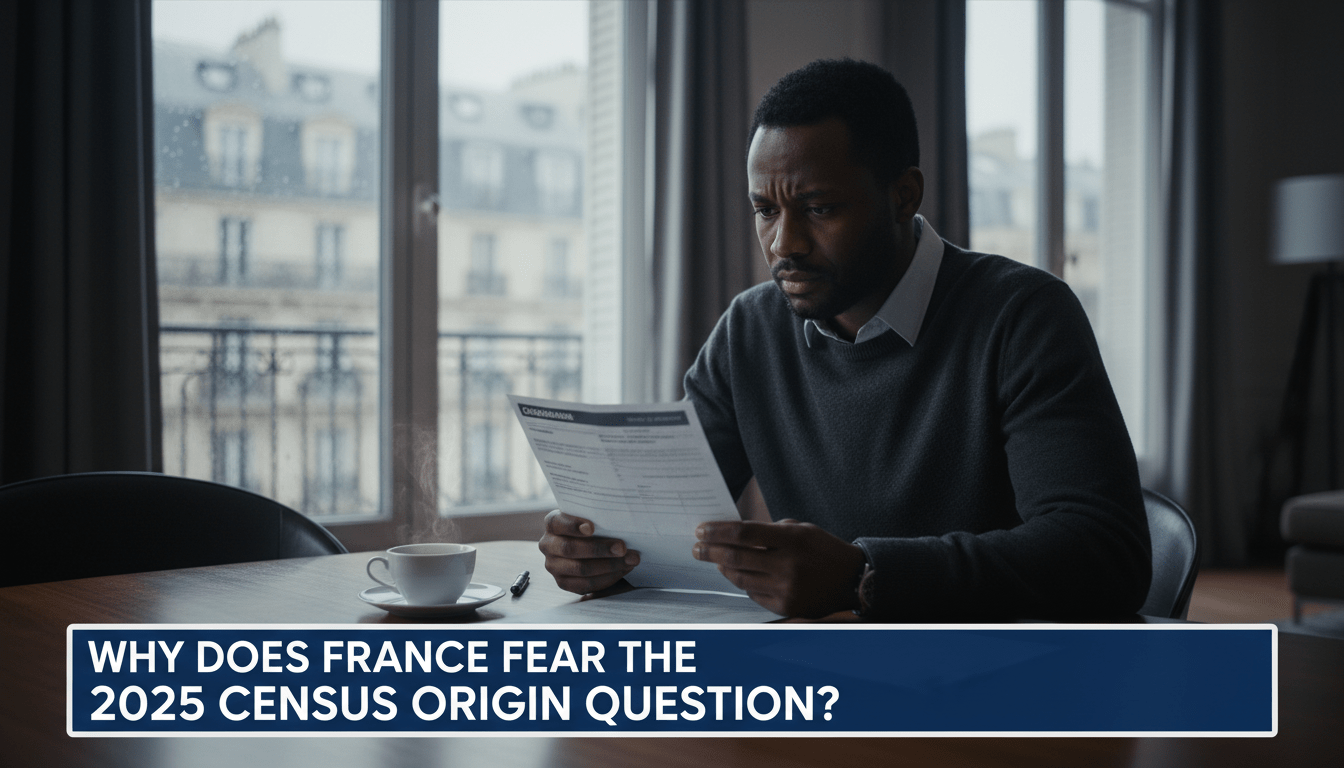
Why Does France Fear the 2025 Census Origin Question?
By Darius Spearman (africanelements)
Support African Elements at patreon.com/africanelements and hear recent news in a single playlist. Additionally, you can gain early access to ad-free video content.
In January 2025, the French national statistics bureau, known as INSEE, launched its annual census with a controversial addition. For the first time, the survey included an optional question asking residents about the birthplaces of their parents (insee.fr). While this might seem like a simple request for data, it has triggered a massive wave of protest across the country. Major trade unions and civil rights groups are sounding the alarm. They believe this information could be used to discriminate against people of immigrant descent. These organizations are now encouraging citizens to leave the question blank as a form of protest (modernghana.com).
The groups leading the charge include the CGT, which is one of the largest labor unions in France. They are joined by the Ligue des droits de l’Homme and MRAP, which are prominent anti-racism organizations. These groups argue that the state does not need to know where a citizen’s parents were born to provide public services. Their primary fear is that this data will create a “map” of where non-native French people live. In a political climate where nationalist ideas are gaining ground, many residents feel that being “visible” to the state is a danger rather than a benefit (theguardian.com).
The Long Shadow of the Republican Model
To understand why this question causes such fear, one must look at the history of the French Republic. Since the French Revolution, the state has followed a philosophy called Republican Universalism. This means the government officially ignores race, religion, and ethnic background. In the eyes of the law, there are no “Black French” or “Arab French” people. There are only citizens. The 1958 Constitution solidifies this by ensuring equality “without distinction of origin, race, or religion” (insee.fr). This model is very different from the approach in the United States, where the census asks about race to protect civil rights.
French leaders often argue that naming different groups creates division. They believe that if the state recognizes ethnic communities, it will destroy national unity. This perspective is a core part of Black Studies in a global context, as it shows how different nations handle identity. However, critics say this “color-blind” approach is a double-edged sword. While it aims to prevent tribalism, it also makes it very hard to track and prove systemic racism. If the state does not count how many Black people live in a neighborhood, it can claim that any lack of resources there is not related to race (brookings.edu).
French Population by Origin (2021)
Immigrants (Born abroad, foreign nationality)
Descendants of Immigrants (Second Generation)
Source: INSEE Data (insee.fr)
The 1978 Law on Information Technology and Liberties was passed to protect citizens from state surveillance. This law strictly prohibits the collection of data regarding racial or ethnic origins. It also created a watchdog agency called the CNIL to oversee how the government uses personal information (insee.fr). The current controversy arises because INSEE is using a loophole. They are asking for “place of birth,” which is considered an objective geographic fact rather than a racial category. This legal distinction allows them to bypass the strict 1978 ban, even though the result is the same (insee.fr).
Vichy and the Trauma of the Tulard File
The most powerful reason for the current boycott is the trauma of World War II. Between 1940 and 1944, the French Vichy government collaborated with Nazi Germany. During this time, French police used a database known as the “Tulard File” to identify Jewish residents. These records were created using census-style information. They were ultimately used to round up thousands of people for deportation to death camps (theguardian.com). This history created a deep, lasting fear that any government list based on origins could become a “death list” if the wrong people take power.
President Jacques Chirac officially apologized for these actions in 1995. He admitted that the French state and its bureaucracy were complicit in these crimes (modernghana.com). This apology did not end the fear. Instead, it reinforced the idea that the only way to stay safe is to remain invisible to the state. Activists argue that once the data exists, it is impossible to control who will use it in the future. They point out that a modern database is much more powerful and easier to search than the paper files of the 1940s. For many, the census question is not a scientific tool but a dangerous precedent (theguardian.com).
This historical context is vital when discussing the rights of marginalized people. Just as some faced involuntary servitude long after emancipation in other parts of the world, French citizens of immigrant descent fear that their rights can be stripped away through administrative means. The memory of Vichy serves as a constant reminder that the state is not always a protector. It can also be a predator. Therefore, the refusal to answer the birthplace question is seen as an act of self-defense (modernghana.com).
The Rise of the Far Right and “National Preference”
The current political situation in France adds another layer of urgency to the protest. The far-right party known as the Rassemblement National (RN) has grown significantly in popularity. They advocate for a policy called “National Preference.” This policy would grant “native” French citizens priority over others for housing, jobs, and welfare benefits (modernghana.com). Under this plan, a person could be a legal French citizen but still be denied services because their parents were born in another country. Critics warn that this would create two classes of citizens based on bloodline (aninjusticemag.com).
During the 2024 legislative elections, the RN gained a record number of seats in Parliament. This shift in power has made rights groups very nervous. They fear that if the RN takes control of the government, they will use the new census data to implement “National Preference.” The data on parents’ birthplaces would allow the state to identify exactly who counts as “native” and who does not (theguardian.com). Even though the current government claims the data is for research on social mobility, activists do not trust that future leaders will follow the same rules (modernghana.com).
Unemployment Rates in France (2021)
8%
13%
Descendants of immigrants face higher unemployment despite being French citizens. (insee.fr)
Labor unions like Solidaires argue that the state already knows that discrimination exists. They point to existing research showing that descendants of immigrants have a 13% unemployment rate, compared to 8% for the general population (insee.fr). These groups believe the government should focus on fixing these disparities rather than collecting more sensitive data. They see the census question as a distraction from the real work of fighting racism in the workplace and in housing. For them, the risk of the data being weaponized by the far right far outweighs any potential benefit to researchers (modernghana.com).
The Invisible Minority: Black Life in the Hexagon
The debate over census data is particularly intense for the Black French population. Because the state is color-blind, it is difficult to accurately measure how many Black people live in France. Private studies suggest that a significant portion of newborns have at least one foreign-born grandparent (insee.fr). However, the census does not record this. This makes Black citizens “visible” when they walk down the street and face discrimination, but “invisible” when they ask the state for protection. They are trapped in a system that acknowledges their existence for policing but ignores them for policy (aninjusticemag.com).
Residents from Overseas France, such as Martinique and Guadeloupe, occupy a unique space in this debate. They are full French citizens by birth, but they are often treated as foreigners in mainland France. The census usually tracks internal migration from these territories separately (modernghana.com). Activists like Rokhaya Diallo have noted that France often views itself as a white country. By refusing to track race, the state avoids facing the reality of its diverse population. This lack of data prevents the kind of targeted civil rights policies that were central to the anti-apartheid movement and other global struggles for equality.
The new question on the census aims to track the “second generation,” but it stops there. This means that a third-generation Black French person—someone whose parents were born in France—would still be counted as “native.” While this sounds inclusive, it actually hides the reality of ongoing racism. A person can be third-generation and still face discrimination because of their skin color. By focusing only on birthplaces, the census misses the core issue of race. Activists argue that the government is choosing a method that is both dangerous for privacy and ineffective for fighting bias (aninjusticemag.com, brookings.edu).
Data for Progress or Tools for Control?
The French government and INSEE defend the census question as a necessary tool for social science. They claim that “place of birth” is an objective fact that helps measure generational mobility. They want to see if the children of immigrants are doing better than their parents in terms of education and income (insee.fr). Furthermore, they emphasize that the question is strictly optional. The CNIL only allowed the question on the condition that no one is forced to answer it. Survey takers are told to encourage completion, but they cannot legally punish someone for skipping it (insee.fr).
However, the concept of an “optional” question in a government document is complicated. Many people, especially those in vulnerable positions, feel pressured to fill out every box. They fear that an incomplete form might lead to a loss of benefits or problems with their residency status (modernghana.com). Unions warn that even if the question is optional, the presence of the data in a government database is the primary threat. Once the information is recorded, it can be accessed by various government agencies. In the wrong hands, this “research data” could quickly become a tool for profiling specific neighborhoods (theguardian.com).
The Data Privacy Paradox
Research Need
Tracking social mobility and inequality to improve public policy.
Vichy Legacy
Preventing the state from ever creating lists of citizens by origin.
France currently tracks racism through “Testing” rather than census data. This involves sending identical job applications with different names—one “French-sounding” and one “North African-sounding”—to see who gets an interview (brookings.edu). This method provides hard evidence of bias without requiring a national database of origins. Groups like SOS Racisme use these results to file lawsuits and advocate for change. They argue that this method is safer and more effective than the new census question. It proves that discrimination is happening right now, regardless of what the census says (aninjusticemag.com).
A Future of Resistance and Responsibility
The boycott of the 2025 census question is part of a larger tradition of civil disobedience in France. By urging people to skip the item, unions and rights groups are making a powerful statement. They are saying that privacy is more important than state-controlled data. This movement highlights a fundamental tension in modern democracies. We want the government to help us, but we also need protection from the government’s potential for harm. This is a lesson found throughout the history of marginalized groups who have had to navigate hostile systems (modernghana.com, theguardian.com).
As the census continues throughout 2025, the debate will likely grow. The government may try to reassure the public, but the fear of the far right is a powerful motivator for the boycott. For the Black community and other minorities, the stakes are very high. They are fighting to remain citizens with equal rights, rather than being reduced to a “second generation” category in a computer system (aninjusticemag.com). The struggle shows that data is never just numbers. In the wrong hands, it is a weapon. In the right hands, it is a shield. But in France, many have decided that the safest path is to simply not provide the data at all (modernghana.com).
The history behind this headline is one of revolution, trauma, and a constant search for equality. From the ideals of the 1789 Revolution to the horrors of the 1940s, France has a unique relationship with identity. This new census question is a tiny change in a survey, but it has reopened old wounds. It serves as a reminder that progress is not a straight line. Sometimes, protecting the future requires remembering the darkest parts of the past. By standing together and refusing to answer, these groups are trying to ensure that history does not repeat itself (theguardian.com).
About the Author
Darius Spearman is a professor of Black Studies at San Diego City College, where he has been teaching for over 20 years. He is the founder of African Elements, a media platform dedicated to providing educational resources on the history and culture of the African diaspora. Through his work, Spearman aims to empower and educate by bringing historical context to contemporary issues affecting the Black community.
