

Why Federal Grant Cuts Threaten Black Student Support Programs
By Darius Spearman (africanelements)
Support African Elements at patreon.com/africanelements and hear recent news in a single playlist. Additionally, you can gain early access to ad-free video content.
A History of Inclusion and Exclusion
The story of higher education in the United States is a long journey from exclusion to targeted support. In the beginning, the federal government provided land for colleges through the First Morrill Act of 1862. However, these new schools did not welcome Black students. This created a massive gap in opportunity that the government had to address decades later (archives.gov). The Second Morrill Act of 1890 changed the landscape by requiring states to either admit Black students or build separate schools for them. This law led to the birth of 19 historically Black land-grant universities. These schools were meant to provide a practical education in agriculture and engineering for the working class (wikipedia.org).
Even though these schools were established by law, they faced a long road of historical exclusion that continues to affect them today. The mission of these land-grant institutions is to combine teaching, research, and public service. They are legally bound to share their research with the public through extension services (aplu.org). While the 1890 act provided a foundation, it also set the stage for a separate and unequal system. This history is vital to understanding why current funding fights are so intense for Black students and the schools that serve them.
MSI Student Enrollment (Millions)
Minority-Serving Institutions educate a massive portion of the American workforce (rutgers.edu).
Building the Framework for Institutional Aid
Modern federal support for these schools comes from the Higher Education Act of 1965. President Lyndon B. Johnson created this law as part of his vision for a more equal society. The law established “Title III” and “Title V” as the primary ways to provide money to colleges that serve many low-income and minority students (ed.gov). Title III focuses on strengthening institutions like Historically Black Colleges and Universities (HBCUs) and Predominantly Black Institutions (PBIs). These grants help schools improve their academic quality and stay financially stable (higheredgrants.info).
The way the government defines these schools is very important for how they get paid. HBCUs are defined by their historical mission because they were founded before 1964 to educate Black Americans. In contrast, PBIs were established later, in 2007. To be a PBI, a school must have at least 40 percent Black students and 50 percent low-income or first-generation students (wordinblack.com). This distinction between “mission” and “enrollment” has become a major legal sticking point. Because policy decisions often shift with the political wind, schools that rely on enrollment numbers face more risk than those with a historical mission status.
The Impact of Legal Challenges
In 2023, a Supreme Court ruling on college admissions changed how the government looks at race-based programs. While the case was about who gets into school, legal experts used it to challenge federal grants for minority institutions. In July 2025, the U.S. Solicitor General made a major determination. The office argued that federal grants based on racial enrollment percentages, like the 40 percent requirement for PBIs, violate the Fifth Amendment of the Constitution (crowell.com). This amendment ensures that the federal government treats all people equally under the law.
This legal shift created a massive problem for the Department of Education. If a grant is seen as a “racial quota,” it becomes much harder to defend in court. Because of this, the administration under Donald Trump moved to cut 350 million dollars in discretionary funding for MSIs in September 2025. They argued that because HBCUs are mission-based rather than quota-based, they could keep their funding while PBIs and Hispanic-Serving Institutions (HSIs) lost theirs (afro.com). This created a divided system where some minority schools were protected while others were left in the cold.
Why the Fifth Amendment Matters
Many people are familiar with the Fourteenth Amendment, which requires states to provide equal protection. However, the Fifth Amendment is the tool used for federal oversight. The Supreme Court decided long ago that the federal government must follow the same rules as the states regarding equality (constitutioncenter.org). When the Solicitor General challenged MSI grants, they cited the Fifth Amendment because the money comes from a federal agency. This legal strategy is designed to end any spending that uses race as a primary factor for eligibility.
The government now argues that funding must be race-neutral or based on socioeconomic status instead of enrollment percentages. For schools like the University of Baltimore or Chicago State University, this is a terrifying prospect. These schools are PBIs that serve thousands of Black students, but they do not have the same historical legal protections as HBCUs (harvard.edu). If the government decides that their enrollment numbers are “quotas,” these schools could lose the very grants that keep their doors open. This legal tension is the core reason why administrators remain worried even when Congress provides temporary funding.
The $12.8 Billion Funding Gap
States failed to match federal dollars for Black institutions for over 30 years (aplu.org).
A Gap Worth Billions
The struggle for money is not just about new grants; it is also about money that was never paid in the past. In 2023, the federal government told 16 governors that they had underfunded their Black land-grant schools by 12.6 billion dollars over three decades. This happened because states are required to match every dollar the federal government gives to these schools. While states matched the money for white universities, they often ignored the Black ones (aplu.org). For example, Tennessee State University was cheated out of 2.1 billion dollars in state funds (indiatimes.com).
North Carolina A&T State University also missed out on over 2 billion dollars. This massive loss of money means these schools could not fix old buildings, build new labs, or hire more advisors. This systemic neglect has left many HBCUs struggling to keep up with modern technology and infrastructure needs. When people talk about the “tension” in higher education funding today, they must remember that these schools are starting from a place of deep financial disadvantage caused by decades of state-sponsored neglect (naicu.edu).
Restoration and the Power of the Purse
By early 2026, Congress stepped in to restore the 350 million dollars that had been cut from MSI programs. This happened because Congress has the “power of the purse,” meaning they decide where the money goes. However, a law called the Impoundment Control Act says the President must spend the money Congress gives them. The President cannot simply refuse to spend it unless Congress agrees to cancel the spending (higheredgrants.info). While this sounds like a win for schools, the reality is more complicated.
Even though the money is available on paper, the Department of Education can create hurdles. They can “freeze” the money for review or delay the application process. This creates a “funding paradox” where the money exists, but the schools cannot touch it. Administrators are forced to plan their budgets without knowing if the check will ever arrive. This uncertainty makes it almost impossible to sign long-term contracts for the academic barriers that these grants are supposed to fix (higheredjobs.com).
Protecting Student Success Centers
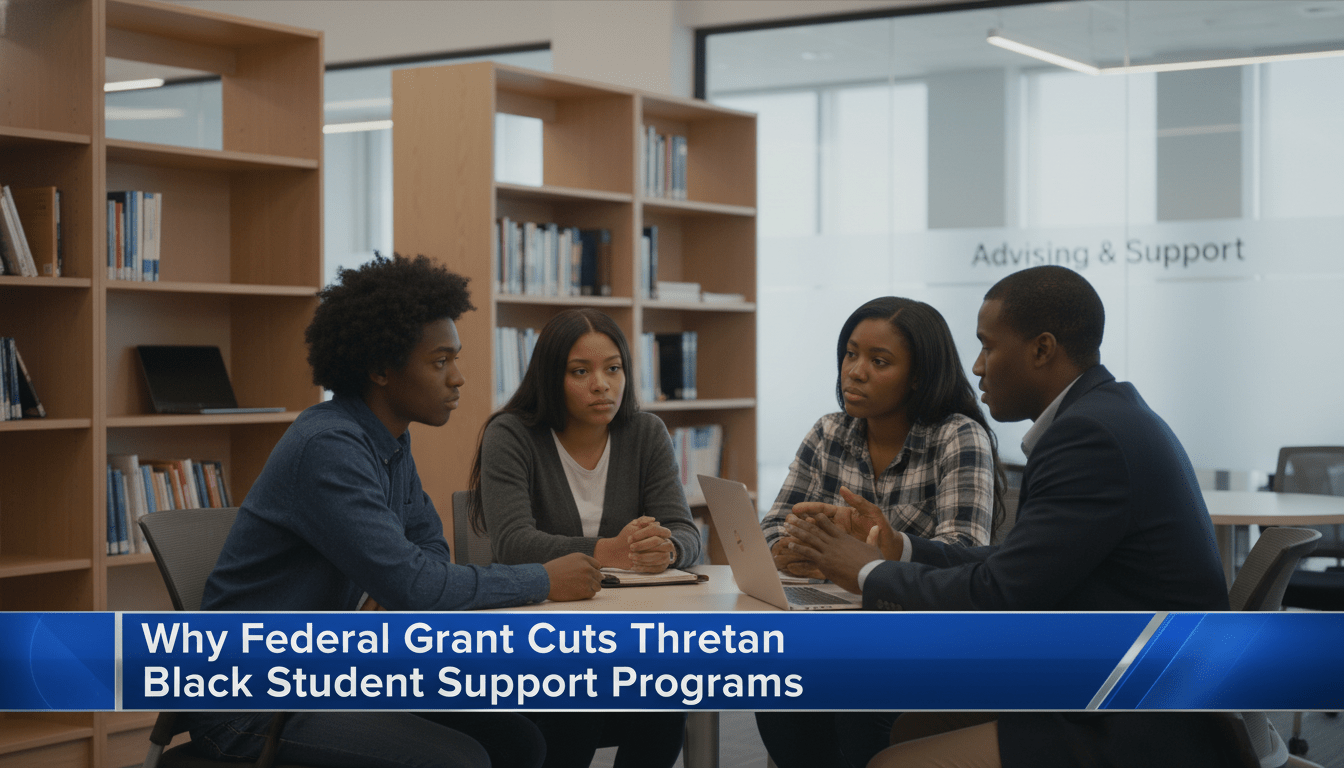
The grants that are currently at risk fund essential programs called “wrap-around services.” These are not just basic classes; they are support systems that help the “total student.” For many Black students, especially those at community colleges, these services are the difference between graduating and dropping out. PBIs use this money for success centers that offer tutoring and career advice. They also fund basic needs, such as food pantries for students who are hungry and emergency housing for those who lose their homes (conexed.com).
One specific method used is “intrusive advising.” This might sound like a bad thing, but it is actually a very helpful strategy. Instead of waiting for a student to ask for help, the school reaches out to them first. Advisors check in during midterms or before big deadlines to make sure students have what they need. This shift in responsibility from the student to the school is vital for first-generation students who might not know what questions to ask (conexed.com). If the funding for these advisors disappears, many students will lose the guidance they need to navigate the complex world of college.
The Hidden Crisis of Pell Grants
While the MSI grants are a major focus, another financial shift has hurt Black students even more. Pell Grants are federal awards for the poorest students, and they do not have to be paid back. Over the last decade, Black student enrollment in public colleges dropped by nearly 500,000 students. Research shows this drop happened at the same time that Pell Grant funding fell by billions of dollars when adjusted for inflation (nasfaa.org). In 2012, the government made it harder to qualify for these grants, which hit the South particularly hard.
In the Southern United States, where more than half of Black students live, the number of people receiving Pell Grants dropped by 23 percent. This loss of financial aid has forced many students to choose between debt and dropping out. Majority-Black community colleges in the South were the most affected, losing over a third of their total enrollment (nasfaa.org). This shows that funding for higher education is a complex web. When one part of the web breaks, like MSI grants or Pell funding, the whole system supporting Black students begins to unravel.
Tribal Colleges and the Sovereignty Model
Another group of schools facing these shifts are Tribal Colleges and Universities (TCUs). These schools have a very different legal standing compared to PBIs or HSIs. TCUs are governed by their own laws and are chartered by sovereign tribal nations. To be a TCU, the school must be run by a federally recognized tribe and have a majority Native American student body and board (state.gov). They share a mission of tribal self-determination, which includes preserving Native languages and culture.
Because TCUs are based on a unique relationship with sovereign nations, they are often protected from the “racial quota” arguments used against other MSIs. Like HBCUs, their mission is viewed as a permanent institutional identity rather than a temporary demographic shift. There are currently 35 TCUs that are also considered land-grant colleges (wikipedia.org). This status gives them a bit more security in the eyes of the law, but they still face the same general instability that haunts the entire higher education landscape during this fiscal year.
The Future of Race-Conscious Funding
The current climate has forced every minority-serving school to re-evaluate their collective struggle for resources. Some legal experts suggest that schools should stop using race-specific names for their programs and focus on socioeconomic status instead. This would make the grants “race-neutral” and harder to challenge in court. However, many leaders argue that race-neutral programs often fail to address the specific obstacles that Black students face. They fear that moving away from race-conscious funding will hide the very problems the money was meant to solve.
The “tension” mentioned in the headlines is about more than just a single year of funding. it is a battle over the future of how the United States supports equity in education. While the money for 2026 is technically there, the legal basis for that money is under fire. Schools are caught between a Congress that wants to help and an executive branch that is rewriting the rules of civil rights compliance. For the 4.8 million students at MSIs, this legal tug-of-war is not just a debate; it is a direct threat to their graduation day (rutgers.edu, forbes.com).
The Road Ahead for Black Students
Despite the challenges, these institutions remain the backbone of the Black middle class. HBCUs and PBIs produce a massive share of the nation’s Black doctors, engineers, and teachers. The programs they fund, like STEM initiatives and student success centers, are essential for closing the graduation gap. However, the constant “funding cliff” creates a culture of survival rather than growth. When administrators have to spend all their time fighting for the next grant, they have less time to innovate and improve their schools (georgetown.edu).
As the nation moves forward, the history of the Morrill Acts and the Higher Education Act serves as a reminder that progress is never permanent. The current struggle for MSI funding is the latest chapter in a long history of trying to make American higher education truly accessible. Whether the government chooses to protect these schools or dismantle their funding will determine the educational future for millions of students. For now, the schools will continue to do their best with the money they have, while always looking over their shoulder at the next legal challenge (apnews.com).
About the Author
Darius Spearman is a professor of Black Studies at San Diego City College, where he has been teaching for over 20 years. He is the founder of African Elements, a media platform dedicated to providing educational resources on the history and culture of the African diaspora. Through his work, Spearman aims to empower and educate by bringing historical context to contemporary issues affecting the Black community.
