

Why Gangs Use Sexual Violence as a Strategic Weapon in Haiti
By Darius Spearman (africanelements)
Support African Elements at patreon.com/africanelements and hear recent news in a single playlist. Additionally, you can gain early access to ad-free video content.
Haiti is facing a period of intense suffering and fear. Recent reports from January 28, 2026, show a terrifying trend in the capital city of Port-au-Prince. Human Rights Watch reports that survivors of sexual violence are being left without any care. Criminal groups and forced displacement have trapped people far from medical clinics and the justice system (hrw.org). The situation is becoming more dangerous every day as gangs gain more control over the streets.
Doctors Without Borders also reports a sharp rise in sexual violence in the city. The group links this spike to armed groups that use rape to terrorize local neighborhoods. This is more than a series of random crimes. It is a calculated strategy to control the population and crush resistance. The collapse of the government has left the most vulnerable people with no protection at all (msf.org.uk).
The Long Shadow of Dictatorship and State Terror
The current violence in Haiti did not start by accident. It has roots that go back many decades. During the era of François “Papa Doc” Duvalier, sexual violence became a tool of political control. He created a private militia known as the Tonton Macoutes (openedition.org). These men were the official enforcers of the state. They used terror to keep the Duvalier family in power for thirty years. They often targeted the families of political rivals to send a message (blackpast.org).
The Tonton Macoutes established a culture where armed men could act with total impunity. They did not have to worry about laws or judges. This historical period set a dangerous precedent for the modern gangs. Today, criminal groups use the same tactics to punish neighborhoods. They want to show that they are the only authority that matters. This history of state-sponsored terror continues to haunt the people of Haiti today.
Monthly Survivors Seeking Care at MSF Clinics
Source: Doctors Without Borders (MSF) Reporting
The Delayed Fight for Legal Recognition
It is shocking to learn that rape was not considered a serious crime in Haiti for a long time. Until 2005, the legal system followed an old penal code from the nineteenth century. This code viewed rape as an offense against morals rather than a crime against a person (openedition.org). Under that old law, a man could avoid prosecution by offering to marry his victim. This legal structure protected the perpetrator and shamed the survivor (coha.org).
Women’s rights organizations fought for many years to change these outdated laws. Their hard work led to a decree in July 2005 that finally criminalized rape. This was a major victory for justice in Haiti. However, having a law on paper is not the same as having justice in the streets. Today, the judicial system is almost completely broken. Prosecutors and judges have been forced to flee because gangs have threatened their lives (hrw.org). This means that even with better laws, there is no one to enforce them.
The Rise of the Viv Ansanm Coalition
In recent years, the nature of gang violence in Haiti has changed. In the past, different gangs fought each other for small pieces of territory. In early 2024, these rival groups formed an alliance. They called this new coalition Viv Ansanm, which means “Living Together” in Haitian Creole (miamiherald.com). This alliance was not created for peace. It was created to launch a coordinated attack against the state (acleddata.com).
Under the leadership of figures like Jimmy “Barbecue” Chérizier, these gangs have become a structural criminal network. They now control about 90% of Port-au-Prince. They use their power to block critical infrastructure like airports and seaports. They also use sexual violence as a way to control the people who live in their territory. By attacking [Black women](https://www.africanelements.org/news/the-haitian-revolution-the-slave-trade-and-black-women-2/) and families, they aim to break the spirit of the community. This ensures that no one dares to challenge their authority.
Who are the Perpetrators?
Hover to spin. Source: MSF 2025 Data
The Race Against the Seventy-Two Hour Clock
Medical care for survivors of sexual violence is a matter of urgent timing. When a person is assaulted, they are at high risk for contracting HIV. There is a medicine called Post-Exposure Prophylaxis, or PEP, that can prevent the infection (nih.gov). However, PEP must be started very quickly. Doctors state that it is only effective if the patient begins the treatment within 72 hours of the exposure (cdc.gov).
In the context of Haiti, this 72-hour window is a massive hurdle. Gangs have set up roadblocks all over the city. They often stop people from moving between neighborhoods. This means a survivor might be trapped in their own home for days after an attack. Human Rights Watch notes that 67% of survivors reach a clinic too late to receive PEP (doctorswithoutborders.org). This situation turns a terrible crime into a life-long medical crisis. It is a clear example of how violence and a lack of infrastructure work together to harm the people.
The Impact of Forced Displacement on Families
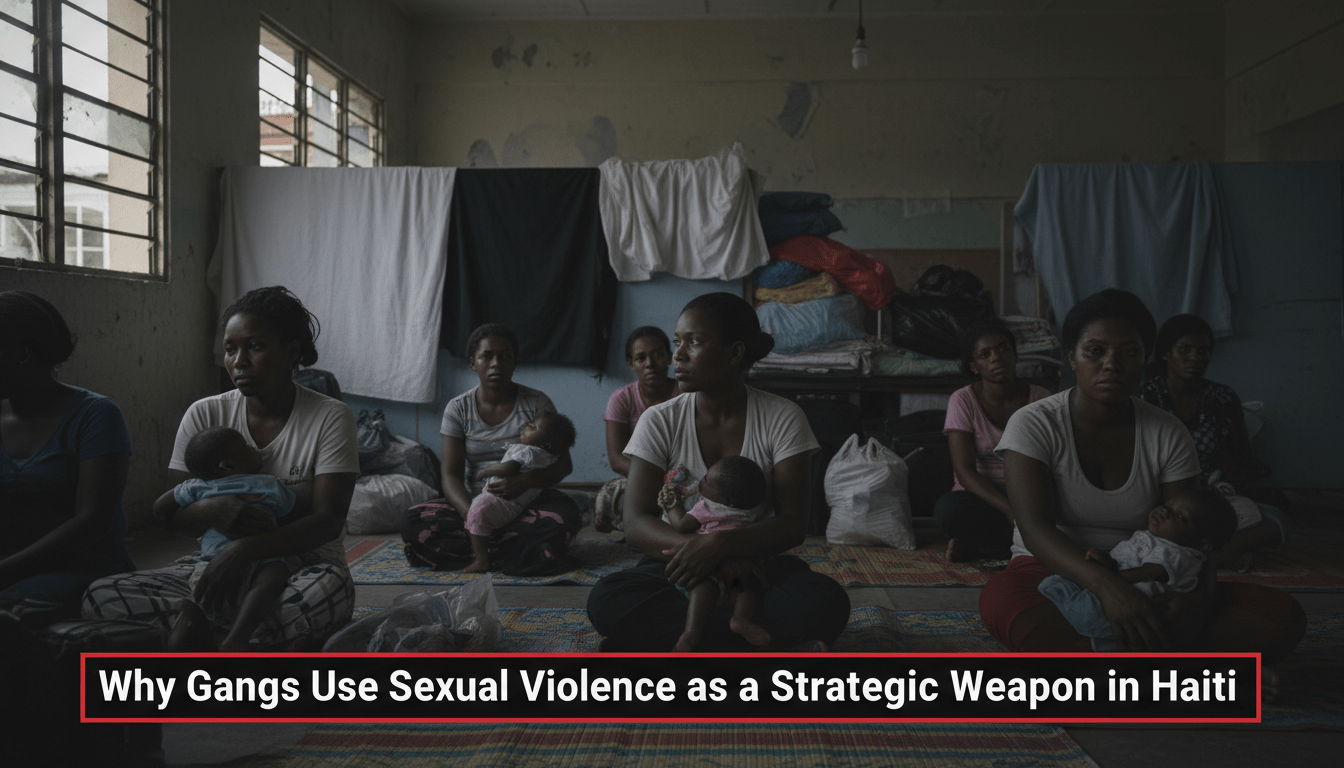
The violence has forced over one million people to flee their homes. These people are known as internally displaced persons, or IDPs (hrw.org). Unlike refugees, they have not crossed an international border. They are still inside Haiti, looking for any safe place to hide. Many families end up living in overcrowded schools or churches. These sites often lack basic security like doors, lights, or clean water (hrw.org).
These temporary shelters are not safe from the gangs. Armed groups frequently raid these displacement sites. They target women and children who have already lost everything. In fact, 70% of sexual violence survivors are people who have been displaced from their homes (doctorswithoutborders.org). Many people have been forced to move multiple times. This constant movement makes it even harder for them to find help or stay healthy. The cycle of trauma never seems to end for these families (un.org).
The Critical Window for Care
67% of survivors arrive AFTER the 72-hour window for HIV prevention medicine.
The Connection Between Weapons and External Policy
The weapons used by gangs in Haiti do not come from within the country. Most of the high-caliber firearms are smuggled from the United States. UN reports identify Florida as a major source for these weapons (miamiherald.com). Criminals buy guns in states with loose laws and then hide them in shipping containers. These containers arrive at small, private ports that are not well-monitored (substack.com).
President Donald Trump and his administration have focused on border security as a primary goal. However, the flow of illegal weapons to the south remains a major challenge. These guns allow gangs to have more firepower than the actual Haitian police force (federalregister.gov). Without a way to stop the flow of rifles like AK-47s and AR-15s, the gangs will continue to hold the country hostage. The international community is struggling to find a way to help restore order while the [revolutionary rise](https://www.africanelements.org/news/the-black-panther-party-the-rise-and-fall-of-a-revolutionary-movement/) of gang power continues to grow.
The Crisis in the Artibonite Region
While most news focuses on Port-au-Prince, the violence is spreading to rural areas. The Artibonite department is the primary agricultural region of Haiti. It is often called the “breadbasket” of the country because it produces most of the rice (miamiherald.com). Gangs have now moved into this area to control the food supply. They target farming families and force them to leave their land. This has led to a major food shortage across the entire nation.
Controlling Artibonite also means controlling the roads that connect the capital to the north. Gangs use these routes to kidnap travelers and extort money from businesses. The violence in the countryside is just as brutal as in the city. Families are losing their livelihoods and their safety at the same time. This geographic expansion of gang power shows that the crisis is a national emergency, not just a local problem in the capital.
The Role of the Diaspora and International Aid
The Haitian Diaspora plays a vital role in keeping the country alive. Millions of Haitians live in places like the United States, Canada, and France. They send money home to help their families survive. These remittances once made up a huge part of the national economy (coha.org). Now, much of that money is used for emergencies. Families must pay ransoms to gangs or buy food at very high prices.
Members of the Diaspora are also calling for more accountability. They want the world to recognize the [historical exploitation](https://www.africanelements.org/patreon/africas-rising-debt-crisis-a-historical-echo-for-black-communities/) that has contributed to the current collapse. They are pushing for better protection for survivors and an end to weapon smuggling. Despite their efforts, international funding for protection services has been reduced. This has forced the closure of many safe shelters that used to help women fleeing violence (hrw.org).
The Uncertain Path Toward Stability
As of early 2026, the political situation in Haiti is very unstable. A Transitional Presidential Council is trying to lead the country, but they face many challenges. There have been no national elections for an entire decade (capitalfm.co.ke). This means there are no elected officials left in the government. The lack of leadership makes it very hard to rebuild the police force or the courts.
There is also an international security mission led by Kenya. This force was created to help the police fight the gangs. While they have prevented a total collapse of the state, they are understaffed and underfunded. They face a well-armed alliance in Viv Ansanm that is ready to fight for every street (substack.com). The path to peace will require more than just security forces. It will require a total rebuilding of the healthcare and justice systems to support the people who have suffered the most.
About the Author
Darius Spearman is a professor of Black Studies at San Diego City College, where he has been teaching for over 20 years. He is the founder of African Elements, a media platform dedicated to providing educational resources on the history and culture of the African diaspora. Through his work, Spearman aims to empower and educate by bringing historical context to contemporary issues affecting the Black community.
