


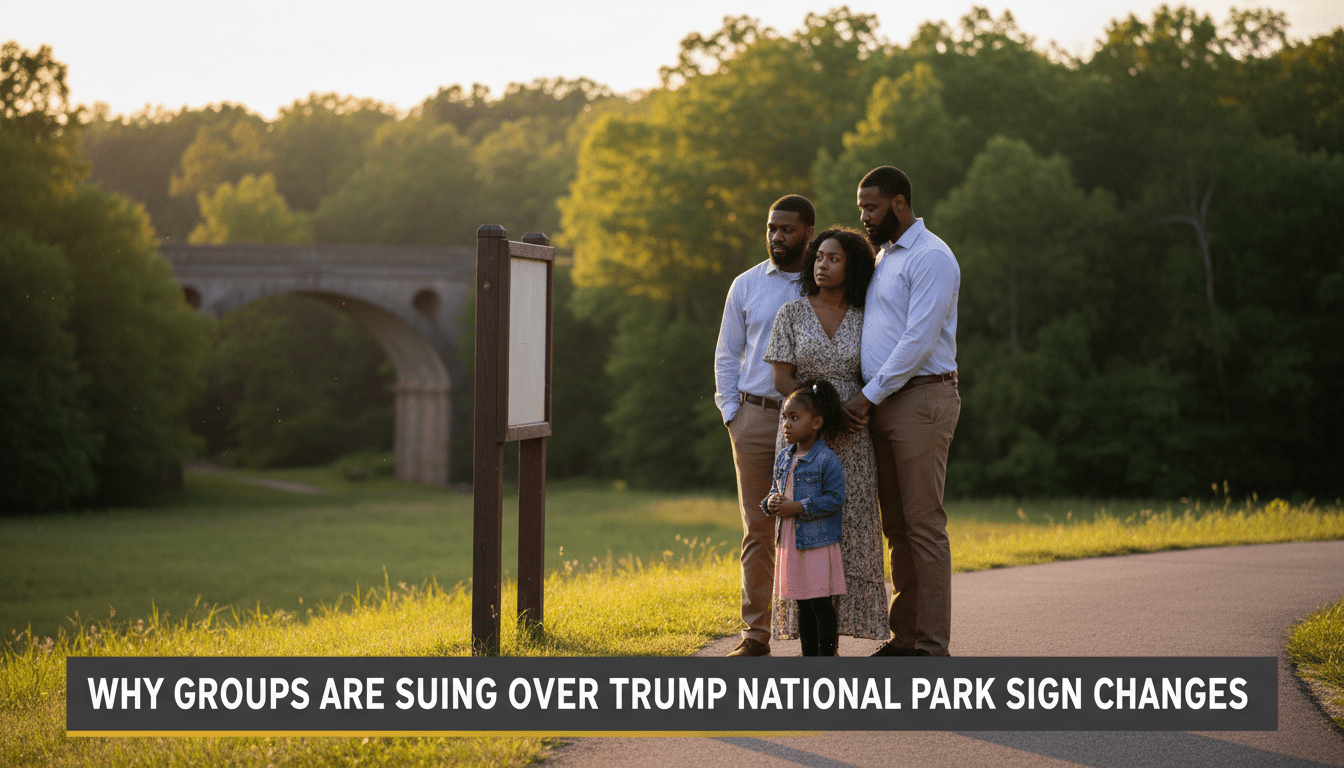
Why Groups Are Suing Over Trump National Park Sign Changes
By Darius Spearman (africanelements)
Support African Elements at patreon.com/africanelements and hear recent news in a single playlist. Additionally, you can gain early access to ad-free video content.
The National Park Service acts as a giant classroom for the American people. Millions of visitors walk through these parks to learn about nature and history every year. However, a major legal battle has started over what those visitors are allowed to read. On February 17, 2026, a large group of scientists and historians sued the Trump administration. They claim the government is hiding the truth by removing park signs about slavery, civil rights, and climate change (democracyforward.org).
This lawsuit comes after months of changes at national parks across the country. Groups like the National Parks Conservation Association say the administration is “gagging” public learning. They argue that the government must provide accurate facts to the public. The conflict is part of a much older struggle. For a long time, Americans have debated how to tell the story of the United States. This current fight focuses on whether the government can delete parts of history that some people find uncomfortable (npshistory.com).
The Roots of the National Park Mission
The National Park Service did not start out as a place for history lessons. In 1916, the Organic Act created the agency to protect beautiful landscapes. The goal was to keep these places safe for future generations to enjoy. At that time, the focus was mostly on nature and wildlife (nps.gov). Things changed in 1935 when Congress passed the Historic Sites Act. This new law gave the agency a job to preserve historical places too. It required the government to conduct research and provide true facts about these sites (npshistory.com).
A man named Freeman Tilden helped shape how parks teach visitors. He is known as the father of interpretation. In 1957, he wrote that interpretation should reveal deep meanings and relationships. It should not only list dry facts. Tilden believed that if people understand a place, they will appreciate and protect it. This idea became the gold standard for park rangers. They use signs, films, and tours to help visitors connect with the land and the past (npshistory.com).
Proposed Budget Cuts for FY 2026
The administration has proposed a $1.2 billion cut (38%) to the National Park Service budget.
Staff Reduction (Full-Time Equivalents):
26% Reduction in Workforce Proposed (reginfo.gov)The Shift Toward Honest History
For many decades, national parks avoided difficult topics. Civil War battlefields often focused only on military moves. They rarely mentioned the reason the war was fought. This changed in 1998 during a meeting in Nashville. Park leaders agreed they needed to talk about the “social, economic, and cultural issues” of the war. They decided that slavery had to be a part of the story. This agreement is called the Nashville Consensus (npshistory.com).
In 2000, Congress made this change official. They told the Secretary of the Interior to make sure all Civil War sites talk about slavery. This helped move away from the “Lost Cause” myth. That myth tried to say the war was only about states’ rights. It ignored the pain of enslaved people. By talking about slavery, parks started to provide a more complete picture of American life. This movement aimed to show the complex U.S. Constitution and slavery connection (npshistory.com).
The “Sanity” Order and New Directives
President Trump changed the direction of these programs in March 2025. He signed an executive order called “Restoring Truth and Sanity to American History.” This order tells agencies to remove content that “inappropriately disparages Americans.” It targets what the administration calls “corrosive ideology.” Critics say this is code for removing mentions of systemic racism and environmental damage. The order demands that displays focus on national achievements instead of historical tragedies (democracyforward.org).
Following this order, Interior Secretary Doug Burgum gave park staff a deadline. They had to review all signs and exhibits. Since then, hundreds of signs have been taken down. Thousands of others are being checked. The administration says this is necessary to protect “shared American values.” However, the coalition suing the government says this violates the law. They argue that the government is ignoring its duty to provide accurate information (reginfo.gov).
Erasing the Presence of the Enslaved
One major point of conflict is the President’s House in Philadelphia. This was the home of George Washington while he was president. For a long time, the story of the nine people he enslaved there was not told. These individuals included Oney Judge and Hercules Posey. Oney Judge famously escaped to freedom from that house in 1796. Hercules Posey was a chief cook who also fled to find his liberty. Their stories show that the freedom and equality struggle was happening even in the president’s own home (whitehousehistory.org).
Recently, officials removed panels describing these nine people. A federal judge eventually ordered the panels to be put back. The judge compared the removal of these signs to the censorship found in the book *1984*. Many historians believe that removing these names is a way to sanitize the past. It hides the fact that the foundations of the nation were built on involuntary servitude. When these stories are gone, the public loses a chance to learn the full truth (democracyforward.org).
Public Demand for Park Knowledge
See Climate Threat
Want to Learn More
Based on 2022 NPCA polling data (savedbynature.org).
Silence Along the Selma Trail
The Selma to Montgomery National Historic Trail is also under review. This trail marks the site of important marches for voting rights. It is where “Bloody Sunday” happened at the Edmund Pettus Bridge. Visitors go there to learn about heroes like John Lewis. However, the new directives have led to the removal of about 80 items. These include signs that explain how voting rights were systemically denied to Black people (wlrn.org).
The administration flagged these items for being “divisive.” Some signs were replaced with QR codes. These codes invite people to report any content that they think disparages Americans. Critics say this turns visitors into censors. It makes park rangers afraid to tell the truth about racial violence. This policy changes the trail from a place of learning into a place of silence. It stops people from understanding how hard the fight for justice has been (democracyforward.org).
Silencing Science and Climate Data
History is not the only target of these changes. Science is also being removed from park signs. National parks like Glacier and Acadia have lost displays about climate change. These signs used to explain why glaciers are melting. They also showed how rising sea levels affect coastal areas. The 2025 mandates have made it difficult for rangers to share this data. Many signs that mention “human-caused” warming are gone (savedbynature.org).
At Fort Sumter, the situation is even more serious. This historic fort is in danger because of rising seas. The lawsuit claims that materials detailing these environmental threats were “ripped away.” The public can no longer read about how climate change puts the fort at risk. Most Americans want to learn about these issues when they visit a park. A 2022 poll showed that 88 percent of people see climate change as a threat to parks. Removing this information goes against what the public wants to know (democracyforward.org).
Economic Value of National Parks (2023)
Degrading educational value may threaten this economic “brand” (savedbynature.org).
The Economic and Professional Toll
These policy changes have a high cost. The Trump administration proposed cutting the National Park Service budget by $1.2 billion. This is a 38 percent reduction from the total budget. It also includes a 26 percent cut in staff. These workers are known as “Full-Time Equivalents” or FTEs. Fewer staff members mean fewer rangers are available to give talks or answer questions. This makes it harder for the parks to serve as living classrooms (reginfo.gov).
The economic impact of parks is very large. In 2023, they generated over $55 billion in activity. They support hundreds of thousands of jobs in local communities. Experts argue that the “brand” of the National Park Service depends on its reputation for truth. If the parks become places of political messaging, people might stop visiting. This could hurt the local economies that rely on park tourism. The lawsuit argues that the government is damaging a national treasure by cutting these programs (savedbynature.org).
Legal Grounds for the Challenge
The coalition of groups is using a law called the Administrative Procedure Act (APA). This law was passed in 1946. It says that government agencies must be transparent. They cannot make rules that are “arbitrary or capricious.” This means they must have a good reason for their actions. The groups say the administration did not follow the proper steps before removing signs. They also say the removals violate the statutory duty of the park service (epic.org).
Under the Historic Sites Act of 1935, the government is required to provide “true and accurate” facts. The lawsuit argues that deleting history is a failure of this duty. If the government only tells one side of the story, it is not being accurate. The Administrative Procedure Act allows courts to stop agency actions that are unfair or illegal. This legal battle will decide if the president has the power to change history at his own will. It is a fight for the integrity of the information given to every American (democracyforward.org).
Conclusion: The Future of Our Living Classrooms
The 2026 lawsuit is about more than physical signs on a trail. It is about who controls the narrative of the United States. The National Park Service has spent decades moving toward more inclusive stories. It has worked to include the voices of the enslaved and the reality of scientific change. Now, those efforts are being pushed back. The Trump administration views its actions as a return to “sanity.” The groups suing them view it as a betrayal of the public trust (npshistory.com).
As the case moves through the court system, the parks remain in the middle of a political storm. The outcome will shape how future generations understand their country. Will the parks continue to show the “whole” view of history? Or will they only show the parts that do not cause debate? The “history behind the headlines” suggests that truth is often a hard thing to protect. For now, the battle for the soul of the National Park Service continues (democracyforward.org).
About the Author
Darius Spearman is a professor of Black Studies at San Diego City College, where he has been teaching for over 20 years. He is the founder of African Elements, a media platform dedicated to providing educational resources on the history and culture of the African diaspora. Through his work, Spearman aims to empower and educate by bringing historical context to contemporary issues affecting the Black community.
