

Why Haiti’s Bwa Kale Vigilantes are Rising Against Gangs Now
By Darius Spearman (africanelements)
Support African Elements at patreon.com/africanelements and hear recent news in a single playlist. Additionally, you can gain early access to ad-free video content.
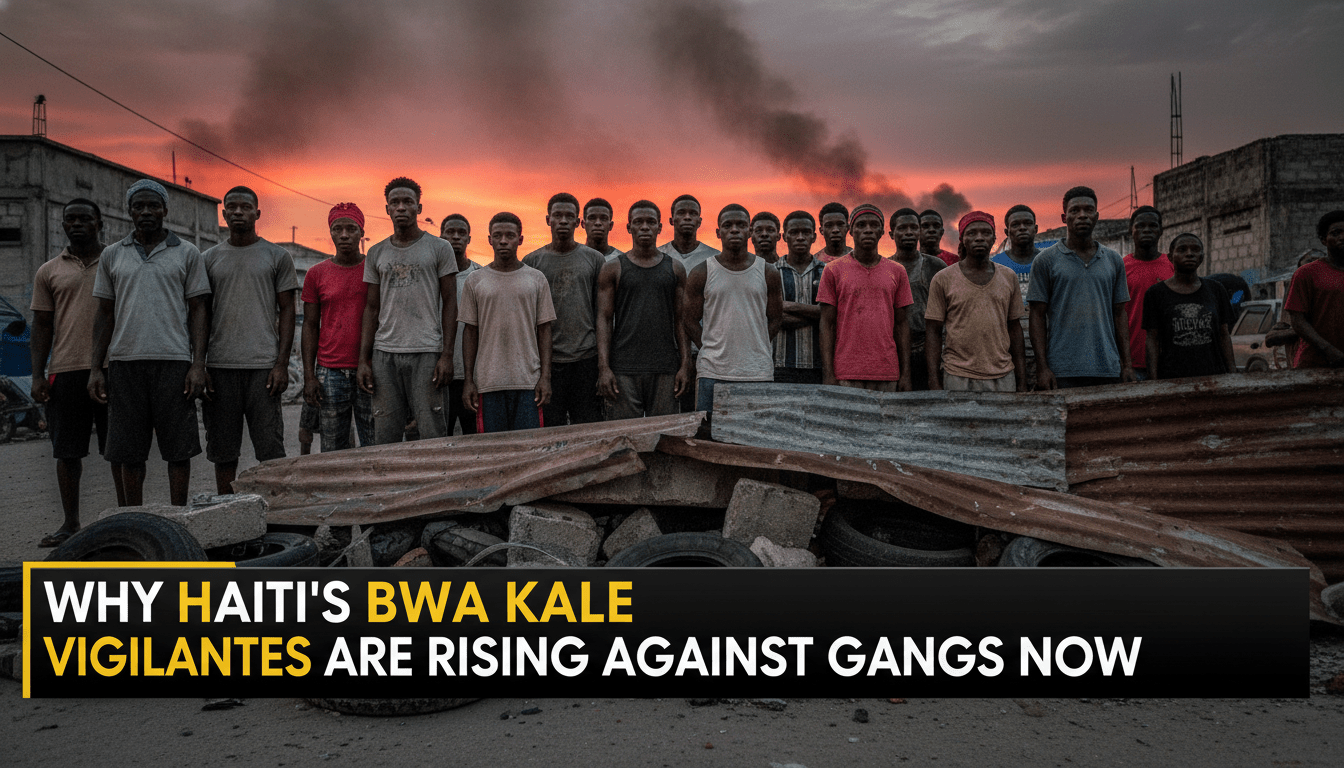
The streets of Port-au-Prince are quiet in a way that feels heavy. Smoke rises from burning tires at neighborhood entrances. People stand guard with machetes and stones. These are not soldiers or police officers. They are regular residents who have decided to fight back. This movement is known as Bwa Kale. It represents a desperate response to a city where gangs have taken almost everything. Today, gangs control about 90 percent of the capital city (un.org).
The world watches as Haiti struggles with this wave of violence. For many in the African diaspora, the pain of Haiti feels personal. This nation was the first to successfully break the chains of enslavement. The Haitian Revolution changed the course of history for Black people everywhere. However, the current crisis is deep. It is rooted in a long history of outside interference and internal struggle. Even as Donald Trump serves his current term as president, the United States remains deeply involved in Haiti’s fate. Understanding the present requires a hard look at the past (youtube.com).
The Long Shadow of Paramilitary Power
Haiti’s current gang problem did not start overnight. It began with leaders who used private armies to stay in power. From 1958 to 1986, President François “Papa Doc” Duvalier ruled with an iron fist. He created a group called the Tontons Macoutes. This was a personal militia that operated outside the law. They terrorized anyone who disagreed with the president. When the group was officially ended in 1986, the members were never truly disarmed. They simply blended back into society, keeping their weapons and their violent methods (wikipedia.org, debatmagazine.nl).
Later, during the early 2000s, another group emerged. These were the chimères. They were armed youth from the poorest neighborhoods. Politicians used them to control the streets and silence rivals. This history shows a pattern where the state relies on armed civilians instead of a fair justice system. Over time, these groups grew tired of working for politicians. They realized they could make more money through kidnapping and extortion. They became independent and more dangerous than ever before (acleddata.com, youtube.com).
Source: United Nations Data (un.org)
The Big Bang of Lawlessness
The current era of chaos has a specific starting point. In July 2021, President Jovenel Moïse was assassinated in his home. This event removed the last bit of central authority in the country. Without a president, the state began to collapse. Gangs saw an opportunity to take over. They stopped fighting each other for a moment to take over the infrastructure of the city. They seized fuel terminals and main roads. This allowed them to control food and water for millions of people (ecoi.net, acleddata.com).
One man became the face of this new power. Jimmy “Barbecue” Chérizier is a former police officer. He led a group called the G9 Family and Allies. He claimed to be a revolutionary fighting for the poor. However, his groups were accused of terrible crimes against the very people they claimed to protect. The police force was too small and poorly equipped to stop them. With only 9,000 active officers for 11 million people, the government lost control of the streets (apnews.com, youtube.com).
The Birth of Bwa Kale
By April 2023, the people of Haiti reached a breaking point. The term “Bwa Kale” literally means “peeled wood” in Haitian Creole. It is a slang term that suggests “stiff justice.” The movement began when a crowd in Port-au-Prince took 13 suspected gang members from police custody. The mob burned the suspects alive in public. This was a shocking moment that changed everything. It signaled that the people would no longer wait for a government that never came (voanews.com, acleddata.com).
Bwa Kale spread quickly across different neighborhoods. Residents built barricades and searched everyone who entered. They were looking for tattoos or signs of gang membership. In the first month, this civilian movement killed over 160 suspected gang members. For many residents, this felt like the only way to survive. They believed that if they did not kill the gangs, the gangs would kill them. This effort to find economic justice and safety became a matter of daily life (acleddata.com, voanews.com).
New Risks for Regular Civilians
While Bwa Kale brought a sense of power to neighborhoods, it also brought new dangers. Mob justice is rarely fair. In May 2023, a police officer named Emmanuel Derilien was killed by a mob. They mistook him for a gang member because he was in an unfamiliar area. This kind of paranoia has made the city dangerous for everyone. Anyone who does not know a secret password or looks “suspicious” can be targeted. This atmosphere of fear has tested the resilience of families who are just trying to live (acleddata.com, youtube.com).
Furthermore, some self-defense groups are starting to look like the gangs they fight. Some groups have begun to demand “taxes” from the people they protect. They use this money to buy weapons and supplies. Human rights groups have warned that these vigilantes are carrying out extrajudicial killings. These are executions done without any trial or proof. In some cases, children as young as 12 have been killed because they were suspected of being gang scouts. The line between a hero and a criminal is becoming very thin (ecoi.net, trialinternational.org).
The Gangs Unite: Viv Ansanm
The gangs did not simply disappear when the people rose up. Instead, they did something nobody expected. Two major rival groups, the G9 and G-Pep, decided to stop fighting each other. They formed a new alliance called Viv Ansanm, which means “Living Together.” This was a historic change. For years, these groups had killed each other over territory. Now, they are working together to fight the government and any international help (acleddata.com, apnews.com).
This alliance has made the gangs more powerful than ever. They have used their combined strength to attack the national airport and major prisons. In 2024, they successfully forced the Prime Minister to resign. They claim to be fighting for the people, but their actions tell a different story. They continue to block aid and move drugs and weapons through the ports. The merger of these groups shows that the gangs are thinking like a military force (apnews.com, theafricareport.com).
~90% of Illegal Guns Trace to the U.S.
Source: U.S. Trace Data (youtube.com)
The International Response and Kenyan Leadership
The world has tried to help Haiti many times, but the results have been mixed. In the past, UN missions were accused of causing more harm than good. They were linked to a cholera outbreak and sexual abuse scandals. Because of this history, the international community was hesitant to send a new UN force. Instead, they approved a mission led by Kenya. This Multinational Security Support mission arrived in mid-2024. This is seen as an act of solidarity among nations with shared struggles (youtube.com, theafricareport.com).
The Kenyan police face a very difficult job. They are trying to take back neighborhoods that have been ruled by gangs for years. However, the gangs are often better armed than the police. Most of these high-powered weapons come from the United States, specifically Florida. Even with international help, the gangs still control most of the capital. The mission has struggled to get enough money and equipment to be fully effective. Many Haitians wonder if this mission will truly change things or if it is just another temporary fix (un.org, theafricareport.com).
The Ghost of the 2010 Earthquake
To understand why the state is so weak, one must look back to the 2010 earthquake. This disaster killed hundreds of thousands of people and destroyed the capital city. It also destroyed government records and killed many police officers. Most importantly, it caused the collapse of major prisons. Around 3,000 inmates escaped during the chaos. Many of these men were gang leaders who went straight back to their neighborhoods to rebuild their power (evrimagaci.org, youtube.com).
The international aid that followed the earthquake also caused problems. Billions of dollars were sent, but much of it never reached the Haitian government. It went to international groups and non-profits instead. This further weakened the Haitian state. Gangs took advantage of this by controlling the camps where displaced people lived. They used these camps to recruit new members and steal humanitarian supplies. The earthquake was a physical disaster that turned into a permanent political crisis (youtube.com, evrimagaci.org).
A Path Toward Sovereignty
Haiti is currently led by a Transitional Presidential Council. This group of nine people is supposed to prepare the country for new elections. However, they are constantly fighting among themselves. In early 2026, they fired the Prime Minister they had just appointed. This political infighting makes it impossible to provide a clear plan for security. Without a working government, the people feel they have no choice but to stay in the Bwa Kale movement (wikipedia.org, apnews.com).
The future of Haiti depends on more than just fighting gangs. It requires a restoration of the justice system and a real economy. For too long, the country has been held back by debt and foreign control. France and the United States have played major roles in keeping Haiti poor through “independence debts” and military occupations. Real change will only come when the people of Haiti can choose their own path without outside interference. For now, the people stand at their barricades, waiting for a peace that has not yet arrived (youtube.com, debatmagazine.nl).
About the Author
Darius Spearman is a professor of Black Studies at San Diego City College, where he has been teaching for over 20 years. He is the founder of African Elements, a media platform dedicated to providing educational resources on the history and culture of the African diaspora. Through his work, Spearman aims to empower and educate by bringing historical context to contemporary issues affecting the Black community.
