

Why HBCU Students Are Marching Miles to Vote Today
By Darius Spearman (africanelements)
Support African Elements at patreon.com/africanelements and hear recent news in a single playlist. Additionally, you can gain early access to ad-free video content.
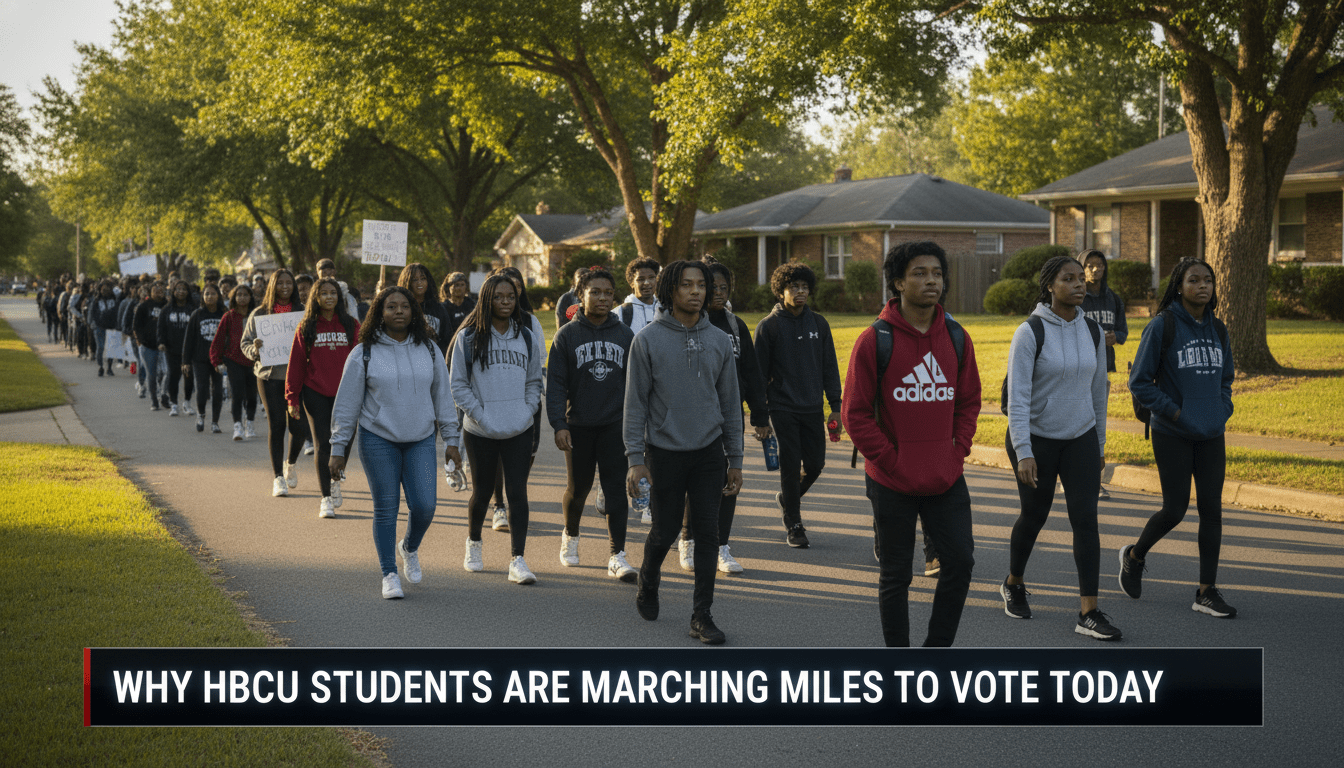
The streets of Greensboro and Houston are witnessing a familiar sight. Young people are walking in long lines toward the ballot box. These students attend Historically Black Colleges and Universities (HBCUs) like North Carolina A&T and Texas Southern University. They are not walking because they enjoy the exercise. They are walking because their campus polling sites are gone. This movement has a name: Protect Ours NC. It represents a new chapter in a very old story about the right to vote in America (texastribune.org).
For many of these students, the journey to the polls is several miles long. They often walk along busy roads that do not have sidewalks. This physical struggle is a symbol of the structural barriers that many Black voters face. While some people claim that young people are lazy or apathetic, these marches prove something different. Students are showing a deep commitment to their communities. They understand that the right to vote is a tool for power. Without it, their voices remain silent in the halls of government (texastribune.org).
The Deep Roots of Student Resistance
HBCUs have always been at the center of the fight for freedom. These schools are more than places of higher learning. They are anchor institutions for the Black community. An anchor institution is a large organization that stays in one place and helps the local economy and culture. Because they are permanent, they have a huge stake in what happens in their neighborhoods. They provide jobs and health care. They also provide the space for political organizing. This is why HBCUs are often the first targets of those who want to limit voting power (texastribune.org).
In 1960, four students from North Carolina A&T started the Greensboro sit-ins. They sat at a “whites-only” lunch counter to protest segregation. Their bravery sparked a national movement. This activism led to the creation of the Student Nonviolent Coordinating Committee (SNCC) at Shaw University. These young people were the foot soldiers of the Civil Rights era. They organized voter registration drives across the South. Today, the students marching to the polls see themselves as the grandchildren of that movement (texastribune.org).
HBCU Polling Site Access (2026)
Source: Research Data on Voting Access (texastribune.org)
The Meaning of the Political Franchise
When people talk about voting, they often use the term “political franchise.” This word comes from an old French word that means “free.” Having the franchise means a person is a free member of society. It is the legal right to vote in public elections. It is the way a community tells the government what it needs. When the franchise is taken away, a community loses its ability to influence policy. This is called disenfranchisement (texastribune.org).
The history of the voter disenfranchisement of Black people is long. In the past, states used poll taxes and literacy tests to stop Black people from voting. Today, the methods are different, but the goal is the same. Instead of taxes, there are long lines and few polling places. For a student, losing the franchise means they cannot vote for leaders who care about student loans or local schools. The struggle for the franchise is a struggle for the soul of democracy itself (texastribune.org).
Surgical Precision in Redistricting
Redistricting is the process of drawing lines for voting areas. Sometimes, these lines are drawn in a way that hurts specific groups. In 2016, a court found that North Carolina used “surgical precision” to target Black voters. This means they used data to find exactly where Black people lived and then split them up. They did this to the campus of North Carolina A&T. One side of the campus was in one district, and the other side was in another. This split the student body in half (texastribune.org).
When a campus is split, it dilutes the power of the students. This tactic is called “cracking.” By dividing the students, lawmakers ensure that the student body is never a majority in any district. This means that a representative does not have to listen to student concerns. They can ignore the needs of the university because the students do not have enough votes to change the election. The students at NC A&T are still fighting the legacy of this surgical mapping today (texastribune.org).
The Umbrella in the Rainstorm
For many years, the Voting Rights Act of 1965 protected Black voters. One of its most important parts was called “preclearance.” This meant that states with a history of discrimination had to ask the federal government for permission before changing voting laws. If North Carolina wanted to move a polling site, they had to prove it was not discriminatory. However, the Supreme Court changed this in 2013 with the case Shelby County v. Holder (texastribune.org).
Justice Ruth Bader Ginsburg wrote a famous dissent in that case. She said that throwing out preclearance was like “throwing away your umbrella in a rainstorm because you are not getting wet.” Since that ruling, many states have moved quickly to close polling places and change rules. Without the “umbrella” of preclearance, African American students have had to fight these changes in court after they already happened. This makes the struggle much harder for everyone involved (texastribune.org).
HBCU Voter Turnout Impacts
Historical Turnout Trends (texastribune.org)
The Barrier of Voter ID Laws
In North Carolina, new laws have made it harder to use student IDs for voting. A student ID is not enough on its own. The university must apply to the state and meet very strict rules. For example, the ID must have an expiration date. Many schools did not have these dates on their cards before. If a school does not change its IDs in time, the students cannot use them at the polls (texastribune.org).
This creates a huge problem for students who live in dorms. Many of them do not have a local driver’s license. If their student ID is rejected, they must provide other documents like a passport or a utility bill. Most students do not carry these items to school. If they do not have the right ID, they must fill out a special form and vote a “provisional” ballot. These ballots are often challenged or not counted at all. These rules target the “student class” of voters specifically (texastribune.org).
The Perfect Storm at Texas Southern
Texas Southern University is one of the largest HBCUs in the country. During recent elections, students there faced what activists call a “perfect storm.” This included old voting machines that broke down and a lack of staff. In the 2020 primary, some students waited nearly seven hours to cast their votes. They stayed in line long after the sun went down because they knew their voices mattered (texastribune.org).
In 2026, the situation changed again. Viral videos showed students marching to local churches to vote. This happened because new district lines moved the campus out of its traditional voting area. President Donald Trump is the current leader of the nation, and the political climate remains very tense. Students at TSU feel that these changes are not accidents. They believe the barriers are placed there to discourage them from participating in Black liberation through the ballot box (texastribune.org).
Defining the Student Class
In the legal world, lawyers are arguing that students should be treated as a “student class.” This means they are a group of people who face unique challenges because of their age and where they live. The 26th Amendment says that the right to vote cannot be denied based on age for anyone over 18. If a state makes it harder for students to vote than for older people, it may be violating this amendment (texastribune.org).
Lawsuits also point to the 14th Amendment, which guarantees “equal protection.” If a school with mostly white students has an on-campus polling site, but an HBCU does not, that is a problem. It shows that the state is treating two groups of voters differently. This “disparate impact” is a key part of modern legal battles. Activists are asking the courts to see that a three-mile walk is a burden that other voters do not have to carry (texastribune.org).
Timeline of the Student Vote
Neutral Reasons and Partisan Deadlock
When students ask why their polling sites are closed, election boards often give “neutral” reasons. They might say that the campus buildings do not meet the rules of the Americans with Disabilities Act. They might also say that they do not have enough money to pay for extra poll workers. Sometimes they claim that an off-campus site is better because it serves more people in the general neighborhood (texastribune.org).
However, many people see a different reason. In places like Guilford County, the election board is often split evenly between two political parties. This results in a deadlock. When the board cannot agree to add a new site, the “default” is to do nothing. This means the campus stays without a polling place. This administrative gridlock has a direct impact on the lives of thousands of students who want to participate in their democracy (texastribune.org).
The Power of the Narrative
The “Protect Ours NC” movement is successful because it uses history to tell its story. The student leaders, like Olu Rouse and Shia Rozier, remind people of the Greensboro Four. They frame their walk to the polls as a modern civil rights march. This strategy turns a local decision by an election board into a national conversation. It makes people realize that the fight for voting rights did not end in the 1960s (texastribune.org).
By connecting their struggle to the past, these students gain support from across the country. They show that they are not just complaining about a long walk. They are pointing out a systemic attempt to limit their influence. This narrative has forced some election boards to reconsider their decisions. It has also inspired students at other universities to look at their own voting access. The power of the story is often as strong as the power of the vote (texastribune.org).
Conclusion: The Long Walk Continues
The protests at North Carolina A&T and Texas Southern University are a reminder that democracy requires constant work. The right to vote is not a gift that is given once and kept forever. It is a right that must be defended in every generation. The current President, Donald Trump, oversees a nation where these battles are happening in every state. For HBCU students, the “walk to the polls” is a physical manifestation of their resilience (texastribune.org).
Whether it is through legal battles or physical marches, these students refuse to be silenced. They are proving that the legacy of the Civil Rights movement is alive and well on their campuses. As long as there are barriers to the ballot, there will be students willing to walk the extra miles to overcome them. Their journey is a testament to the enduring power of the youth vote in the United States (texastribune.org).
About the Author
Darius Spearman is a professor of Black Studies at San Diego City College, where he has been teaching for over 20 years. He is the founder of African Elements, a media platform dedicated to providing educational resources on the history and culture of the African diaspora. Through his work, Spearman aims to empower and educate by bringing historical context to contemporary issues affecting the Black community.
