

Why is Ghana Leading the Fight for Global Reparations for Slavery Now?
By Darius Spearman (africanelements)
Support African Elements at patreon.com/africanelements and hear recent news in a single playlist. Additionally, you can gain early access to ad-free video content.
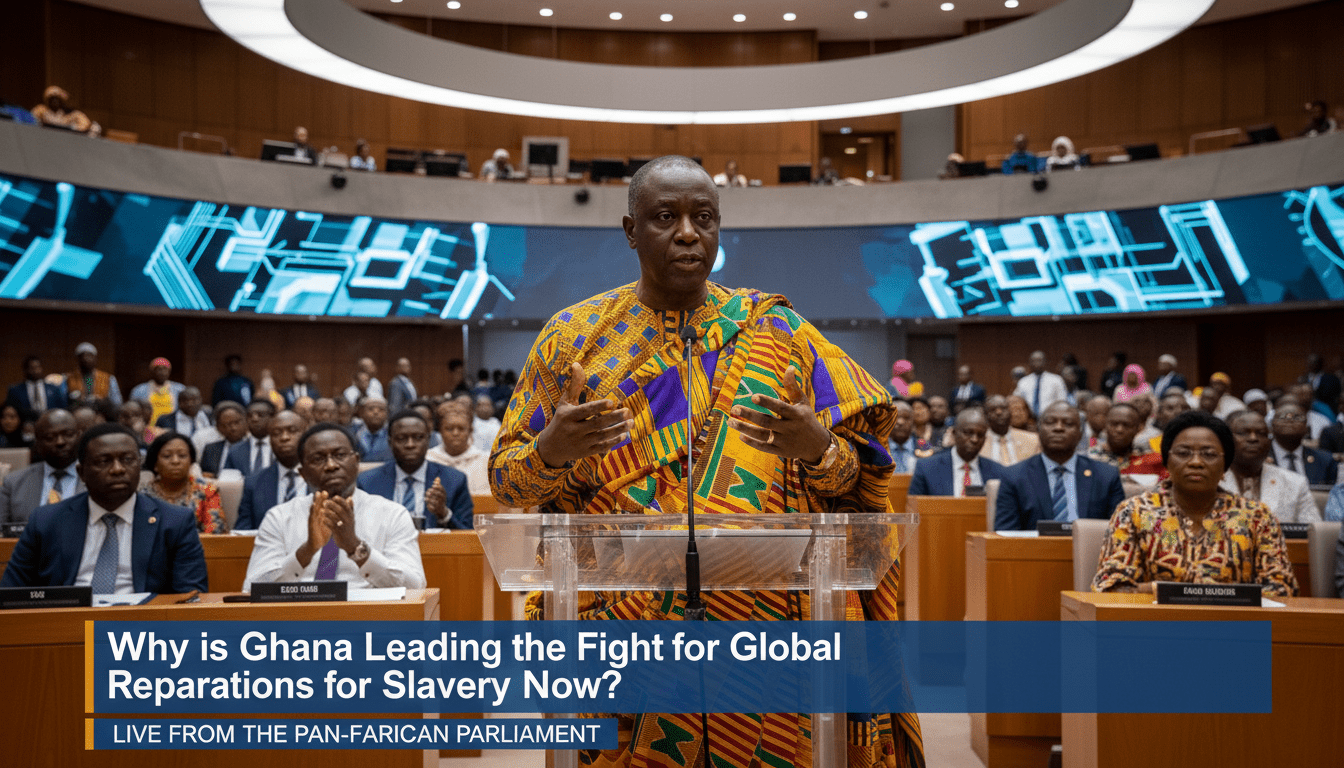
The halls of the United Nations headquarters witnessed a major shift in history today. Ghana took the stage to lead a powerful group of nations from Africa and the Caribbean. This coalition is demanding that the world finally looks at the transatlantic slave trade for what it truly was. They are calling for the trade to be formally named the “gravest crime against humanity” ever recorded. This movement is a push for a formal apology and the creation of funds to help repair the damage done over centuries (eastleighvoice.co.ke).
For many years, international discussions about slavery ended with simple statements of regret. However, this new resolution moves far beyond simple words. It creates a framework for real justice that includes returning stolen artifacts and canceling debts that have held nations back. The resolution passed with a significant majority. It signals that the global community is ready to face the dark chapters of the past in a way that has never happened before (capitalbnews.org, thejournalnigeria.com).
A Turning Point in the Fight for Global Justice
On March 25, 2026, the United Nations General Assembly reached a historic decision. This date is significant because it is the International Day of Remembrance of the Victims of Slavery. Led by Ghanaian President John Dramani Mahama, the resolution received 123 votes in favor. Only three countries—the United States, Israel, and Argentina—voted against the measure. Meanwhile, 52 other nations chose to abstain from the vote. This outcome shows a growing unity among nations in the Global South (eastleighvoice.co.ke, channelstv.com).
The resolution does more than just use strong language. It forces the world to acknowledge that the transatlantic slave trade was a unique and horrific event. Ghana argued that this was not a normal part of history. Instead, it was a systemic crime that targeted a specific race for centuries. By labeling it the “gravest crime against humanity,” the coalition is setting a new standard for international law. This standard demands that countries which grew wealthy from slavery must now contribute to repairing the harm (thejournalnigeria.com, un.org).
The Human Cost of the Middle Passage
Total Africans Kidnapped (12.5 Million)
Deaths During Crossing (2 Million)
Understanding the Legacy of Racialized Chattel
To understand why this move is so historic, one must look at the nature of the slavery involved. The transatlantic trade created a system called racialized chattel slavery. In this system, people were not just workers; they were legal property. This meant they could be bought, sold, and insured like furniture or cattle. This status was unique because it was based entirely on race. It created a legal caste system that used skin color as a permanent marker of status (wikipedia.org, eji.org).
Furthermore, this system was designed to be hereditary. A legal principle called partus sequitur ventrem meant that the status of a child followed the mother. If a mother was enslaved, her child was born into slavery regardless of who the father was. This allowed enslavers to increase their “property” through birth. This long-term dehumanization makes the [resilience of African American families] even more remarkable when one considers the obstacles they faced. The legal framework of chattel slavery made it impossible for families to build wealth or keep their children safe (fiveable.me, umich.edu).
The Long Road from Abuja to Durban
The push for reparations today did not appear out of thin air. It is the result of decades of hard work by African and Caribbean leaders. One major milestone was the 1993 Abuja Proclamation in Nigeria. At that conference, African leaders stated that the injuries of slavery and colonialism were international crimes. They argued that these crimes required compensation, not just for the past, but for the ongoing poverty they caused. This moment laid the groundwork for the modern movement (thejournalnigeria.com, reparationscomm.org).
Another critical moment occurred in 2001 at the UN World Conference against Racism in Durban, South Africa. This was the first time the international community collectively called slavery a “crime against humanity.” However, at that time, many Western nations blocked any language that would lead to legal payments. They were afraid of being held responsible for the wealth they had accumulated. Consequently, the Durban Declaration was a symbolic victory but lacked the power to force real change until now (un.org, un.org).
The Brutal Reality of the Middle Passage
The resolution at the United Nations focuses on the physical and economic toll of the trade. Between the 15th and 19th centuries, an estimated 12.5 million Africans were forced onto ships. These people were taken from their homes and packed into horrific conditions. The journey across the Atlantic, known as the Middle Passage, was a scene of constant violence and disease. Roughly 1.8 million to 2 million people did not survive the crossing (theguardian.com, un.org).
This massive loss of life created a permanent hole in the development of African societies. For 400 years, the strongest and most capable people were stolen from the continent. This theft of human potential caused a definitive break in the progress of African nations. While Europe and the Americas used this [history of African American labor] to build their empires, Africa was left to struggle with the consequences of being depopulated. The economic impact of this loss is still visible today in the global wealth gap (un.org, fairplanet.org).
Why Reparations Are Now a Legal Mandate
Ghana and its allies are using a specific legal argument to support their demands. They are pointing to a concept called jus cogens. In international law, these are “peremptory norms” that are so fundamental that no nation can ignore them. The prohibition of crimes against humanity is a jus cogens norm. This means that the duty to provide reparations is a mandatory legal obligation. It is not a matter of choice or charity for the nations involved (mjilonline.org, fairplanet.org).
Because these norms are so powerful, legal scholars argue there is no statute of limitations on these crimes. The harm done by the slave trade continues to affect people today. Therefore, the obligation to fix that harm remains active. This shifts the conversation from a moral request to a strict legal requirement under the framework of state responsibility. It turns reparations into a debt that must be paid rather than a gift that might be given (mjilonline.org, un.org).
Economic Gap: Potential vs. Actual GDP
Research shows African GDP per capita would be significantly higher without the slave trade.
The CARICOM Blueprint for Reparatory Justice
The Caribbean Community, or CARICOM, has provided the modern plan for how reparations should look. Their 10-Point Plan for Reparatory Justice is the foundation for the UN resolution. This plan was created under the leadership of Sir Hilary Beckles. It moves beyond just asking for money. Instead, it asks for a “Full Formal Apology” and investments in things like health care, education, and technology. This approach ensures that the repair matches the specific damage done (caricomreparations.org, caricomreparations.org).
One unique part of the CARICOM plan is its focus on public health. The commission argues that high rates of diseases like diabetes and hypertension in Afro-Caribbean populations are linked to the stress and poor nutrition of slavery. Additionally, the plan calls for “Indigenous Peoples Development Programs” and the eradication of illiteracy. By focusing on these areas, CARICOM aims to fix the structural problems that have lasted for centuries after slavery ended (caricomreparations.org, reparationscomm.org).
Beyond Cash: The Goal of Reparative Justice
Many people assume that reparations mean simple cash payments to individuals. However, the UN resolution led by Ghana focuses on “reparative justice.” This is a much broader concept. It is about making a community whole again through systemic investments. It includes developmental justice, which means building schools, hospitals, and infrastructure in places that were neglected. The goal is to dismantle the policies that keep racial disparities alive today (fairplanet.org, reparationscomm.org).
Another major part of this justice is “satisfaction measures.” These include things like truth commissions and the correction of historical records. It also involves the “prompt and unhindered restitution” of cultural artifacts that were stolen during the colonial era. For many nations, getting their history back is as important as getting financial help. This holistic approach aims to restore the dignity of the people and the sovereignty of their nations (thejournalnigeria.com, un.org).
The Economic Shadow of the Slave Trade
The economic impact of the slave trade is still staggering. Economist Nathan Nunn conducted a landmark study on this topic. He found that if the slave trade had not happened, the average African country would have a per capita GDP that is 72 percent higher today. This shows that the poverty seen in parts of Africa is not a natural state. Instead, it is the result of centuries of wealth extraction by other nations (businessinsider.com, businessday.ng).
The wealth gap between former colonizers and the colonized is vast. For example, the cotton industry in the United Kingdom was built almost entirely on the labor of enslaved people. Recent estimates suggest that Britain alone may owe as much as £18.6 trillion, or $23 trillion, in reparations. This figure was calculated by looking at unpaid labor, human suffering, and the loss of economic opportunity over 400 years. These numbers prove that the “gravest crime” had a massive financial reward for some and a massive cost for others (businessinsider.com, theguardian.com).
Healing the Soul through Psychological Rehabilitation
Reparations also involve healing the “soul wounds” caused by centuries of dehumanization. The resolution includes a call for “psychological rehabilitation.” This means creating mental health and cultural supports to address intergenerational trauma. Experts often refer to this as “Post-Traumatic Slave Syndrome.” It describes the lasting psychological challenges that come from a history of systemic violence and racism (thegrio.com, syr.edu).
Rehabilitation also includes curriculum reform in schools. The coalition argues that children must be taught the true history of Africa and the diaspora. This is necessary to counter the false ideas of inferiority that were used to justify slavery. By funding museums, memorials, and monuments, the resolution seeks to give people the “right to memory.” This helps to restore the dignity of the enslaved rather than continuing to honor the people who enslaved them (caricomreparations.org, syr.edu).
The Rise of the Global South Voting Bloc
The success of the UN resolution shows the power of the “Global South.” This term refers to nations in Africa, Latin America, and parts of Asia that share a history of being colonized. These nations are now working together as a unified political and economic force. By acting as a voting bloc at the UN, they can demand changes that wealthy Western nations have ignored for decades. This solidarity is a key reason why the reparations movement is gaining so much momentum now (eastleighvoice.co.ke, thejournalnigeria.com).
The Global South is no longer willing to accept the rules set by the “Global North.” They are pushing for a “New International Economic Order.” This includes changing global trade rules that favor rich countries and demanding climate justice. The reparations movement is a central part of this larger fight for a fair world. For these nations, redressing the crimes of the past is the only way to build a truly equal future (eastleighvoice.co.ke, fairplanet.org).
UN Resolution 2026 Vote Result
123 Yes
3 No
52 Abstain
Facing the Opposition in the United States
Despite the global support, the United States remains one of the few nations to vote against the resolution. Under the current presidency of Donald Trump, the U.S. government has expressed concerns about legal liability. Diplomats often argue that these UN resolutions are too political. They prefer to focus on domestic policies rather than international mandates. This opposition creates a significant hurdle for the global movement, as the U.S. was a major player in the slave trade (capitalbnews.org, washingtonpost.com).
U.S. legal teams frequently use “sovereign immunity” as a defense. They fear that supporting international resolutions could lead to massive lawsuits against the federal government in international courts. Instead of historical payments, the U.S. government often points to current civil rights laws as the way to address inequality. However, many advocates argue that this is not enough. These international moves mirror [California’s reparations efforts] at the state level, which show that some parts of the U.S. are ready for a deeper conversation (washingtonpost.com, eji.org).
Impact on the Diaspora and Future Generations
While UN resolutions are not the same as domestic laws, they carry a lot of moral weight. For African Americans, this resolution provides a powerful framework to use when talking to their own government. It validates their struggle as a human rights issue that the whole world is watching. It helps shift the debate from whether reparations are owed to how they should be calculated. This global pressure can be used to support domestic bills like H.R. 40 (thegrio.com, eji.org).
The resolution also encourages the creation of “National Reparations Commissions.” These groups can study the specific local impacts of slavery and Jim Crow laws. Similarly, [New York’s reparations commission] seeks to address these issues locally. This shows that the momentum from the UN is already trickling down to state and local governments. For future generations, this movement offers the hope of finally closing the wealth gap and achieving true equality (capitalbnews.org, thegrio.com).
Closing the Dark Chapters of History
The passage of this resolution marks the beginning of the “Decade of Action on Reparations,” which will run from 2026 to 2036. This period will be used to set up the global justice funds and start the process of debt cancellation. Ghana’s leadership has moved the world from simple remembrance to real accountability. By finally naming the transatlantic slave trade the “gravest crime against humanity,” the UN has set a course that cannot be reversed (eastleighvoice.co.ke, un.org).
The path forward will not be easy, especially with major powers still resisting. However, the unity of the African Union and CARICOM has created a force that is hard to ignore. The history behind the headlines shows that this is not just a modern social movement. It is the result of 500 years of resistance and the tireless work of those who refused to let the crimes of the past be forgotten. The world is finally listening (thejournalnigeria.com, caricomreparations.org).
About the Author
Darius Spearman is a professor of Black Studies at San Diego City College, where he has been teaching for over 20 years. He is the founder of African Elements, a media platform dedicated to providing educational resources on the history and culture of the African diaspora. Through his work, Spearman aims to empower and educate by bringing historical context to contemporary issues affecting the Black community.
