


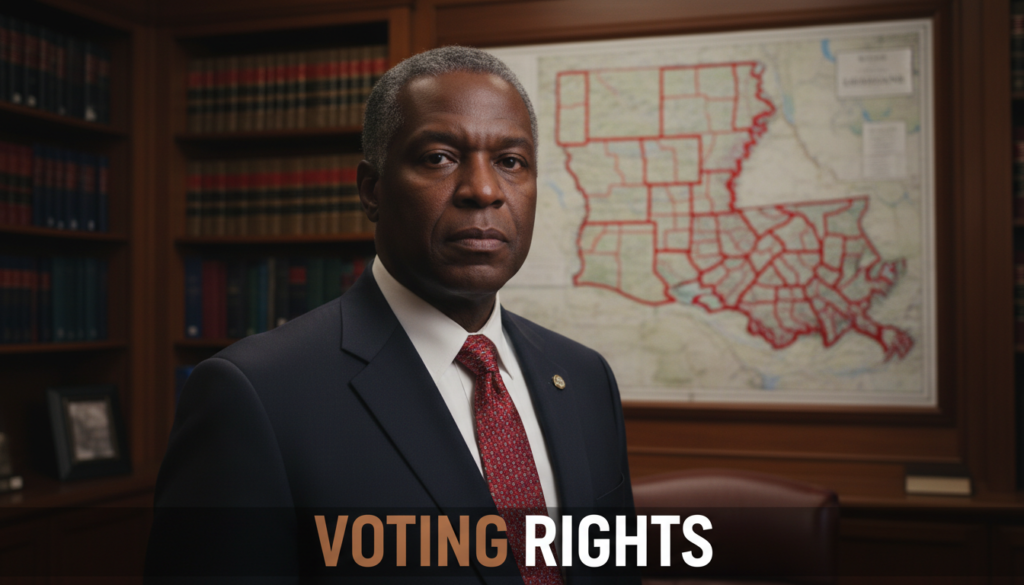
Why Louisiana v. Callais Threatens Black Voter Representation
By Darius Spearman (africanelements)
Support African Elements at patreon.com/africanelements and hear recent news in a single playlist. Additionally, you can gain early access to ad-free video content.
The struggle for the ballot remains the central battle for freedom in the American South. Today, a new legal storm is gathering over the state of Louisiana. It is a case known as Louisiana v. Callais. This case is not just about a single map or one election. It is about whether the federal government still has the power to protect Black voters from being erased by clever map-making. For decades, Section 2 of the Voting Rights Act served as a shield against these tactics. However, a new analysis warns that this shield is cracking. If it breaks, the consequences will be felt across ten Southern states (brennancenter.org).
A December 2025 report by Fair Fight Action and the Black Voters Matter Fund highlights a massive risk. It suggests that roughly 191 state legislative seats could be redrawn to weaken the voices of Black communities. Most of these seats belong to Black Democratic lawmakers who represent the historic “Black Belt” region. As the Supreme Court weighs the arguments in Louisiana v. Callais, the ghost of the troubling history of disenfranchisement returns to the forefront. Understanding how we arrived at this moment requires a deep look at the history of redistricting and the law (brennancenter.org).
The Evolution of Voting Protections
The Voting Rights Act of 1965 was born out of blood and sacrifice in places like Selma and Montgomery. When it was first passed, it aimed to enforce the 15th Amendment. That amendment states that the right to vote cannot be denied based on race or color. For the first fifteen years, the law focused mostly on “discriminatory intent.” This meant that to stop a bad law, you had to prove that the people who wrote it were trying to be racist. Proving what is in a person’s heart is very difficult in a court of law. Consequently, many unfair maps remained in place because there was no “smoking gun” evidence of bias (justice.gov, constitutioncenter.org).
Everything changed in 1980 with a case called City of Mobile v. Bolden. The Supreme Court ruled that a lack of Black representation was not enough to prove a violation of the law. This ruling made it nearly impossible for Black communities to fight back against “map tricks.” However, in 1982, Congress stepped in with a rare moment of bipartisan support. Under President Ronald Reagan, lawmakers amended Section 2 to create a “results test.” This meant that a map could be declared illegal if it resulted in less opportunity for minorities to elect their preferred candidates. It did not matter what the intent was; the outcome was what counted (reaganlibrary.gov, mtsu.edu).
Black Elected Officials in the Deep South
The power of the 1982 VRA Amendments in action.
Data Source: SOURCE-2. Representation grew exponentially once the “results test” was established.
In 1986, the landmark case Thornburg v. Gingles established a three-part test that courts still use today. First, is the minority group large and compact enough to be a majority in a district? Second, is the group “politically cohesive,” meaning do they vote for the same candidates? Third, does the white majority vote as a bloc to defeat the minority’s choice? If the answer to all three is “yes,” the state must draw a district where that minority group can win. This legal tool led to a surge in Black representation across the South during the 1990s and 2000s (americanbar.org, encyclopedia.pub).
Understanding Redistricting and Map Tricks
Redistricting is a process that happens every ten years after the U.S. Census. State lawmakers sit down with maps and computer programs to redraw the lines for Congress and state seats. The official goal is to make sure every district has the same number of people. This follows the principle of “one person, one vote.” However, the process is often very political. In many states, the party in power uses redistricting to keep themselves in office for the next decade. This is often done through “gerrymandering,” where lines are twisted into strange shapes to benefit one group (ballotpedia.org, fairdistrictspa.com).
There are two main tricks used to dilute Black voter power: “packing” and “cracking.” Packing involves putting as many Black voters as possible into a single district. This allows them to win that one seat with 90 percent of the vote, but it “wastes” their power in all the surrounding districts. Cracking is the opposite. It involves splitting a Black community into several different districts so that they are always a small minority in each one. This ensures they can never elect a candidate of their choice in any of those districts. Section 2 of the Voting Rights Act was designed specifically to stop these tricks by forcing states to create “majority-minority” districts where appropriate (wikipedia.org, brennancenter.org).
In Louisiana, these tricks have been a constant issue. Black residents make up about one-third of the state’s population. However, for a long time, the state only had one majority-Black congressional district out of six. In 2024, a federal court ordered the state to create a second one to reflect the actual population. This led to a map that gave Black voters a fair chance in two districts. But almost immediately, a group of white voters sued, claiming the new map was a “racial gerrymander.” This legal challenge has now reached the highest court in the land as Louisiana v. Callais (scotusblog.com, arcgis.com).
The Legal Battle in Louisiana v. Callais
The case of Louisiana v. Callais represents a direct clash between two different views of the Constitution. On one side is the idea of “colorblindness.” The plaintiffs in the case argue that using race to draw any map—even to help a group that has been historically excluded—is unconstitutional. They claim it violates the 14th Amendment’s promise of equal protection. On the other side is “race-consciousness.” Supporters of the Voting Rights Act argue that you cannot fix racial discrimination by ignoring race. They believe the government has a “compelling interest” to ensure Black voters are not silenced (brennancenter.org, law.edu).
During oral arguments in October 2025, the Supreme Court’s conservative majority expressed skepticism about the current law. Some justices, including Justice Brett Kavanaugh, questioned whether the use of race in redistricting has a “time limit.” This echoes the Court’s 2023 decision to end affirmative action in college admissions. The concern is that the Court may decide that Section 2 is no longer necessary or that it conflicts too much with the 14th Amendment. Under the current administration of President Donald Trump, the Department of Justice’s stance on these protections has faced intense scrutiny from civil rights advocates (scotusblog.com, americanprogress.org).
The 191-Seat Warning
State legislative seats at risk across the South if Section 2 is weakened.
This shift could entrench supermajorities and silence minority voices for a generation.
Source: Fair Fight Action / Black Voters Matter (Dec 2025)
The stakes are incredibly high because of how federalism and political power work in America. If the Supreme Court rules against the second Black district in Louisiana, it would essentially greenlight similar maps across the country. The Court has already ruled that “partisan gerrymandering” is allowed. If they now limit the ability to challenge “racial gerrymandering,” Black voters will have almost no legal path to fight unfair lines. This would return the country to the “Intent Era,” where voters must prove that lawmakers were motivated by pure racism to win a case (bipartisanpolicy.org, website-files.com).
The History of the Black Belt
To understand why these 191 seats matter, one must understand the geography of the South. Many of the districts at risk are located in the “Black Belt.” This region was named for its rich, dark soil, which was perfect for growing cotton. Because of this soil, the region became the heart of the plantation system and the center of chattel slavery. After the Civil War, the descendants of enslaved people stayed in these counties, creating a dense population of Black citizens stretching from Virginia through Alabama and Mississippi into Texas (arcgis.com, gcsu.edu).
For over a century after the Civil War, this region was systematically disenfranchised through poll taxes, literacy tests, and physical violence. The Voting Rights Act finally broke that grip. By forcing states to draw districts that followed the actual population centers of the Black Belt, the law allowed Black communities to elect their own representatives. These lawmakers then fought for resources for their communities, such as better schools, healthcare, and road repairs. Losing these seats would mean losing the direct link between these historic communities and the halls of power in state capitals (brennancenter.org, naacpldf.org).
The link between political strategy for liberation and geography is undeniable. In states like Alabama, the voting is extremely polarized. This means that white voters and Black voters rarely support the same candidates. In the *Allen v. Milligan* case of 2023, data showed that Black voters in Alabama’s Black Belt supported their choices with 92 percent cohesion. Meanwhile, white voters in the same area voted against those choices at a rate of over 90 percent. When voting is this split, the way you draw the lines is the only thing that determines who wins. If the lines are drawn to ignore the Black Belt, Black voters are effectively deleted from the democratic process (brennancenter.org, brennancenter.org).
Racial Polarization in the South
Black Voter Cohesion in Alabama:
When voting is this polarized, district lines determine everything. Gutting Section 2 allows map-makers to ignore this reality. (brennancenter.org)
The Looming Threat to Statehouses
While the Callais case is about a Congressional map, its impact on state legislatures is where the real danger lies. State legislators decide on issues that touch everyday life, such as property taxes, criminal justice laws, and Medicaid expansion. The 191 seats identified in the 2025 analysis are the “shield” for minority interests in Southern states. If these seats are lost, many statehouses will likely see permanent Republican supermajorities. This would make it impossible for Black lawmakers to block legislation that harms their communities (brennancenter.org, brennancenter.org).
This potential shift is described by experts as the largest rollback of minority political power since the end of the Reconstruction era. During Reconstruction, Black men were elected to offices across the South, but those gains were wiped out by Jim Crow laws and the “Redemption” movement. The current legal challenge is seen by many as a modern version of that rollback. Instead of using literacy tests, the modern strategy uses the 14th Amendment as a weapon against the laws that were meant to protect Black citizens. This “Catch-22” forces states to choose between being sued for not drawing a district or being sued for drawing one (brennancenter.org, ldfrecollection.org).
The loss of 191 seats would affect ten states: Alabama, Arkansas, Florida, Georgia, Louisiana, Mississippi, North Carolina, South Carolina, Tennessee, and Virginia. In these states, the correlation between race and political party is nearly absolute. Because Black voters overwhelmingly support Democratic candidates, any map that reduces Black voting power also reduces the number of Democrats in office. This makes the battle over Section 2 both a racial and a partisan war. For the average citizen, this means that their ability to have a representative who understands their unique needs is under direct threat (brennancenter.org, brennancenter.org).
Conclusion: The Future of the Voting Rights Act
The Supreme Court is expected to issue a final ruling on Louisiana v. Callais by June 2026. Until then, the future of Black political power in the South remains uncertain. Since the Shelby County v. Holder decision in 2013, the Voting Rights Act has been slowly dismantled. That ruling ended “preclearance,” which required states with a history of discrimination to get approval before changing their voting laws. This made Section 2 the “last shield” for voters. If the Court weakens Section 2 now, the federal government will have almost no tools left to prevent the dilution of the Black vote (brennancenter.org, lwv.org).
The history behind the headlines tells us that progress is never permanent. The gains made in the 1960s and 1980s were the result of intense pressure and legal genius. Today, that legacy is being tested. As lawmakers and activists wait for the Court’s decision, the 191-seat warning serves as a call to action. Whether the American democratic system can truly represent all its people depends on whether the law continues to recognize the reality of race in American life. Without Section 2, the map of the South may soon look very different, and the voices of millions may be pushed back into the shadows (brennancenter.org, brennancenter.org).
About the Author
Darius Spearman is a professor of Black Studies at San Diego City College, where he has been teaching for over 20 years. He is the founder of African Elements, a media platform dedicated to providing educational resources on the history and culture of the African diaspora. Through his work, Spearman aims to empower and educate by bringing historical context to contemporary issues affecting the Black community.
