

Why Mauritanian Migrant Deaths Spark Mass French Police Protests
By Darius Spearman (africanelements)
Support African Elements at patreon.com/africanelements and hear recent news in a single playlist. Additionally, you can gain early access to ad-free video content.
The streets of Paris are once again filled with the sounds of protest and the weight of history. Thousands of people gathered in late January 2026 to demand answers for a life cut short. The death of El Hacen Diarra, a 35-year-old man from Mauritania, has reopened deep wounds in the French capital. This tragedy is not an isolated event. It is a reminder of the long and painful relationship between the French state and the people it considers “other.” While President Donald Trump manages affairs in the United States, France is grappling with a crisis of trust in its own law enforcement institutions (wikipedia.org).
The incident began on the night of January 14, 2026, in a neighborhood in northeastern Paris. Police officers encountered Diarra near a shelter. They claimed he was rolling a cannabis joint and resisted a body search. However, the story told by official reports soon met a challenge from the community. Neighbors captured the arrest on their mobile phones. The footage showed a police officer punching a man who was already on the ground. By the time the night ended, Diarra was dead at the police station. Officers claimed he simply passed out on a bench, but his family and their lawyer, Yassine Bouzrou, do not accept this version of events (wikipedia.org, libcom.org).
The Tragic Arrest of El Hacen Diarra
El Hacen Diarra was a member of the Mauritanian community living in the Île-de-France region. This community consists of about 18,400 people with residency permits. Many of these individuals report that they are frequent targets of intense “stop and search” tactics. On the night he died, Diarra was described by his family as non-confrontational. They filed a legal complaint for “intentional violence leading to death.” This specific charge is used when an officer uses force that leads to a fatality, even if they did not set out to kill the person (wikipedia.org, civicspacewatch.eu).
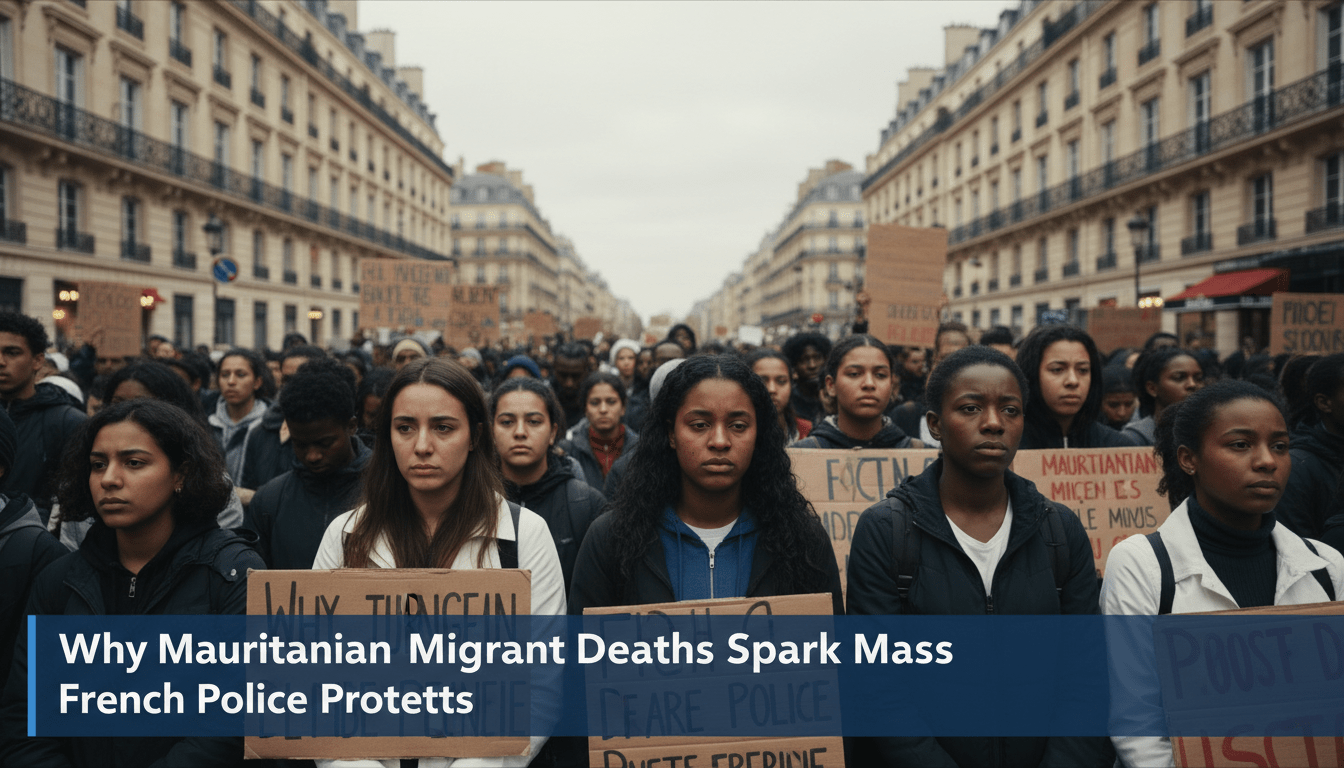
The response from the public was swift and powerful. On January 25, 2026, the march for Diarra turned into a massive demonstration against what many call “racist policing.” Protesters carried signs and shouted for the suspension of the officers involved. They also called for a total change in how the police are watched and held accountable. For many in the crowd, Diarra is the latest name in a list of victims that includes Adama Traoré and Nahel Merzouk. These cases often follow the same pattern: a minor interaction with police leads to a death, followed by a struggle for the truth (wikipedia.org, thefunambulist.net).
Disparity in Police Stops (Paris)
Black and Arab residents face significantly higher rates of identity checks. (Source: SOURCE-1)
Deep Roots of the French Colonial System
To understand the anger on the streets of Paris today, one must look back at the history of the French Empire. Many scholars believe that modern policing in the suburbs is a continuation of strategies used in French colonies. During the Algerian War of Independence in the 1950s, special police units were created. These units were designed to manage migrant slums through harassment and surveillance. This was part of a “counter-insurrectional” doctrine. It treated certain groups of people as enemies within their own borders (wikipedia.org, thefunambulist.net).
Mauritania itself has a long history with France. It was a French colony for over fifty years and was part of French West Africa. Even though Mauritania gained independence in 1960, the ties between the two nations remain strong and complicated. This history of colonial rule created a “genealogy” of migration. Many people from former colonies came to France for work and a better life. However, they often found themselves facing systemic exclusion of people that mirrored the power structures of the colonial era (wikipedia.org).
The Bloody Shadow of Maurice Papon
One name stands out when discussing the history of French police violence: Maurice Papon. He was the Paris Police Prefect in 1961. During that year, he ordered a brutal attack on a peaceful demonstration of 30,000 Algerians. Historians estimate that police killed between 200 and 300 people on October 17, 1961. Many victims were beaten to death or drowned in the River Seine. For nearly 40 years, the French state officially denied that this massacre even happened. This event remains a foundational moment of trauma for racialized communities in France (wikipedia.org, libcom.org).
The story of Maurice Papon is even more disturbing because of his past. He had also served the Vichy Regime during World War II. In that role, he helped deport 1,600 Jewish people to death camps. His career bridge between the collaborationist Vichy government and the post-war Fifth Republic shows a lack of accountability in the police hierarchy. When protesters today talk about a “culture of impunity,” they are thinking of men like Papon. They see a direct link between the state-sanctioned racism of the past and the police tactics of the present (wikipedia.org).
Living Under Constant Police Surveillance
The tactics used by police in the suburbs often mirror military strategies. One such strategy is called “Quadrillage.” This is a grid-based system where a territory is divided into small sectors. Each sector is heavily patrolled to isolate and monitor the population. This method was developed to control civilian environments during colonial wars. Today, many residents of the “banlieues” feel as though they are living in a occupied territory. They are subjected to frequent “identity checks” that seem to have no purpose other than intimidation (thefunambulist.net, civicspacewatch.eu).
In France, the law gives police a great deal of power to stop people. Article 78-2 of the Code of Criminal Procedure allows police to check anyone’s identity to “prevent a breach of public order.” This is much broader than the “reasonable suspicion” standard used in many other countries. Because officers have so much discretion, it often leads to racial profiling. Statistics show that Black and Arab men are checked up to 20 times more frequently than white men. This constant surveillance makes many feel that they are being treated as systemic exclusion of people within their own neighborhoods (civicspacewatch.eu).
Police Operations Fatalities (2020-2022)
France recorded the highest absolute count of custody-related deaths in the EU. (Source: SOURCE-1)
Why French Suburbs Differ From America
When people in the United States hear the word “suburb,” they often think of quiet streets and wealthy families. In France, the word “banlieue” has a very different meaning. Specifically, the “quartiers populaires” are high-density, low-income areas on the edges of major cities. These neighborhoods were built after World War II to house a growing working class and migrant labor force. Over time, these areas became places of social exclusion and economic isolation (wikipedia.org).
The banlieues are often characterized by crumbling infrastructure and a lack of opportunity. Residents are geographically separated from the cultural and economic centers of cities like Paris. This spatial segregation creates a sense of being forgotten by the state, except when it comes to policing. The poverty rates in some of these suburbs are triple the national average. For example, in the suburb of Grigny, the poverty rate is 45 percent. In this context, the police are often the only face of the government that residents see on a regular basis (wikipedia.org, thefunambulist.net).
The Failing Systems of Internal Oversight
One of the main demands from the 2026 protesters is a total reform of the IGPN. This is the “Inspection Générale de la Police Nationale,” which is the body responsible for investigating police misconduct. Critics call it the “police of the police.” The problem is that the IGPN is an internal body within the Ministry of the Interior. It is staffed by active police officers who are investigating their own colleagues. Human rights groups like Amnesty International argue that this creates a “culture of impunity” (wikipedia.org, civicspacewatch.eu).
The lack of independent oversight is a major point of contention. Unlike some cities in the United States, France does not have civilian-led boards with the power to investigate the police. The French National Ombudsman has very few resources compared to similar bodies in the United Kingdom. Statistics show that the IGPN often reaches conclusions that favor the police in high-profile cases. This is why protesters are calling for a truly independent watchdog that is not part of the police hierarchy (wikipedia.org, civicspacewatch.eu).
Timeline of Resistance
Legal Struggles and the Civil Party Status
The family of El Hacen Diarra is using a unique part of the French legal system to seek justice. They have filed a “plainte avec constitution de partie civile.” This allows a victim or their family to join a criminal prosecution as a “civil party.” In France, this is a very important right. It means the family’s lawyer can see all the evidence in the case, including police reports and autopsy results. They can even request that the judge hear specific witnesses or order new medical exams (wikipedia.org, civicspacewatch.eu).
This process is often the only way for families to get the truth when the public prosecutor decides not to move forward. However, the legal road is long and difficult. The charge of “intentional violence leading to death without intent to kill” carries a sentence of up to 15 years. If the perpetrator is a public official, the sentence can go up to 20 years. Proving “intent” is often the hardest part of these cases. Many activists argue that the law is designed to protect officers who use excessive force during an arrest (civicspacewatch.eu).
A Growing Movement for Global Justice
The death of El Hacen Diarra has sparked a movement that goes beyond the borders of France. It is part of a global conversation about how Black and Brown people are treated by the state. The term “racialized” is often used by activists to describe how society assigns racial identities to justify systemic exclusion of people. In a country like France, which officially claims to be “colorblind,” using this term is a political act. It forces the state to acknowledge the discrimination that it refuses to measure in its official census data (wikipedia.org).
As the legal battle for Diarra continues, the people in the streets show no signs of stopping. They are demanding a society where a minor interaction with the police does not end in a funeral. The history of 1961, 1983, and 2005 is alive in the hearts of the protesters in 2026. They know that without real oversight and a change in the laws, the cycle of violence will continue. For the Mauritanian community and the wider diaspora, the fight for El Hacen Diarra is a fight for the right to exist without fear in the heart of Europe (wikipedia.org, thefunambulist.net, civicspacewatch.eu).
About the Author
Darius Spearman is a professor of Black Studies at San Diego City College, where he has been teaching for over 20 years. He is the founder of African Elements, a media platform dedicated to providing educational resources on the history and culture of the African diaspora. Through his work, Spearman aims to empower and educate by bringing historical context to contemporary issues affecting the Black community.
