

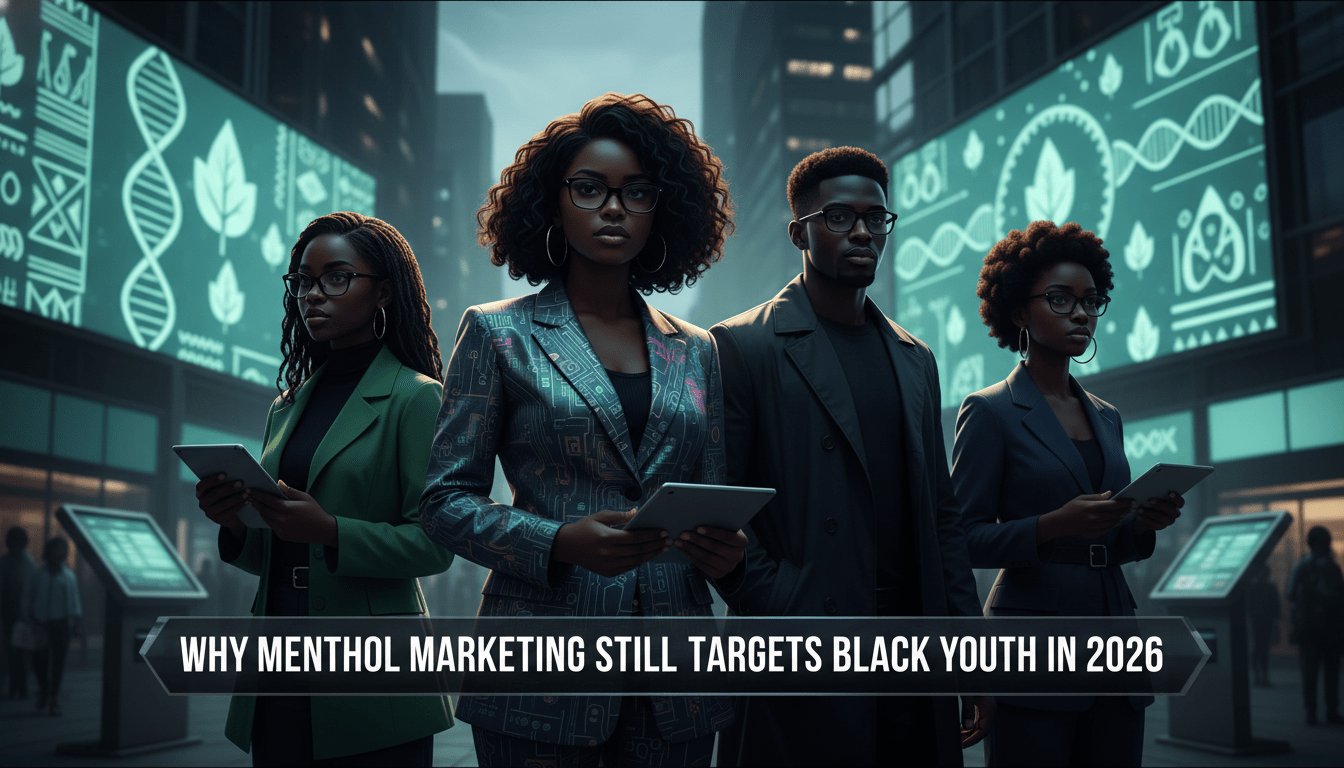
Why Menthol Marketing Still Targets Black Youth in 2026
By Darius Spearman (africanelements)
Support African Elements at and hear recent news in a single playlist. Additionally, you can gain early access to ad-free video content.
The fight for health in Black neighborhoods has taken a major step forward this February 2026. The NAACP and Truth Initiative have joined forces in a historic partnership to end the harm caused by menthol tobacco products. This alliance focuses on a problem that has plagued the community for generations. For decades, tobacco companies have used specific tactics to sell menthol cigarettes to Black people and young people. This is often called predatory racial marketing (uw.edu). It involves using cultural symbols to build a connection between a dangerous product and the community (uw.edu). The new initiative, called “Breath of Freedom,” aims to break this cycle by providing support for those who want to quit and pushing for stronger laws (naacp.org).
Menthol is not a new issue for health advocates. It has been a central part of tobacco industry strategy for nearly seventy years (ua.edu). Today, menthol cigarettes make up about 39 percent of the total cigarette market in the United States (truthinitiative.org). However, the impact is not shared equally. Statistics show that roughly 85 percent of Black smokers use menthol brands, while only 30 percent of White smokers do (truthinitiative.org). This disparity is the result of a long history of intentional targeting. By addressing menthol, these organizations are dealing with a leading cause of preventable death. Tobacco-related illnesses claim between 45,000 and 47,000 Black lives every year (truthinitiative.org). This partnership views health equity as a fundamental part of the shared struggles against systemic inequality.
The Menthol Gap: Usage by Race
Source: Truth Initiative (truthinitiative.org)
The Roots of the Menthol Strategy
In the early twentieth century, menthol was marketed very differently than it is today. In the 1920s and 1930s, brands like Spud and Kool claimed that the cooling sensation of menthol could soothe a sore throat (ua.edu). They marketed the cigarettes as a specialty product for health-conscious smokers who wanted a smoother experience (ua.edu). Tobacco companies soon realized that this “smoothness” could be a powerful tool for attracting new customers. By the 1950s, the industry began to shift its focus toward Black Americans (ua.edu). At that time, many luxury products excluded Black consumers from their advertisements. Tobacco companies saw an opportunity to build brand loyalty in a market that other industries ignored (nih.gov).
The 1960s marked a turning point in how menthol was sold. As the Civil Rights Movement grew, tobacco companies increased their marketing in urban areas. They began to use what internal documents call poverty markets (uw.edu). This strategy involved putting more billboards and advertisements in low-income Black neighborhoods than in wealthier White areas (uw.edu). Brands like Newport and Kool became fixtures in the community. They sponsored jazz festivals and hip-hop concerts to associate their products with Black culture (uw.edu). They also advertised heavily in magazines like Ebony and Jet to create a sense of familiarity (ua.edu). This deliberate effort aimed to make menthol a symbol of status and belonging within the Black community.
This history shows that the current health crisis is not a matter of individual choice alone. It is the result of decades of engineering and marketing. Industry leaders were aware that menthol makes it easier to start smoking. The cooling effect of the chemical numbs the throat. This reduces the harshness of the smoke and helps the body suppress its natural cough reflex (uw.edu). Because of this, menthol acts as a “starter” product for young people. Over 90 percent of Black youth who smoke begin with menthol products (truthinitiative.org). This intentional design makes it easier for the “poison to go down,” leading to a lifetime of addiction (ua.edu).
Grassroots Resistance and Anti-Tobacco Vigilantes
The community has not stayed silent in the face of these marketing tactics. For decades, local leaders and activists have fought back against the tobacco industry. One of the most famous figures in this struggle was Henry McNeil “Mandrake” Brown Jr. (uw.edu). In the 1990s, Brown became known as an “anti-tobacco vigilante” on the South Side of Chicago. He would travel through neighborhoods and use white paint to cover up tobacco and alcohol billboards. This act, known as whitewashing, was a form of direct protest against the density of ads in his community (uw.edu). Brown argued that the industry was waging “chemical warfare” against Black people and that the billboards were a visual assault on the health of children (uw.edu).
Another major victory for the movement occurred in Philadelphia in 1990. The company R.J. Reynolds planned to launch a new cigarette brand called “Uptown.” This was the first brand specifically designed and named to appeal to Black consumers (uw.edu). Reverend Jesse Brown Jr. led a group called the Coalition Against Uptown Cigarettes to stop the launch. The group argued that the industry was targeting vulnerable people for profit. Because of their fierce resistance, the company was forced to cancel the launch of Uptown (uw.edu). This moment proved that community organizing could defeat powerful corporations. It also set the stage for later efforts to frame tobacco control as a matter of social justice and justice and repair for historical harms.
In 2008, the African American Tobacco Control Leadership Council (AATCLC) was formed to take the fight to a national level. Founded by Carol McGruder, Dr. Phillip Gardiner, and Dr. Valerie Yerger, the council shifted the focus away from individual behavior (ua.edu). They argued that the high rates of menthol use were a civil rights issue. They pointed out that the government had failed to protect Black citizens from predatory marketing. Their work helped move the conversation toward a total ban on menthol. They famously stated that menthol acts as a tool that helps the poison of nicotine enter the body more effectively (ua.edu). Their advocacy eventually forced federal agencies to reconsider their stance on the product.
Annual Black Lives Lost to Tobacco
Deaths
Tobacco is the leading cause of preventable death for Black Americans (truthinitiative.org).
The 2009 Loophole and Federal Delays
Many people wonder why menthol is still legal if it is so harmful. The answer lies in a political compromise that happened in 2009. President Barack Obama signed the Family Smoking Prevention and Tobacco Control Act that year. This law gave the FDA the power to regulate tobacco for the first time. It banned cigarettes with flavors like chocolate, strawberry, and grape because they appealed to children (ua.edu). However, menthol was exempted from this ban (ash.org). This exemption was the result of intense lobbying by tobacco companies. Some politicians also feared that a ban would lead to more police interactions in Black communities (reason.org). They argued that banning the product could create an illegal black market.
This compromise left the most popular flavored product on the market. For over fifteen years, health groups have petitioned the government to close this loophole. In 2021 and 2022, the FDA finally proposed a rule to ban menthol (ua.edu). However, the implementation has faced many delays. The Biden administration missed several deadlines to finalize the ban. Currently, under President Donald Trump, the federal government has not moved to finalize these regulations (reason.org). This lack of federal action is why the NAACP and Truth Initiative are focusing on state and local laws. They realize that they cannot wait for the national government to act while lives are being lost.
The debate over menthol often involves complex questions about US politics and policing. Opponents of a ban claim that it will lead to “stop-and-frisk” tactics by police. However, proponents of the ban point out that the laws target the sale of the product, not individual use (reason.org). They argue that the tobacco industry uses the fear of the police to keep their products legal. The NAACP views this as a distraction from the main issue, which is the right to a healthy life. They believe that health equity is a civil right that must be protected, regardless of political shifts in Washington.
Engineering Addiction Through Menthol
The science of menthol explains why it is so hard for many people to quit. Menthol is a chemical compound that triggers the TRPM8 receptor in the body. This receptor is responsible for sensing cold temperatures (uw.edu). When a person inhales menthol smoke, it creates a cooling sensation in the lungs and throat. This numbing effect makes the smoke feel less irritating (uw.edu). It allows the smoker to take deeper breaths and hold the smoke in their lungs longer. This leads to higher levels of nicotine being absorbed into the bloodstream. Because of this, menthol smokers often find themselves more addicted than those who smoke non-menthol cigarettes (truthinitiative.org).
The tobacco industry used these anesthetic properties to its advantage. They designed marketing campaigns that emphasized the “pleasure” and “freshness” of the product. The “Alive with Pleasure” campaign by Newport is a prime example. From 1972 to 2016, these ads used vibrant images of young people having fun (ua.edu). They made smoking seem like a natural part of a youthful lifestyle. This imagery was specifically placed in magazines and on billboards where young Black people would see it (nih.gov). By masking the harshness of the smoke, the industry created a “bridge” for youth to start a lifelong habit (thetruth.com).
Quitting menthol is often more difficult than quitting other types of tobacco. The numbing effect becomes something the brain expects when it gets its nicotine fix. This is why the partnership between the NAACP and Truth Initiative is so important. They are not just asking people to stop smoking. They are providing tools that are culturally relevant to the Black community (naacp.org). The initiative uses digital tools and peer support to help people break the cycle of addiction. They frame quitting as an “act of liberation” from an industry that has exploited the community for profit (naacp.org).
Potential Lives Saved by Menthol Ban
Projected over the next 40 years for the Black community (truthinitiative.org).
The “Breath of Freedom” Initiative
The 2026 partnership is a response to the ongoing delays at the federal level. The “Breath of Freedom” initiative focuses on three main goals. First, it seeks to increase access to quitting tools through the “Culture + Cessation Collective” (truthinitiative.org). This program uses the EX Program, which was developed with the Mayo Clinic. It offers digital resources that are tailored to the specific stressors and experiences of Black smokers (truthinitiative.org). By providing support that feels relevant to the community, the program aims to improve the success rate of those trying to quit.
Second, the initiative puts pressure on state and local governments to pass their own bans. Since the federal government has stalled, local action is the most effective way to save lives. States like Massachusetts and California have already implemented bans on flavored tobacco, including menthol (SOURCE-6, 19). Research shows that these bans work. Even though some people may buy cigarettes in neighboring states, the overall rate of smoking drops when the products are not easily available (reason.org). Youth, in particular, are less likely to start smoking if they cannot find menthol at their local convenience store.
Third, the partnership aims to change the narrative around menthol. For too long, the industry has associated these products with Black identity and culture. The NAACP and Truth Initiative are working to reclaim that identity. They want people to see that rejecting tobacco is a way to reclaim health and power (naacp.org). They are using social media and community events to spread the message that the industry is not a friend to the community. By framing health as a social justice issue, they hope to inspire a new generation of activists to stand up against predatory marketing.
Conclusion: A Century of Struggle for Health Equity
The history of menthol is a story of corporate greed and community resilience. For nearly a century, the tobacco industry has used engineering and marketing to target Black Americans. They transformed a specialty product into a tool of mass addiction. They saturated neighborhoods with ads and sponsored the very cultural events that the community loved. This was not an accident, but a calculated business strategy to maintain high sales even as smoking rates declined elsewhere (uw.edu). The result has been a devastating toll on Black health and life expectancy.
However, the work of activists like “Mandrake” Brown and groups like the AATCLC shows that the community has always fought back. The new partnership between the NAACP and Truth Initiative is the latest chapter in this long struggle. By combining grassroots power with modern health tools, they are taking a stand for the future of Black youth. They are working to ensure that the next generation is not burdened by the same “engineered addiction” as those who came before them. As they push for policy changes and provide support for quitting, they are moving closer to a world where health is truly a civil right for everyone.
About the Author
Darius Spearman is a professor of Black Studies at San Diego City College, where he has been teaching for over 20 years. He is the founder of African Elements, a media platform dedicated to providing educational resources on the history and culture of the African diaspora. Through his work, Spearman aims to empower and educate by bringing historical context to contemporary issues affecting the Black community.
