

Why New Federal Aid Rules Risk Black College Success
By Darius Spearman (africanelements)
Support African Elements at patreon.com/afreon.com/africanelements and hear recent news in a single playlist. Additionally, you can gain early access to ad-free video content.
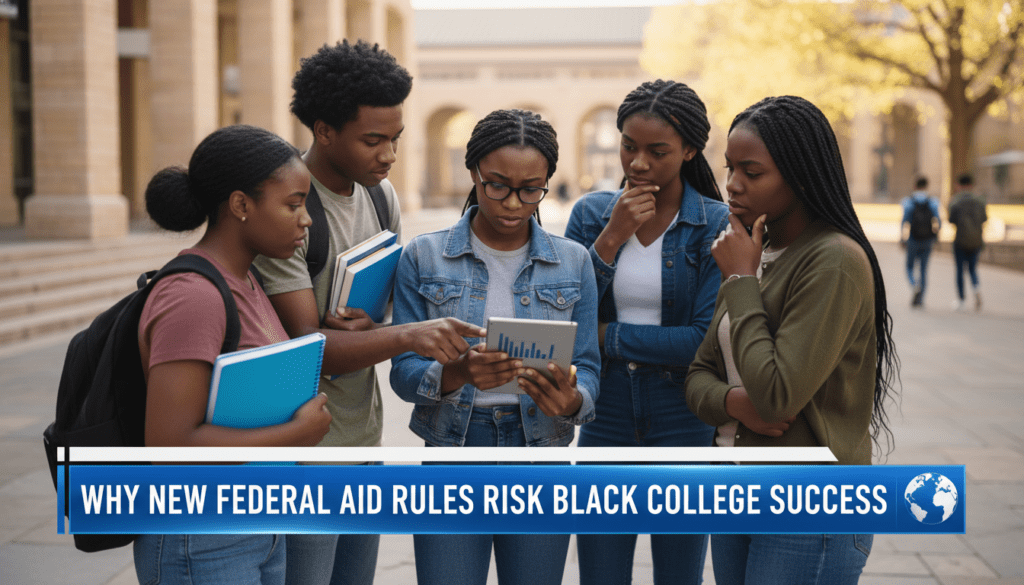
A major shift in how the government funds higher education is now unfolding. These changes center on a concept called “Gainful Employment.” This rule links federal financial aid to the actual earnings of graduates. If a program does not lead to a good-paying job, it may lose federal support. This policy seeks to protect students from high debt and low-value degrees. However, many leaders worry it will harm Black students the most. They fear it ignores the reality of a biased labor market. This article explores the history and impact of these high-stakes rules.
The core of this debate sits at the intersection of civil rights and economic survival. For decades, education has been seen as a path to freedom. Yet, for many, it has become a trap of debt. The current administration believes strict tests will stop predatory schools. Critics argue these same tests punish programs that serve marginalized communities. To understand this tension, one must look at the laws that started it all. The history of these rules is as complex as the student loan crisis itself.
The Long History of Gainful Employment
The term “gainful employment” first appeared in 1965. It was part of the Higher Education Act signed by President Lyndon B. Johnson. This law aimed to open college doors for all citizens. It defined which vocational programs could receive federal aid. At that time, Congress wanted to ensure students were prepared for recognized jobs. However, the government did not create a strict definition for this term for over forty years (tcf.org, tcf.org).
This long silence allowed the for-profit college sector to grow rapidly. These schools often focus on career training. Without federal metrics, many programs charged high tuition but offered little return. By the early 2000s, student loan defaults began to skyrocket. Reports of deceptive marketing became common. These issues highlighted historical factors that have often limited the success of minority students. The lack of oversight created a vacuum where predatory practices could thrive (hklaw.com, clickpointsoftware.com).
The first formal rules emerged under the Obama administration in 2011. These rules established the debt-to-earnings ratio. This ratio measured if graduates could afford their loan payments. If debt was too high compared to income, the program faced sanctions. The Trump administration, currently led by President Donald Trump, later rescinded these rules in 2019. They argued the rules unfairly targeted for-profit schools. Instead, they focused on transparency through tools like the College Scorecard (hklaw.com, mcclintockcpa.com).
The Earnings Premium Threshold
Programs must beat the high school graduate baseline to pass the Earnings Premium test.
The New Rules and the Double Test
The rules changed again in October 2023. The Biden administration introduced a “double test” framework. These rules took full effect on July 1, 2024. Now, programs must pass two specific hurdles to keep federal aid. The first is the Debt-to-Earnings Ratio. This ensures that loan payments do not exceed 8 percent of total earnings. It also checks that payments stay below 20 percent of discretionary income. Discretionary income is what remains after paying for basic needs (ed.gov, mcclintockcpa.com).
The second hurdle is the Earnings Premium Test. This test compares college graduates to high school graduates in the same state. At least half of a program’s graduates must earn more than a typical high school worker. This worker is usually between 25 and 34 years old and never went to college. If a program fails either test twice in three years, it loses access to Title IV aid. Title IV aid includes Pell Grants and federal student loans. These are the primary tools used to fund higher education (ed.gov, mcclintockcpa.com).
This system applies to all for-profit programs. It also covers non-degree certificate programs at non-profit colleges. However, the new framework includes something called Financial Value Transparency. This requires almost all institutions to report their data. This includes traditional public four-year universities. The goal is to provide students with a clear picture of the financial risk. The first potential loss of aid will happen in the 2026/2027 school year (civilrights.org, ed.gov).
Why Black Students Are at the Center
The impact on Black students is a major point of concern. Statistics show that Black students are 25 percent of the for-profit student body. However, they only make up 13 percent of all college students. For-profit schools often market heavily in majority-Black neighborhoods. They use aggressive tactics to drive enrollment. These methods sometimes exploit the desire for better job opportunities. This creates a pattern of historical exploitation that mirrors other debt crises (civilrights.org, clickpointsoftware.com).
Debt levels for these students are alarmingly high. Nine out of ten Black graduates from for-profit schools had to borrow money. On average, they carry $10,000 more in debt than their peers at public schools. This debt is often paired with low graduation rates. For example, the six-year graduation rate for Black students at for-profit schools is only 18 percent. In contrast, graduation rates at public and private non-profit schools are much higher. This makes the risk of a “debt-filled dead end” very real (bet.com, tcf.org).
Supporters of the rule argue it is a civil rights necessity. Groups like the NAACP believe the rule protects students from predatory actors. They argue that the government should not fund programs that leave students worse off. By cutting aid to failing programs, the rule aims to steer students toward better options. They believe this will help close the racial wealth gap over time. However, not everyone agrees that an earnings test is the right solution (civilrights.org, edtrust.org).
For-Profit Student Composition
Total Students
For-Profit Share
The Danger of Occupational Segregation
Critics warn that the earnings test ignores systemic bias. This is often called “occupational segregation.” It is the process where Black workers are funneled into lower-paying fields. These fields often include social work, childcare, and personal care. These roles are essential to the community but are often undervalued by the market. As a result, graduates in these fields earn less. This happens regardless of the quality of their education (nelp.org, opportunityatwork.org).
Even with the same degree, Black workers often face a wage gap. They may earn less than white peers in the same job track. This is a primary driver of the racial wealth gap. Because the Earnings Premium Test uses a general baseline, it may penalize programs that serve Black students. A program could do a great job of training a student. However, that student may still earn less due to labor market racism. This makes the earnings test a “moving target” for minority-serving institutions (thirdway.org, aspeninstitute.org).
Social work is a perfect example of this problem. A study of Master of Social Work graduates showed high debt levels. Black graduates carried an average debt of $66,000. Their median starting salary was only $47,100. This math makes it very hard to pass the debt-to-earnings test. If these programs are shut down, it could lead to political dynamics that reduce the number of Black professionals in vital fields. This could harm the very communities the rule aims to help (edtrust.org, tcf.org).
Historically Black Colleges and Universities
Historically Black Colleges and Universities (HBCUs) have a unique mission. They were created to educate Black Americans during legal segregation. Their goal is social advancement and community service. They are mission-driven, non-profit institutions. This is very different from the profit maximization goals of for-profit schools. HBCUs have historically created the majority of the Black middle class. This includes doctors, lawyers, and teachers (civilrights.org, edtrust.org).
Many HBCU advocates worry the new rules will target them unfairly. While HBCUs are not the primary focus of Gainful Employment, their career programs are. Because HBCUs often serve low-income students, their graduates may start with more debt. If the labor market pays these graduates less, the programs could fail the federal tests. Critics argue this ignores the “wealth creation” and social mobility HBCUs provide. These schools often lack the large endowments of wealthier universities. This makes federal aid even more critical for their survival (edtrust.org, ed.gov).
The debate highlights a tension between protection and access. Protecting students from bad schools is important. However, closing doors to career paths is a risk. Advocates for HBCUs argue for “demographic context.” They want the government to consider the systemic hurdles Black graduates face. Without this, they fear the rules will lead to fewer degree options. This could limit the ability of Black families to build strength and resilience through education (civilrights.org, civilrightsdocs.info).
The 2026 Aid Cutoff Timeline
Programs failing metrics twice within three years will lose Title IV eligibility.
What Happens to Students in Failing Programs?
Students currently enrolled in failing programs face uncertainty. If a program fails the tests for two out of three years, it loses federal aid. However, the rule does not shut the school down immediately. It creates a “runway” to protect students in the pipeline. Schools must provide “warning notices” to current and prospective students. This ensures that no one is blindsided by a sudden loss of funding (msche.org, ed.gov).
Once aid is cut off, students cannot use Pell Grants or federal loans at that school. They can still continue their studies, but they must find other ways to pay. The Department of Education estimates that most students have a better option nearby. They believe 90 percent of students can find a “passing” program in the same field. This assumes that other schools have the capacity to take them in. For many Black students, this may not be true if local community colleges are full (hklaw.com, ed.gov).
The rule does not provide automatic loan forgiveness. Students in failing programs must still pay back what they borrowed. They may be eligible for “Borrower Defense to Repayment” if the school misled them. This is a separate process that requires proof of deception. The goal of the new rules is to prevent the need for such claims. By stopping the flow of money to bad programs, the government hopes to end the cycle of debt (protectborrowers.org, tcf.org).
Looking Ahead to 2026
The first year of potential aid loss is 2026. This gives schools a short window to improve their outcomes. Some schools may lower tuition to improve their debt ratios. Others may work harder to help graduates find high-paying jobs. However, the systemic issues of the labor market remain. Without changes to how employers hire and pay, some programs will continue to struggle. This is a major concern for those who advocate for federalism and Black politics (msche.org, hklaw.com).
The Department of Education estimates the rule will protect 700,000 students per year. This is a massive number of people who could avoid low-value degrees. For the Black community, the stakes are very high. Success could mean a new generation with less debt and more wealth. Failure could mean a loss of educational options in the neighborhoods that need them most. The balance between accountability and access remains delicate (ed.gov, tcf.org).
As the 2026 deadline approaches, transparency will be key. Students must use the available data to make informed choices. The College Scorecard and the new Financial Value Transparency data are important tools. They allow students to see the median earnings and debt of any program. While the rules are complex, the goal is simple. Education should be a ladder to a better life, not a weight that pulls people down. The next few years will show if these new rules can truly deliver on that promise (civilrights.org, mcclintockcpa.com).
About the Author
Darius Spearman is a professor of Black Studies at San Diego City College, where he has been teaching for over 20 years. He is the founder of African Elements, a media platform dedicated to providing educational resources on the history and culture of the African diaspora. Through his work, Spearman aims to empower and educate by bringing historical context to contemporary issues affecting the Black community.
