

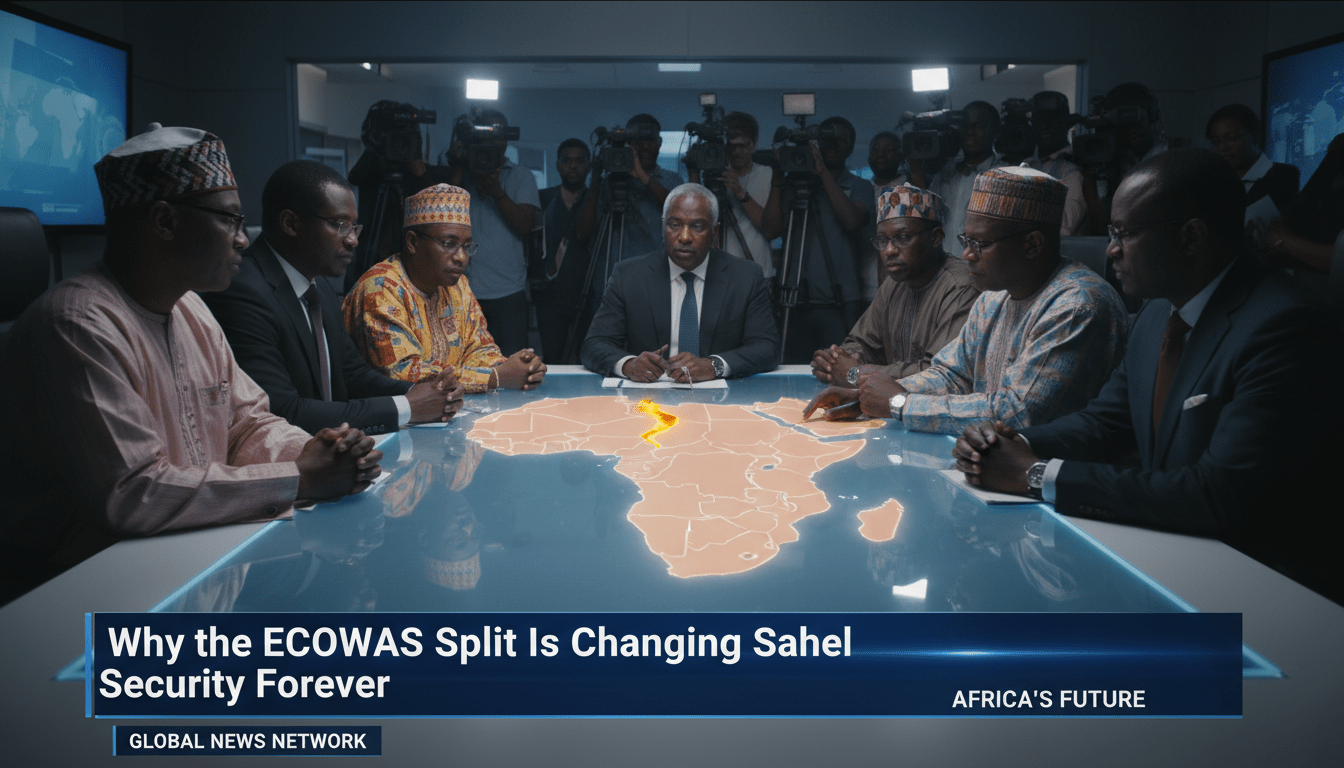
Why the ECOWAS Split Is Changing Sahel Security Forever
By Darius Spearman (africanelements)
Support African Elements at patreon.com/africanelements and hear recent news in a single playlist. Additionally, you can gain early access to ad-free video content.
The map of West Africa is changing in ways that few people expected a decade ago. For nearly fifty years, the Economic Community of West African States, known as ECOWAS, served as the primary glue holding the region together. It was a symbol of unity and shared purpose. However, a deep feud has emerged between this long-standing bloc and three of its former members. Mali, Burkina Faso, and Niger have broken away to form the Alliance of Sahel States, or AES. This split is more than a diplomatic disagreement. It is a fundamental rupture that threatens the very safety of millions of people as armed violence spreads across the continent (amaniafrica-et.org).
To understand the current crisis, one must look at the history of how these nations once worked together. This story is about a search for security in a region where borders are often lines on a map that do not stop the movement of people or threats. As the alliance fractures, the teamwork that once kept extremist groups in check is falling apart. This deep-dive explores how the feud started and why the breakdown in cooperation is creating a dangerous void. The situation is complicated, but the impact on human lives is very clear (amaniafrica-et.org).
The Evolution of a Regional Giant
ECOWAS did not start as a military organization. When leaders signed the Treaty of Lagos in 1975, their focus was on money and trade. They wanted to create a big market where goods and people could move freely. This was a dream of regional economic integration. The original goal was to lift people out of poverty by working as one large unit (amaniafrica-et.org). However, the 1990s brought a harsh reality. Brutal civil wars in Liberia and Sierra Leone showed that trade cannot happen without peace. The organization had to change its identity to survive. It created a peacekeeping force called ECOMOG to stop the fighting. By 1993, the bloc revised its treaty to make peace and security a core part of its mission (cambridge.org).
This shift toward security was further cemented in 2001. The organization adopted a new protocol on democracy and good governance. This document was a promise that military coups would no longer be tolerated in West Africa. It gave the bloc the power to punish any leader who took power by force. For many years, this protocol helped stabilize the region. It encouraged leaders to follow the rules of democracy. Yet, this very “zero-tolerance” policy has become a major point of anger for the new military leaders in the Sahel. They see these rules as a way for Western powers to control African politics (amaniafrica-et.org). These leaders are now shaping political dynamics by rejecting the old ways of doing business in West Africa.
The Growing Global Terrorism Share
Sahel Region vs. The Rest of the World (2024)
Sahel
Global Other
Source: 2024 Global Terrorism Index (africacenter.org)
The Sahel Crisis and the Breaking Point
The modern trouble started in 2012 in Mali. A rebellion by Tuareg fighters and a subsequent takeover by jihadist groups exposed a massive problem. The government in the capital could not control its vast northern territories. This vacuum allowed groups like JNIM, which is linked to Al-Qaeda, and the Islamic State in the Sahel to grow (crisisgroup.org, africacenter.org). These groups did not stay in Mali. They moved across the dry, semi-arid lands of the Sahel into Burkina Faso and Niger. They exploited the fact that these countries are some of the poorest in the world. People in these areas often feel forgotten by their governments. Many live in places where climate change has made farming nearly impossible. This poverty and lack of state presence provided a perfect breeding ground for insurgencies (reliefweb.int).
The response from the international community and ECOWAS was to push for military solutions. However, many years of foreign military presence did not stop the violence. In fact, things got worse. This failure led to a wave of anger among the local populations. Military officers in Mali, Burkina Faso, and Niger eventually seized power, claiming they could do a better job of fighting the terrorists than the elected politicians. ECOWAS responded with harsh sanctions. They closed borders and cut off electricity to Niger. These moves were meant to pressure the military to step down. Instead, the sanctions hurt ordinary people the most. This created a permanent rift between the Sahel nations and the coastal members of the bloc (amaniafrica-et.org, premiumtimesng.com). This struggle reminds many of the long history of economic justice struggles that African people have faced for centuries.
Formation of the Alliance of Sahel States
In September 2023, the three military-led nations decided they had seen enough of ECOWAS. They formed the Alliance of Sahel States, or AES. Initially, it was a pact to defend each other if anyone attacked. It was a direct response to the threat of a military intervention by ECOWAS to restore the president of Niger. By January 2025, the split became final. Mali, Burkina Faso, and Niger gave their official notice and left the bloc for good. They argued that ECOWAS had become a tool for foreign powers, especially France (amaniafrica-et.org, africanews.com). The exit of these three nations took away nearly half of the land area of the original 15-member group. It was a massive blow to the idea of West African unity.
The leaders of the AES are promoting a new kind of independence. They call it a “Second Independence.” They are moving away from the democratic models promoted by the West. Instead, they focus on military strength and national sovereignty. They have started to create their own institutions. For example, they launched a 5,000-strong military force headquartered in Niamey. This force is designed to operate without the help of the neighbors they left behind. They have also introduced new passports for their citizens. This signals that they do not plan on returning to the ECOWAS family anytime soon (amaniafrica-et.org, timbuktu-institute.org). This shift represents a major change in how these countries interact with the rest of the world.
Burkina Faso Fatality Escalation
Total fatalities recorded since late 2022
Data: ACLED (africacenter.org)
The Disintegration of Security Teamwork
The most dangerous result of this feud is the collapse of security cooperation. For years, the nations of the Lake Chad Basin worked together in a Multinational Joint Task Force to fight Boko Haram. In March 2025, Niger officially pulled its troops out of this mission. Instead of fighting insurgents at the border, the soldiers were sent to protect oil pipelines at home. This move left a huge gap in the defense against groups like ISWAP. When one country stops sharing intelligence or guarding its side of the border, the extremists win. They use these “blind spots” to move freely between countries (zagazola.org, amaniafrica-et.org).
The violence is now spilling over into coastal countries like Benin and Togo. These nations used to be peaceful, but they are now seeing more attacks every month. In one tragic incident in April 2025, 54 soldiers from Benin were killed in a single attack. Because of the feud, Benin and Niger are not talking to each other. They do not share information about where the jihadists are hiding. This silence is deadly. Militant groups are taking over critical transit corridors between the desert and the sea. Without a unified front, these countries are fighting a losing battle against a highly mobile enemy (amaniafrica-et.org, amaniafrica-et.org). The security teamwork that took decades to build has vanished in a matter of months.
Global Rivalries and the U.S. Pivot
The split in West Africa is also attracting global powers. As the AES states moved away from France and the United States, they looked for new partners. Russia has stepped in to fill the void. The Wagner Group, now rebranded as the Africa Corps, provides security for the military juntas. These Russian fighters do not ask questions about human rights or democracy. They offer military support in exchange for access to natural resources like gold and uranium. This has created a new era of the relationship between Russia and African nations (thesoufancenter.org, timbuktu-institute.org). This partnership complicates the efforts of ECOWAS to bring the Sahel states back into the fold.
Meanwhile, the United States has had to change its strategy. In early 2026, under the administration of President Donald Trump, the U.S. State Department signaled a “new course” for the region. The U.S. realized that isolating the military leaders was not working. Instead of demanding a quick return to democracy, the U.S. is now focusing on “interest-based” diplomacy. This means working with the juntas to maintain influence and counter Russian and Chinese growth. This pivot shows that the old rules of international relations are being rewritten. The U.S. is now prioritizing regional stability and access to minerals over democratic oversight (africanews.com). This change has left ECOWAS even more isolated in its mission to protect democratic norms.
The Human Cost of the Feud
While leaders argue and military forces move, the people of the Sahel are suffering the most. The displacement crisis has reached staggering levels. Nearly four million people have been forced to leave their homes across Mali, Burkina Faso, and Niger. Most of these people are farmers who have lost everything. They are now living in crowded camps with very little food or water. The conflict has destroyed schools and hospitals, leaving an entire generation of children without an education (un.org, reliefweb.int). The humanitarian situation is a direct result of the breakdown in regional cooperation.
The end of the "ECOWAS Passport" is another major concern. For decades, citizens could travel across 15 countries without a visa. This freedom of movement allowed people to find work and visit family across borders. Now, that freedom is at risk. While there is a temporary grace period, the long-term status of millions of West Africans is uncertain. If countries start requiring visas or closing borders permanently, the economic impact will be devastating. This is especially true for landlocked countries like Niger, which depend on coastal ports for trade (amaniafrica-et.org, premiumtimesng.com). The feud is not just about politics. It is about the daily survival of the people (reliefweb.int).
Searching for a Path Forward
The fracture in West Africa is deep, but it is not necessarily permanent. There are voices in the region calling for dialogue. Some experts suggest that ECOWAS must evolve again. Perhaps it needs to focus more on humanitarian needs and less on punishing military leaders. At the same time, the leaders of the AES must realize that they cannot defeat the insurgency alone. The borders of the Sahel are too long and too porous for any one country to guard. Cooperation is not a luxury. It is a necessity for survival (amaniafrica-et.org, amaniafrica-et.org).
The history of West Africa is a history of resilience. The people have faced colonialism, droughts, and civil wars. Each time, they have found a way to endure. The current feud between ECOWAS and the Alliance of Sahel States is a major challenge, but it also offers a chance to build something new. A security model that truly reflects the needs of the people, rather than the interests of foreign powers, could be the answer. For now, the region remains at a crossroads. The decisions made by leaders today will determine the safety of millions for decades to come (amaniafrica-et.org).
About the Author
Darius Spearman is a professor of Black Studies at San Diego City College, where he has been teaching for over 20 years. He is the founder of African Elements, a media platform dedicated to providing educational resources on the history and culture of the African diaspora. Through his work, Spearman aims to empower and educate by bringing historical context to contemporary issues affecting the Black community.
