


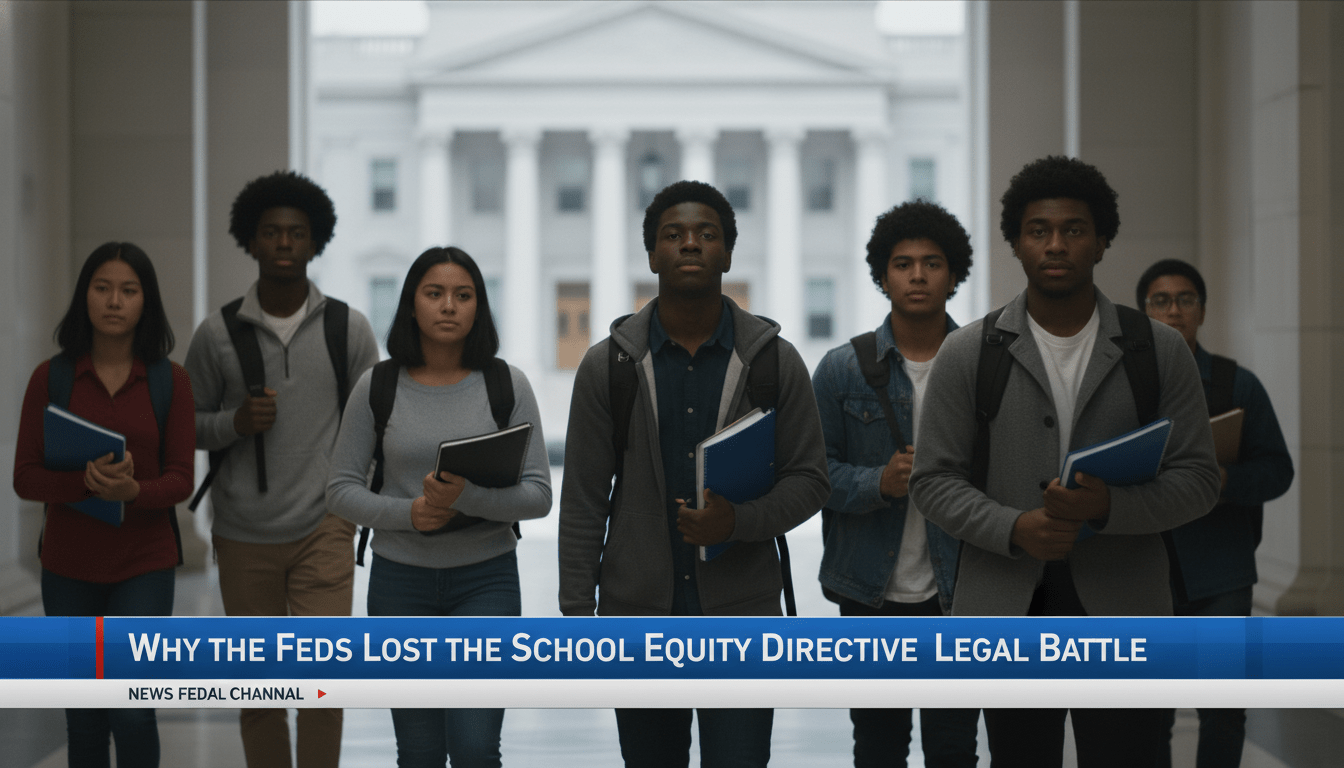
Why the Feds Lost the School Equity Directive Legal Battle
By Darius Spearman (africanelements)
Support African Elements at patreon.com/africanelements and hear recent news in a single playlist. Additionally, you can gain early access to ad-free video content.
A Sudden Turn in Federal School Policy
The United States Department of Education faced a major setback in February 2026. This moment marked the end of a intense legal fight over how the government defines fairness in schools. The Department officially withdrew a controversial directive that had targeted diversity programs across the nation (bsk.com). This move followed a string of losses in federal courts that challenged the authority of the current administration. President Donald Trump and his Department of Education had introduced these rules to change how civil rights laws apply to students (ed.gov).
The conflict centered on two main documents released in 2025. The first was a “Dear Colleague” letter sent on February 14. This letter aimed to stop schools from using certain methods to help minority students. The Department argued that these methods were “race-based proxies” that violated the law (bsk.com). The second document was a requirement issued on April 3. It forced schools to certify that they were following these new rules or lose federal money. However, several judges ruled that the Department did not follow the proper legal steps to make these changes (pillsburylaw.com).
Surge in Federal Civil Rights Complaints
Complaints nearly tripled from roughly 8,000 to over 22,000 cases. (nih.gov)
The Roots of Federal Power in Education
To understand this recent court loss, one must look at the history of federal involvement in schools. For a long time, the federal government stayed out of local classrooms. This changed with the Civil Rights Act of 1964. Title VI of that act became the most powerful tool for ensuring equity (naacpldf.org). It says that no program receiving federal money can discriminate based on race. This law allowed the government to tell schools they must treat all students fairly if they want to keep their funding (uoregon.edu).
The Elementary and Secondary Education Act of 1965 also changed things. President Lyndon B. Johnson used this law to give money to schools that served low-income children. This created a “carrot” to encourage schools to follow civil rights rules. Over time, the Department of Education became the “guarantor of opportunity” for Black students (edtrust.org). They used their power to address racial inequality in higher education and K-12 systems. This history shows that the federal role has always been about balancing local control with national rights.
Later, Title IX was added in 1972. This law, championed by Representative Patsy Mink, prevented discrimination based on sex (uoregon.edu). These laws created a framework that the government uses to protect students. However, the recent court cases suggest that the current administration tried to use these laws in a way they were never intended. The judges ruled that the Department of Education cannot simply redefine laws without asking the public first. This tension between federal rules and the law is a recurring theme in American history.
The Rise of Shadow Law and Guidance
Since the late 1970s, the Department has used “Dear Colleague Letters” to manage schools. These letters are technically just guidance and not actual laws. Nevertheless, schools often treat them as binding rules because they fear losing federal funds (theregreview.org). This practice is sometimes called “shadow law.” It allows an administration to change policy quickly without going through Congress. This has led to a “ping-pong” effect where policies change every time a new president enters the White House (acus.gov).
Democratic administrations have used these letters to expand protections for marginalized groups. They often focus on education systems that serve diverse populations. Conversely, Republican administrations have used the same tool to limit those protections. The 2025 directives were a clear example of this trend. They attempted to use Title VI to ban initiatives that many schools use to promote diversity (nationalaffairs.com). The courts eventually stepped in to say that this method of making “shadow law” had gone too far (pillsburylaw.com).
The legal problem is that these letters bypass the Administrative Procedure Act. This act requires agencies to allow the public to comment on new rules before they take effect. By skipping this step, the Department of Education made the rules “procedurally defective” (ballotpedia.org). The court ruled that the government cannot make major changes to civil rights interpretations in secret. This failure to follow the rules led to the nationwide invalidation of the equity directive in early 2026.
The Education Funding Reality
The federal government provides only about 10% of total K-12 funding but uses it to influence nearly all school policies. (edbuild.org)
The Fight Over Race-Based Proxies
A major part of the 2025 directive targeted what the government called “race-based proxies.” Since the Supreme Court limited race-conscious admissions, many schools used other data to help find diverse students. These data points include a student’s ZIP code or their socioeconomic status (journalistsresource.org). Schools use these “neutral” factors to ensure their student bodies reflect the community. The Department of Education claimed that using these proxies was just a different way to discriminate (bsk.com).
The 2025 letter specifically told schools that they could not eliminate standardized tests if the goal was to achieve racial balance. It also targeted the use of neighborhood data to help students from high-poverty schools (irispublishers.com). For many Black families, these proxies were a vital way to gain access to better schools. Critics of the directive argued that the government was trying to create a “colorblind” system that ignores the reality of historical inequality. They believed the directive would lead to a decline in Black and Hispanic enrollment (naacpldf.org).
The courts found that these rules were “unconstitutionally vague.” This means the rules were so unclear that school officials did not know how to follow them without breaking the law (aclu-nh.org). Because the rules were vague, they threatened the free speech rights of teachers. Educators were afraid to talk about diversity or use inclusive materials in their classrooms. The withdrawal of the directive means that schools can continue to use these proxies for now (ed.gov).
Affinity Groups and Inclusive Curricula
The 2025 mandates also went after affinity groups in schools. These are organizations like Black Student Unions where students who share an identity can gather. These groups serve as “safe spaces” and help students feel like they belong in school (greatschoolspartnership.org). For teachers of color, these groups are essential for staying in a profession that often feels isolating. The Department of Education labeled these groups as “segregationist” and threatened to pull funding from schools that allowed them (naacpldf.org).
Furthermore, the government targeted “inclusive curricula.” This includes programs that teach about the systemic struggles of marginalized people. The 1619 Project and AP African American Studies were primary targets of these restrictions (naacpldf.org). Many states had already passed laws against “divisive concepts” in Black Studies curricula and history classes. The federal directive tried to make these bans a national standard by using Title VI (weteachnyc.org).
Civil rights groups like the NAACP-LDF argued that seeing oneself in the school curriculum is a right. They stated that these programs help improve academic performance and student engagement (naacpldf.org). The legal defeat of the directive is a victory for those who want to keep these programs alive. Schools that had paused their affinity groups are now being told to “stay the course” and bring them back. The withdrawal of the federal mandate removes the threat of immediate financial punishment (ed.gov).
The Revenue Gap for Districts of Color
Predominantly nonwhite districts receive roughly 16% less revenue than white districts. (edtrust.org)
The Persistent Gap in School Funding
Even though the government focus was on DEI programs, a larger issue remains in school funding. Data shows that districts serving students of color receive significantly less money than white districts. Nationally, there is a 16% gap in funding between these types of schools (edbuild.org). This works out to about $2,200 less per student every year. This gap exists because schools rely heavily on local property taxes, which are higher in wealthy white neighborhoods (edtrust.org).
Title VI protections are supposed to prevent this kind of inequality. However, the federal government has limited power over local taxes. Most federal money is “supplemental,” meaning it is extra money and not the main budget (lrs.org). This creates a “funding paradox.” If the government pulls money from a poor district to punish it for inequality, it actually hurts the students even more. This makes Title VI a “nuclear option” that is very difficult to use effectively (naacpldf.org).
The 2025 directive did not address these base funding disparities. Instead, it focused on how schools spent the small amount of diversity money they had. Critics point out that the government was more interested in stopping DEI than in fixing the underlying property tax problem. The recent court loss highlights that federal power is most effective when it supports students rather than restricting local efforts to achieve equity (edbuild.org).
Mass-Filers and Administrative Overload
Another reason for the Department’s recent struggles is a massive surge in civil rights complaints. In 2024, the Office for Civil Rights received over 22,000 complaints (nih.gov). This is the highest number in history. A large portion of these cases were filed by “mass-filers.” These are outside groups that use automated systems to file thousands of complaints against schools (nih.gov). They often target scholarships or programs meant for Black and Hispanic students.
These mass-filers create a false sense of a crisis. By filing so many cases, they make it look like DEI programs are causing widespread harm. This volume of work has overwhelmed the Department’s staff. While complaints have tripled since 2009, the number of employees has actually decreased (nih.gov). This caseload makes it very hard for the government to help individual students who face real harassment or assault in schools.
The 2025 directive was partly a response to this political pressure from mass-filers. However, the courts noted that many of these complaints were not filed by people who were actually harmed. In legal terms, many mass-filers lack “standing.” This means they do not have a personal stake in the outcome of the case (nih.gov). The withdrawal of the directive allows the Department to refocus its limited resources on protecting students from actual discrimination.
Conclusion: The Future of School Equity
The withdrawal of the 2025 directive marks a turning point for American education. It shows that the courts are willing to check federal power when it oversteps its bounds. Schools that were in a state of “regulatory limbo” now have more clarity. They are no longer required to certify compliance with rules that the courts have called “procedurally defective” (ballotpedia.org). This allows local school boards to return to the business of supporting their diverse student bodies.
However, the struggle for equity is far from over. Many states still have their own bans on DEI and inclusive history lessons. The federal government remains a powerful force, but its ability to lead through “shadow law” has been weakened. The history of education in the United States is a story of constant tension between the feds and local districts. As this recent chapter closes, the focus returns to the students who need these protections the most (edtrust.org).
The lessons from this court loss are clear. Any administration that wants to change civil rights policy must follow the law and listen to the public. It cannot simply issue letters to bypass the democratic process. For the Black community, this is a reminder that the path to equity is often blocked by administrative hurdles. Nonetheless, the removal of these restrictive mandates provides a new opportunity for progress in the nation’s classrooms (ed.gov).
About the Author
Darius Spearman is a professor of Black Studies at San Diego City College, where he has been teaching for over 20 years. He is the founder of African Elements, a media platform dedicated to providing educational resources on the history and culture of the African diaspora. Through his work, Spearman aims to empower and educate by bringing historical context to contemporary issues affecting the Black community.
