

Why Trinidad Families Sued the US Over a Fatal Boat Strike
By Darius Spearman (africanelements)
Support African Elements at patreon.com/africanelements and hear recent news in a single playlist. Additionally, you can gain early access to ad-free video content.
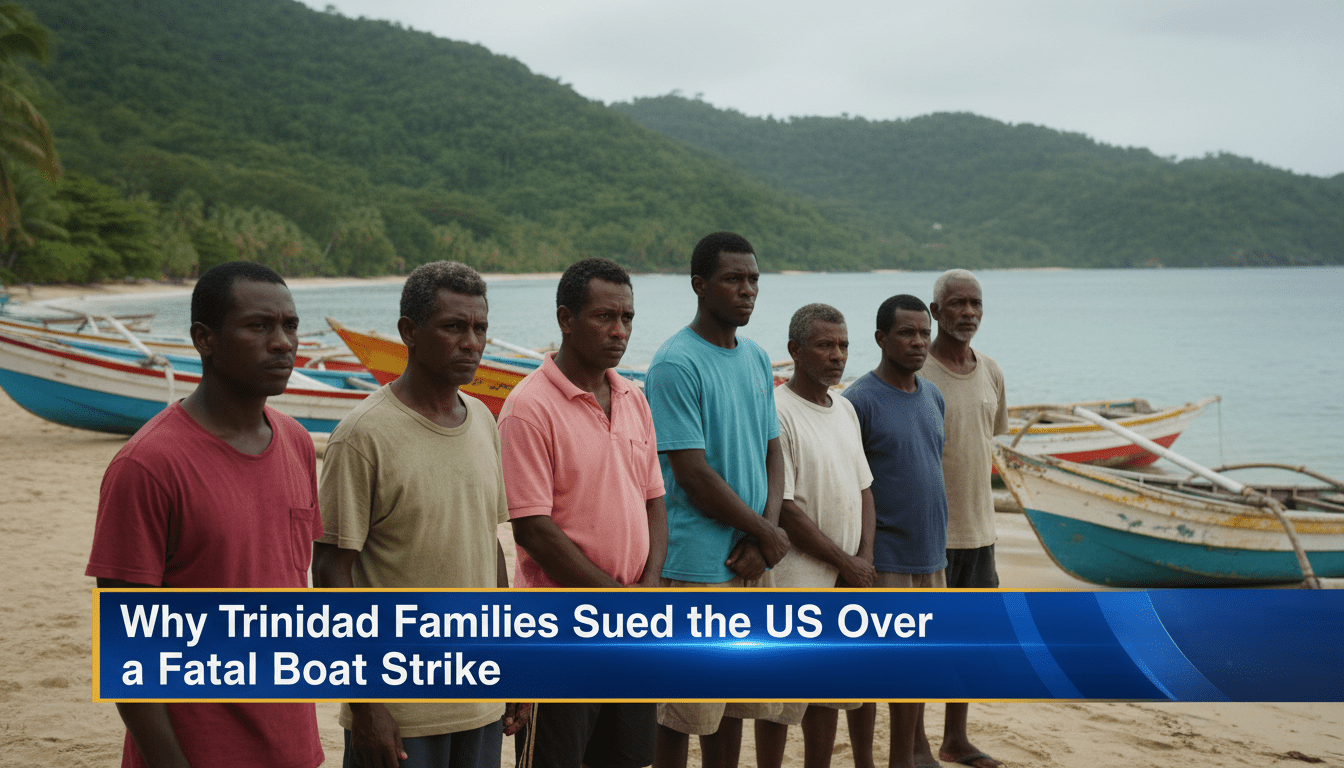
The quiet fishing village of Las Cuevas, Trinidad, is currently at the center of a massive international legal battle. On January 27, 2026, families from this seaside community filed a federal lawsuit in Massachusetts against the United States government (theguardian.com). This legal action follows the deaths of two men, Chad Joseph and Rishi Samaroo, who were killed in a military strike on October 14, 2025. The families claim the men were simple fishermen and laborers, while the American government labeled them as part of a “narcoterrorist” network. This case is much more than a local dispute. It highlights a major change in how the United States operates in the Caribbean Sea.
For decades, maritime security in the region relied on cooperation and law enforcement. However, under the current Trump administration, this policy has shifted toward open military conflict. The lawsuit, known as Burnley v. U.S., argues that the strike was a case of extrajudicial killing (aclum.org). Attorneys from the American Civil Liberties Union and the Center for Constitutional Rights are representing the families. They are seeking accountability for what they describe as a reckless use of deadly force on the high seas. This tragedy has shaken the local community and raised difficult questions about sovereignty and human rights in the African diaspora.
The Dramatic Pivot to Operation Southern Spear
To understand why these families are in court, one must look at the recent history of maritime policy. For nearly thirty years, the “Shiprider Agreements” governed how the United States and Caribbean nations worked together (wikipedia.org). These pacts, signed in the mid-1990s, allowed the U.S. Coast Guard to board suspect vessels in foreign waters. However, a local officer from the host country had to be present on the American ship (ouplaw.com). The goal was always to arrest suspects and bring them to trial within a legal framework. This was a cooperative approach that respected the laws of each nation involved.
Everything changed in September 2025 with the launch of Operation Southern Spear (defensescoop.com). The United States reclassified powerful drug cartels, such as the Venezuelan “Tren de Aragua,” as Foreign Terrorist Organizations (venezuelanalysis.com). This designation allowed the administration to move away from police work and toward the “laws of war.” Instead of stopping boats to search them, the military began using “lethal kinetic strikes” to destroy them (wprl.org). This massive political shift turned the Caribbean into a combat zone where civilian boats can be targeted by missiles without warning.
Casualties Under Operation Southern Spear
Data as of January 2026 (wprl.org)
The reclassification of criminal groups as terrorists gave the executive branch the power to bypass standard legal processes. The Department of Justice now argues that the United States is in a state of “armed conflict” with these cartels (justsecurity.org). This allows for the use of high-tech weaponry, including drones and missiles, against small maritime vessels. Critics argue that this theory violates the United Nations Charter and international norms regarding self-defense. For the people of Trinidad, this means that the waters they have fished for generations are now filled with the threat of sudden, state-sanctioned violence.
The Human Cost in Las Cuevas
The village of Las Cuevas is a place where fishing is a way of life and a primary source of income. Chad Joseph and Rishi Samaroo were well-known members of this community. On the day they died, they were reportedly returning from Venezuela on a small boat (theguardian.com). Their families describe them as hardworking men who provided for their children and neighbors. In many ways, their lives reflected a sense of survival as invention that is common in tight-knit Black communities (theguardian.com). They were not wealthy men, but they were essential to the survival of their households.
The U.S. military claimed the vessel was linked to “narcoterrorist networks,” but it has provided no public evidence to support this (youtube.com). There are no cargo manifests or GPS data showing illegal activity. Instead, the families are left with the reality of “mangled bodies” washing ashore, according to local reports (iheart.com). The loss of these two breadwinners has caused deep economic and emotional pain. This tragedy illustrates the “collateral damage” that occurs when the military treats a crime zone like a traditional battlefield. Artisanal fishermen now live in fear that a simple mistake in navigation could lead to a missile strike.
The local fishing industry is highly decentralized, with over 1,900 small boats operating across Trinidad and Tobago (fao.org). These fishermen often cross maritime boundaries to find the best catch. Historically, they might have faced a fine or a short detention if they strayed into the wrong waters. Now, they face the world’s most advanced military technology. The USS Gerald R. Ford, the largest aircraft carrier in the world, is currently patrolling these waters (defensescoop.com). The massive difference in power between a nuclear-powered carrier and a wooden fishing boat highlights the extreme nature of this new policy.
The Legal Framework for Justice
The lawsuit filed by the families relies on two major pieces of American law. The first is the Death on the High Seas Act of 1920 (congress.gov). This law was originally created to help families sue for negligence when a death occurs more than three miles from the U.S. shore. It is a tool for seeking financial compensation when someone is killed on the open ocean. However, the families are also using the Alien Tort Statute (dechert.com). This 1789 law allows non-citizens to sue in American courts for violations of international human rights norms.
The Alien Tort Statute is a powerful tool because it addresses “torts” committed in violation of the “law of nations.” In this case, the families argue that the missile strike was an extrajudicial killing, which is a major violation of international law (aclu.org). They claim that the U.S. military acted as judge, jury, and executioner without any due process. This legal strategy has been used in the past to hold individuals and governments accountable for torture and murder. By bringing this case to a federal court in Massachusetts, the families hope to force the government to justify its actions in a public setting.
Economic Impact on Trinidadian Fishing
Annual Value in TTD (Tobago Sector Only)
The industry supports roughly 50,000 local livelihoods. (newsday.co.tt)
The U.S. government is expected to argue that the courts should not interfere in military matters. They will likely claim that the “political question doctrine” prevents a judge from reviewing decisions made during an armed conflict (justsecurity.org). However, the families’ attorneys argue that there was no real conflict in the waters where the men were killed. They point out that the men were unarmed and posed no immediate threat. This legal battle will likely take years to resolve, but it serves as a critical test of whether the U.S. military can operate with total immunity in the Caribbean.
Geopolitics and the Shadow of Colonialism
There is a deep historical context to the U.S. presence in Trinidad. During World War II, the United States built major military bases at Chaguaramas and Wallerfield (wikipedia.org). Trinidad was viewed as an “unsinkable island” and a forward defense post against German submarines. This history established a pattern where the security interests of the United States often overshadowed the sovereignty of the local people. Today, that same strategic importance is being used to justify the militarization of the region in the “war on drugs.”
Some observers have noted a troubling pattern in these strikes. Critics point out that “lethal kinetic strikes” are being used exclusively in Black and Brown maritime corridors (iheart.com). There are no reports of the U.S. military using missiles against suspected drug smugglers in the North Atlantic or near European waters. This discrepancy has led some to argue that the policy has a colonial basis. It treats the lives of people in the Global South as more expendable than those in the Global North. This dynamic is a central part of the modern postcolonial identity struggle in the Caribbean (youtube.com).
The Trinidadian government has been surprisingly quiet about the deaths of its citizens. Prime Minister Kamla Persad-Bissessar has officially welcomed the return of U.S. troops for “anti-narcotics exercises” (tobagoupdates.com). The Attorney General even stated that the strikes appear to be consistent with international law (newsday.co.tt). This stance has frustrated many locals who feel their own government is not protecting them. It highlights the difficult position of smaller nations that rely on the United States for economic and security assistance. Often, these governments must choose between standing up for their citizens and maintaining a good relationship with a superpower.
The Tactic of the “Double-Tap”
One of the most controversial aspects of Operation Southern Spear is the reported use of “double-tap” strikes. This is a military tactic where an initial strike is followed by a second one a short time later (youtube.com). The goal of the second strike is often to destroy survivors or those who come to help. On September 2, 2025, U.S. Admiral Frank Bradley reportedly ordered such a strike against a vessel (iheart.com). This tactic is widely condemned by human rights groups because it targets people who are no longer combatants.
The use of the double-tap in the Caribbean has drawn sharp criticism from the United Nations and the European Union. They have labeled these actions as extrajudicial killings because they bypass all forms of judicial review (aclu.org). In a law enforcement setting, the goal is to save lives and make arrests. In a “kinetic strike” setting, the goal is total destruction. This shift in tactics shows that the U.S. military is applying the brutal methods used in the Middle East to the Western Hemisphere. For the families in Las Cuevas, the possibility of a double-tap strike means that even searching for their loved ones’ remains could be deadly.
U.S. Public Opinion on “Double-Tap” Strikes
Source: ACLU/YouGov Poll (aclu.org)
The public sentiment in the United States is also divided on this issue. While the administration frames these strikes as a necessary part of protecting the border, many Americans are horrified by the tactics. An ACLU poll found that a majority of certain political groups view these actions as murder rather than military necessity (aclu.org). This domestic pressure might eventually force a change in policy, but for the families of Chad Joseph and Rishi Samaroo, it may be too late. Their goal now is to ensure that no other families have to endure the same heartbreak.
A Long Road to Accountability
The legal battle in Massachusetts is just the beginning of what will likely be a long and difficult road. The families are not just looking for money. They want a court to rule that these “send a message” strikes are illegal under both American and international law (theguardian.com). They want to stop the military from acting as a global police force with no oversight. If they win, it could set a major precedent that limits how the U.S. military operates in the Caribbean and other parts of the world.
This case also highlights the importance of groups like the ACLU and the Center for Constitutional Rights. These organizations provide the legal expertise and resources that small-village families could never afford on their own (aclu.org). By bringing this case to light, they are forcing a conversation about the value of Black lives in the context of U.S. foreign policy. The tragedy in Las Cuevas is a reminder that the “war on drugs” often has a human cost that is far removed from the halls of power in Washington, D.C. Justice for these families would be a victory for human rights and for the entire Caribbean community.
As the case moves forward, the world will be watching to see how the American legal system handles such a direct challenge to military authority. The families of Las Cuevas have shown incredible courage by taking on the world’s most powerful government. Their struggle is a testament to the strength and resilience of the African diaspora in the face of state violence. Regardless of the final verdict, they have already succeeded in bringing international attention to a secret war that was being fought in their backyard. The memory of Chad Joseph and Rishi Samaroo will continue to inspire those who believe in justice and the rule of law.
About the Author
Darius Spearman is a professor of Black Studies at San Diego City College, where he has been teaching for over 20 years. He is the founder of African Elements, a media platform dedicated to providing educational resources on the history and culture of the African diaspora. Through his work, Spearman aims to empower and educate by bringing historical context to contemporary issues affecting the Black community.
