

Why Wilmington Must Learn Free Speech After Park Police Row
By Darius Spearman (africanelements)
Support African Elements at patreon.com/africanelements and hear recent news in a single playlist. Additionally, you can gain early access to ad-free video content.
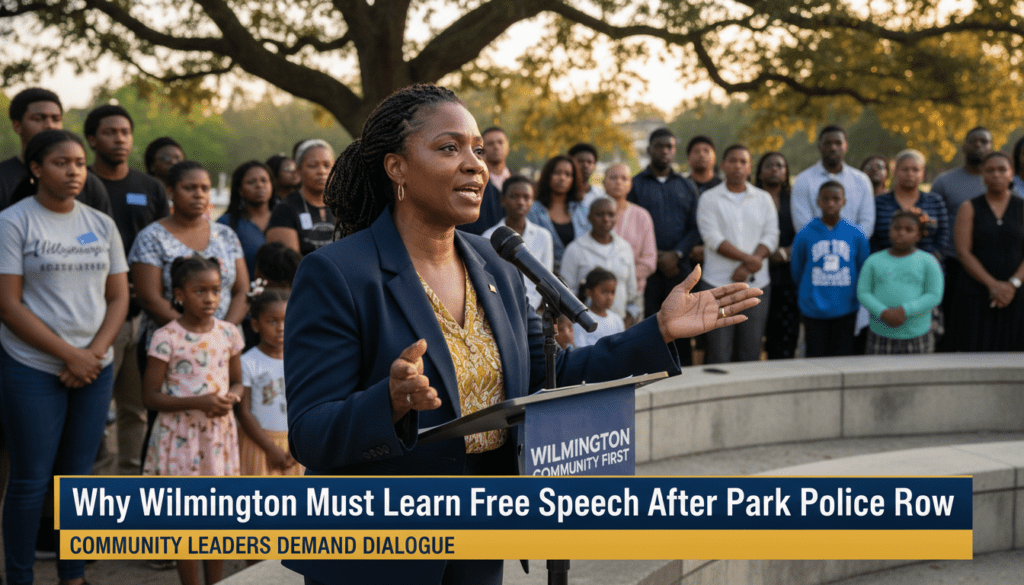
The city of Wilmington, Delaware, recently found itself in a legal spotlight that many residents argue was a long time coming. In late 2024, city officials agreed to a settlement that requires mandatory First Amendment training for leadership. This legal turn of events began with a community gathering called “Positive Vibes in the Park.” What was supposed to be a peaceful afternoon of art and community turned into a battle over who has the right to speak in public spaces. The organizers claimed that city leadership and the police department tried to silence them because the event was critical of law enforcement (aclu-de.org).
While the headlines focus on this single settlement, the story is actually much older. It is a story about how a city manages dissent and who it allows to gather. Wilmington has a history that stretches back over a century regarding the control of public assembly. This latest legal defeat for the city is a single chapter in a book that includes a nine-month military occupation and a long-standing “law enforcement mandate.” To understand why a park event led to a federal settlement, one must look at the deep-seated tensions that have shaped this city (newsfromthestates.com).
The Ghost of the 1968 Military Occupation
The current climate of policing in Wilmington cannot be separated from the events of 1968. After the assassination of Dr. Martin Luther King Jr., many American cities saw unrest. In Wilmington, the actual rioting lasted only two days. However, Governor Charles Terry made a decision that would haunt the city for decades. He deployed the National Guard and kept them there for nine months. This remains the longest peacetime military occupation of an American city in history (aaihs.org).
During those nine months, the reality for Black residents was one of constant surveillance and restricted movement. Armed guardsmen with loaded bayonets patrolled neighborhoods like West Center City, which was then known as “The Valley.” Residents lived under strict curfews and had to pass through checkpoints to move through their own neighborhoods. This era created a deep “scar” on the relationship between the community and law enforcement. The occupation did more than just patrol the streets. It accelerated “white flight” and left Black communities under a state of permanent watch (wikipedia.org).
This history of control is also seen in the development of the Wilmington Police Department itself. In 1916, department leaders traveled to the New York City Police Academy to model their own training. This move established what experts call a “law enforcement mandate.” This philosophy prioritizes social control and making arrests over working with the community. The ACLU of Delaware argues that this culture still exists today and influences how the city treats public gatherings that criticize the police (aclu-de.org).
The Event That Sparked the Settlement
The 2024 dispute centered on Haneef Salaam, a local leader and the Director of the Campaign for Smart Justice for the ACLU of Delaware. Salaam had successfully organized five “Positive Vibes in the Park” events at the Urban Artist Exchange (UAE) Amphitheater. These events were generally seen as community celebrations. However, for the August 2024 event, Salaam changed the theme to “Justice for All.” The planned gathering was set to feature speakers who were family members of people killed by the police (aclu-de.org, spotlightdelaware.org).
Internal city emails later revealed that the Wilmington Police Department was watching closely. The “Real Time Crime Center” flagged the event as a “potential concern” four days before it was scheduled. Because the event included activists and families of victims, the police re-categorized it as a “rally” rather than an arts event. This change allowed the city to demand strict new rules. They told Salaam he could not have speeches about police violence, no signs, no chanting, and could not even use the phrase “Justice for All” (newsfromthestates.com).
Salaam refused to accept these restrictions, viewing them as a violation of his rights. He eventually moved the event outside of the city limits to ensure the speakers could talk freely. He then filed a lawsuit with the help of the ACLU, arguing that the city was using its permit process to silence political speech. Under the current administration of President Donald Trump, the debate over federal oversight and local police conduct remains a national conversation, but in Wilmington, the struggle is deeply local (aclu-de.org, aclu-de.org).
Paid to Darrell Petrey and Tony Thomas after they were arrested for criticizing police at a Wilmington City Council meeting.
A Pattern of Silencing Critical Voices
The “Positive Vibes” incident was not an isolated case. It followed a series of legal losses for the city involving free speech. For example, in 2023, the city paid $297,500 to settle a lawsuit from Darrell Petrey and Tony Thomas. These men were arrested and removed from a City Council meeting simply for criticizing city officials and the police during the public comment section. This case showed that the city was willing to use physical arrest to stop criticism in public forums (delawarepublic.org).
There was also a policy shift at Tubman-Garrett Park in 2024. Groups like “Jeremy McDole Police Reform Now” pressured the Riverfront Development Corporation to change its rules. Previously, protesters were required to give 45 days of notice and pay thousands of dollars in fees. These requirements acted as unconstitutional barriers that stopped people from exercising their rights. The city eventually acknowledged these rules were wrong and created new procedures for protesters (vera.org).
The city’s history of [struggles against oppression] often involves these types of administrative hurdles. By making it difficult or expensive to gather, the government can control the narrative without making a single arrest. These tactics are often used against groups that seek racial justice or police accountability. The 2024 settlement aims to stop this by training the “gatekeepers” who handle permits and cultural events (opengov.com).
Surveillance and the Real Time Crime Center
A major part of the city’s control strategy involves high-tech surveillance. The Real Time Crime Center (RTCC) was launched in May 2016 and was the first of its kind in Delaware. It was modeled after surveillance hubs in New York City. The center uses a network of over 1,000 cameras and gunshot detection technology. While the city says it is for fighting crime, the Salaam case showed it is also used to monitor political activity (police1.com, delawarepublic.org).
Detectives at the RTCC monitor social media for specific keywords and track the activity of local activists. In the case of the “Justice for All” event, they flagged the gathering because family members of Jeremy McDole and Lymond Moses were involved. These are two Black men whose deaths at the hands of police sparked major movements for reform in the city. By “flagging” the event, the police triggered a review process that led to the unconstitutional restrictions (newsfromthestates.com, spotlightdelaware.org).
This type of monitoring creates a chilling effect on the community. When people know the police are watching their Facebook pages and tracking who they invite to a park, they may be less likely to speak out. This technology allows for a new kind of “occupation” that is digital rather than military. It is a system that allows the department to maintain situational awareness of any group that might challenge the status quo (delawarepublic.org).
The Importance of the Urban Artist Exchange
The location of the “Positive Vibes” event added another layer of meaning to the dispute. The Urban Artist Exchange (UAE) is an arts campus located on Wilmington’s East Side. It was built on the site of former police stables. The $3.4 million project was intended to turn a space of police control into a space of art and community healing. For many, it was a symbol of “creative placemaking” meant to empower the Black community (opengov.com, spotlightdelaware.org).
Because the UAE was marketed as a place for community empowerment, the city’s attempt to censor “Justice for All” messaging felt like a betrayal. The city argued that the UAE was an “entertainment venue” and not a “public forum.” This distinction was central to the lawsuit. The city believed that because it owned the space for arts programming, it could control what was said there. However, the settlement clarifies that government-run cultural entities cannot use their power to discriminate based on a person’s viewpoint (aclu-de.org).
The UAE is situated in one of the city’s oldest African American neighborhoods. The attempt to restrict speech there is part of a [long history] of managing Black public spaces. Movements like the Black Panther Party often faced similar challenges when trying to organize in their own communities. In Wilmington, the struggle to control the East Side continues through these administrative and legal battles (opengov.com).
Who Was Jeremy McDole?
To understand why the police were so concerned about the “Justice for All” event, one must know the story of Jeremy McDole. In 2015, McDole was a 28-year-old Black man who used a wheelchair. He was shot and killed by Wilmington police officers while sitting in that wheelchair. Dashcam footage showed that officers opened fire only seconds after shouting commands. The incident became a defining moment for the modern police reform movement in Delaware (talkingpointsmemo.com, loevy.com).
Although the state did not file criminal charges against the officers, the Delaware Department of Justice called the incident “extraordinarily poor police work.” The city eventually paid $1.5 million to McDole’s family, which was one of the largest settlements for a police shooting in the city’s history. His sister, Keandra McDole, became a lead organizer for police reform. Her planned presence at Salaam’s event was one of the main reasons the RTCC flagged it as a “rally” (loevy.com, spotlightdelaware.org).
The McDole case is a reminder of why many in the community feel the need to speak out. It is also a reminder of why the city is often defensive. The families of McDole and others, like Lymond Moses, represent a vocal demand for change. By trying to stop these families from speaking at a city-owned park, officials were effectively trying to hide the ongoing pain caused by these incidents (talkingpointsmemo.com, newsfromthestates.com).
The Terms of the New Settlement
The settlement reached in October 2024 with Haneef Salaam and the ACLU is unique. It is not about a massive payout. In fact, the city paid only $11,500 to cover legal fees and damages. The real impact of the settlement is the mandated institutional change. For the first time, employees within the Mayor’s Office of Cultural Affairs and CityFest must undergo First Amendment training (aclu-de.org, aclu-de.org).
CityFest is a nonprofit, but it is entirely staffed by city employees. This structure has allowed the city to maintain strict control over permit approvals while seeking private money for events. The settlement ensures that these “gatekeepers” understand they cannot use their administrative power to block speech based on its political content. The city has four months from the signing of the agreement to provide this training (opengov.com, aclu-de.org).
The city maintained that it did nothing wrong and only settled to avoid more expensive litigation. However, the evidence from internal emails made it clear that police surveillance was driving administrative decisions. This settlement sets a precedent that the city cannot hide behind permit rules to avoid the First Amendment. It is a small but significant step in the long history of [revolutionary rise] in community activism within Wilmington (aclu-de.org, newsfromthestates.com).
Conclusion: The Future of the Public Square
The battle over “Positive Vibes in the Park” shows that the struggle for civil rights is often fought in the details of city permits and email chains. It is a reminder that the “law enforcement mandate” established over a century ago is still at work. Whether it is through a nine-month military occupation or a “flagged” event in a digital crime center, the goal of the city has often been the same: to manage and control public expression (aaihs.org, spotlightdelaware.org).
However, the residents of Wilmington have shown that they are not willing to be silent. Leaders like Haneef Salaam and families like the McDoles continue to push back against these systems of control. The requirement for training city officials is a victory for everyone who believes the public square should be open to all, especially those who have the most to say about justice. As the city moves forward, the hope is that these “positive vibes” will finally include the freedom to speak truth to power (aclu-de.org, aclu-de.org).
About the Author
Darius Spearman is a professor of Black Studies at San Diego City College, where he has been teaching for over 20 years. He is the founder of African Elements, a media platform dedicated to providing educational resources on the history and culture of the African diaspora. Through his work, Spearman aims to empower and educate by bringing historical context to contemporary issues affecting the Black community.
