

Will Africa Finally Erase Discriminatory Laws Against Girls?
By Darius Spearman (africanelements)
Support African Elements at recent news in a single playlist. Additionally, you can gain early access to ad-free video content.
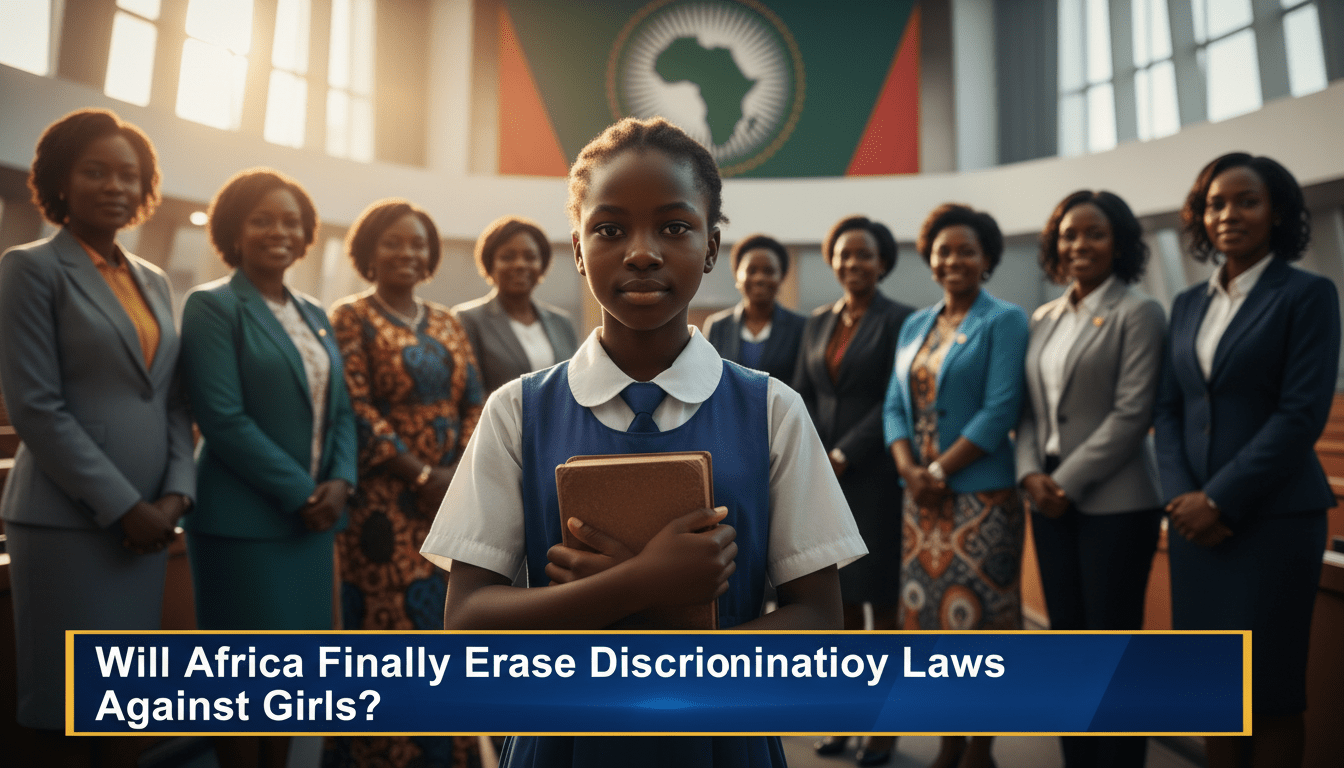
The streets of New York are buzzing this March 2026. Leaders from across the globe have gathered for the 70th Session of the Commission on the Status of Women. At the center of this gathering is the African Union. Specifically, the International Centre for Girls’ and Women’s Education in Africa is leading a bold charge. They are calling for the total harmonization of legal frameworks across the continent. This effort aims to wipe away every law that treats girls as second-class citizens. For the Diaspora, this is more than just foreign policy. It is a vital step toward the global liberation of Black people (au.int, unwomen.org).
The mission focuses on closing gaps that allow child marriage to persist. In many places, national laws say one thing while local customs say another. This confusion leaves young girls vulnerable to exploitation. The African Union wants one clear standard for all 55 member states. They argue that a girl in a rural village deserves the same legal protection as a girl in a major city. This push for legal unity is a key part of the broader strategy for continental growth (newafricanmagazine.com, au.int).
The Long Road to Protecting African Girls
This movement did not start overnight. It is the result of a 35-year journey in legal evolution. The foundation was laid in 1990 with the African Charter on the Rights and Welfare of the Child. This was a historic moment for the continent. It was the first regional treaty to define a child as anyone under 18 years old. It also called for an end to child marriage. This treaty proved that African nations were ready to set their own standards for human rights (au.int, wikipedia.org).
Thirteen years later, the Maputo Protocol took these protections even further. This protocol is widely viewed as one of the most progressive documents for women’s rights in the world. It set the minimum age of marriage at 18 without exception. It also demanded that every marriage happen with full and free consent. Over the years, 46 out of 55 African nations have ratified this agreement. However, signing a paper is only the first step. The real challenge is making those promises a reality in every local community (soawr.org, au.int).
Source: AU Research Notes & UN Data
The journey continued in 2004 with the creation of the AU/CIEFFA. This office focuses specifically on the education of girls. They understand that education is the most powerful tool against child marriage. When a girl stays in school, she is much less likely to be married off early. Leaders realized that the strength and resilience of families depends on the safety of children. Consequently, the African Union began to link education directly to legal reform (au.int, unisapressjournals.co.za).
Closing the Loopholes in Modern Law
Today, the biggest hurdle is what experts call the “implementation gap.” Many countries have passed national laws that ban child marriage. Yet, these same countries often have “judicial consent” loopholes. This means a judge can still give permission for a child to marry under certain conditions. Often, pregnancy or family poverty are used as excuses. The African Union is now demanding that these exceptions be removed entirely. They want a “zero tolerance” policy that applies to every courtroom on the continent (girlsnotbrides.es, amazonaws.com).
Another issue is the existence of dual legal systems. Many African nations balance European-style civil law with traditional customary law. In some cases, traditional leaders might approve a marriage that civil law forbids. This creates a dangerous grey area. The harmonization push at CSW70 seeks to ensure that civil laws always take priority. This is about establishing a clear balance of political power that favors human rights over outdated traditions. Harmonization makes the law predictable and protective for everyone (newafricanmagazine.com, pmg.org.za).
In 2025, the African Union added a new weapon to this fight. They adopted the Convention on Ending Violence Against Women and Girls. This convention is legally binding and includes strict accountability rules. It requires states to collect data on how they are protecting girls. It also uses a digital system called the AU Gender Observatory to track progress. Now, governments cannot just make promises; they must prove they are taking action. This level of oversight is a game-changer for justice in Africa (au.int, au.int).
Education as a Legislative Shield
The African Union is not just looking at criminal laws. They are also looking at education statutes. The #AfricaEducatesHer campaign is a central part of the strategy at CSW70. This initiative calls for laws that make secondary education compulsory for every girl. If the law requires a girl to be in school, it becomes much harder for a parent to marry her off. Education essentially acts as a legal shield that protects her future (au.int, reliefweb.int).
The data clearly supports this approach. Research shows that every extra year of secondary school reduces the chance of child marriage. Specifically, each year of schooling drops the risk by about 7.5 percentage points. This is why the African Union is pushing for transforming educational systems to be more inclusive. They want schools to be safe spaces where girls can grow without fear of being removed for marriage. This is a practical solution to a complex social problem (unfpa.org, amazonaws.com).
Source: World Bank & African Union Statistics
However, the challenge remains immense. There are currently 98 million children and adolescents out of school in Sub-Saharan Africa. Many of these are girls who have been forced out by poverty or conflict. In fragile states like Sudan or the Eastern DRC, girls are 2.5 times more likely to be out of school. The African Union is calling for special legal protections for these displaced girls. They want to ensure that war does not become an excuse for violating a girl’s right to an education (au.int, reliefweb.int).
The Final Nine: A Call for Total Ratification
While most of Africa has joined the Maputo Protocol, nine countries still hold out. These are often called the “Final Nine.” They include states like Egypt, Morocco, Sudan, and Niger. In these nations, resistance often comes from religious or very traditional groups. They argue that the Protocol interferes with their local ways of life. However, activists across the continent disagree. They believe that no culture should justify the harm of a child (amnesty.org, soawr.org).
The situation in Niger is especially critical. The country has one of the highest child marriage rates in the world, exceeding 70 percent. Without their cooperation, the dream of a harmonized Africa remains incomplete. The African Union is using the CSW70 stage to put pressure on these nine states. They want a continent where a girl’s rights are respected from Cairo to Cape Town. This unity is essential for the goals of Agenda 2063, which envisions a prosperous and integrated Africa (au.int, amazonaws.com).
Pressure is also coming from within these countries. Local women’s groups are demanding that their governments sign the protocol. They are tired of seeing their daughters lose their futures. These groups are working with the Pan-African Parliament to draft “Model Laws.” These models show exactly how to rewrite national codes to align with the Maputo Protocol. This provides a clear path forward for any government willing to make the change (au.int, soawr.org).
The Role of the Global Diaspora
The African Union considers the Diaspora to be the “Sixth Region” of the continent. This means people of African descent in the United States and elsewhere are part of this story. When Africa strengthens its laws, it strengthens the global Black community. The fight for gender justice in Africa parallels the struggles for equality in the West. It is all part of a single movement for human dignity (au.int, au6rg.org).
In the United States, current leadership under President Donald Trump has shown interest in African trade. However, there is tension regarding social policies. During the CSW70 session, the U.S. delegation expressed concerns about “digital justice” and AI regulation. They want to protect American technology companies from foreign rules. Meanwhile, African leaders argue that digital spaces must be safe for women and girls. This debate shows how global politics can impact local safety (passblue.com).
84% OF THE CONTINENT
Despite these tensions, the partnership between the U.S. and Africa remains important. Programs like the 2X Women’s Initiative provide funding for women-led businesses. When African girls are educated and protected, they become the entrepreneurs of tomorrow. This creates a stronger market for global trade. For the Diaspora, this economic empowerment is a way to build lasting bridges with the continent. Justice and prosperity go hand in hand (au.int, passblue.com).
Champions Leading the Way
Success in this movement requires strong leadership. Several “Champions” have stepped up to lead the charge. President Hakainde Hichilema of Zambia is one such leader. He has overseen the passage of new laws in his own country to end child marriage. He serves as a model for other heads of state. His work shows that political will can overcome even the oldest traditions (au.int, ejscenter.org).
Another key figure is Simone Yankey, the head of AU/CIEFFA. She is the one leading the technical team at CSW70. She understands that while laws are made in parliaments, they are lived in the community. She works closely with traditional and religious leaders to gain their support. Her approach is about building bridges rather than burning them. She believes that everyone must be part of the solution for it to last (au.int).
The African Union’s push for legal harmony is a historic effort. It is an attempt to rewrite the future for millions of girls. By closing loopholes and prioritizing education, they are building a safer continent. This mission at CSW70 is not just about today’s headlines. It is about creating a legacy of justice that will last for generations. The world is watching, and for the Diaspora, the progress of the continent is a source of immense pride (newafricanmagazine.com, au.int, au.int).
About the Author
Darius Spearman is a professor of Black Studies at San Diego City College, where he has been teaching for over 20 years. He is the founder of African Elements, a media platform dedicated to providing educational resources on the history and culture of the African diaspora. Through his work, Spearman aims to empower and educate by bringing historical context to contemporary issues affecting the Black community.
