

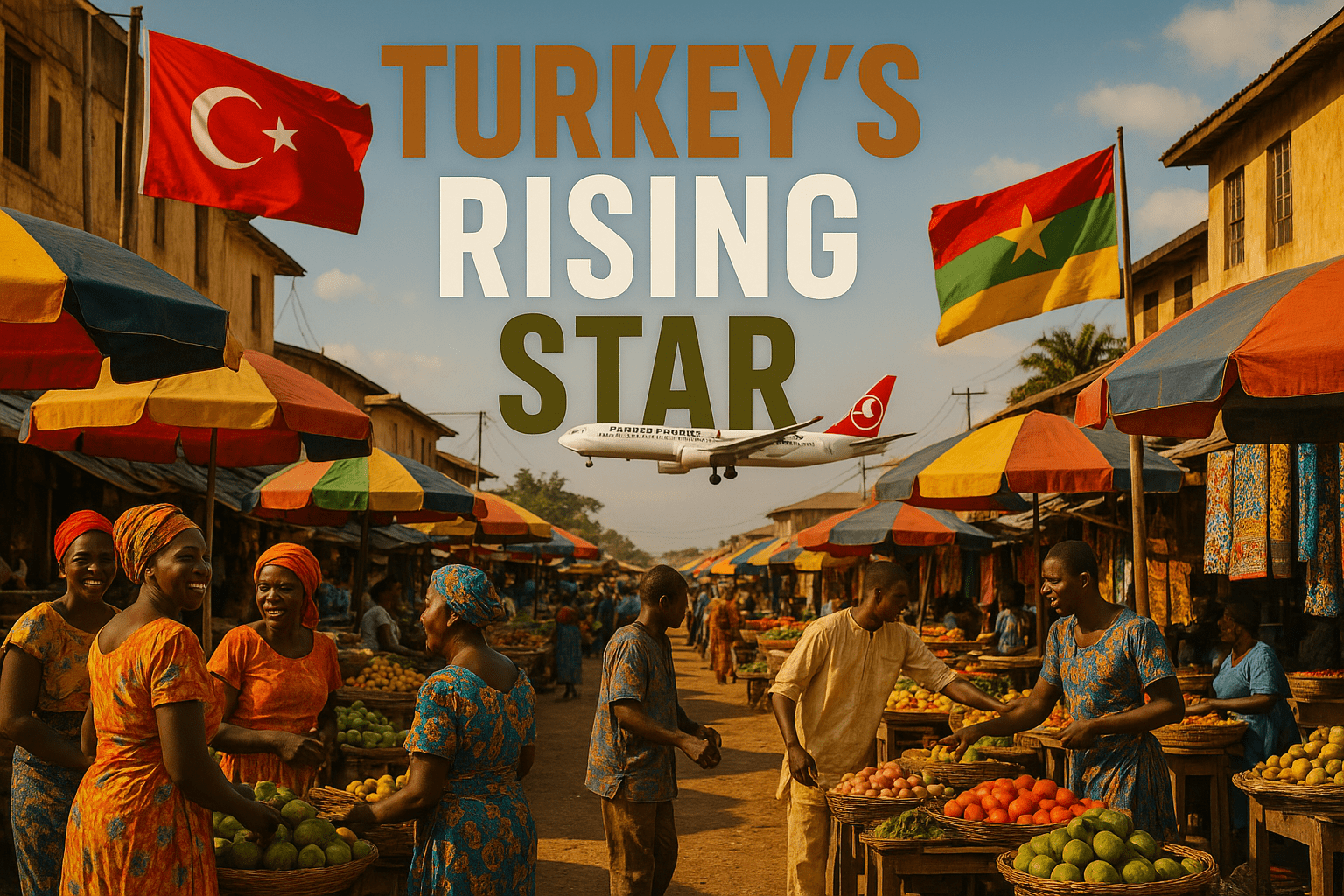
Turkey’s Rising Star in West Africa: A New Era of Engagement
By Darius Spearman (africanelements)
Support African Elements at patreon.com/africanelements and hear recent news in a single playlist. Additionally, you can gain early access to ad-free video content.
Ankara’s Two-Pronged Approach to African Influence
Turkey is steadily increasing its presence and influence across West Africa, adapting to the changing geopolitical and economic landscape of the region. This growing engagement is driven by a strategic, two-pronged approach that combines both official state power and vibrant grassroots initiatives (The Gülen Movement in Africa: From Turkish Transnational Asset to Anti-State Lobby). On one hand, state-backed agencies form the institutional pillar of this strategy. These include embassies, the religious affairs directorate Diyanet, and the economic cooperation agency known as TIKA (The Gülen Movement in Africa: From Turkish Transnational Asset to Anti-State Lobby).
Furthermore, non-state actors play a crucial role in these grassroots efforts. Religious foundations and various non-governmental organizations have been instrumental in laying the groundwork for Turkey’s expansion into Africa, often preceding official government involvement (The Gülen Movement in Africa: From Turkish Transnational Asset to Anti-State Lobby). This blend of state and non-state efforts creates what is known as a “multitrack approach” to engagement (Turkey’s involvement in Sub-Saharan Africa: an empirical analysis of multitrack approach). This complex interaction between institutional power and grassroots initiatives allows various entities to contribute to Turkey’s foreign policy goals in the region. The effectiveness of this strategy has made Turkey a newly relevant player in Sub-Saharan Africa (Turkey’s involvement in Sub-Saharan Africa: an empirical analysis of multitrack approach).
The Gülen Movement’s Evolving Role in Turkish Diplomacy
A significant player in Turkey’s early soft power initiatives in Africa was the Gülen movement. This Islamic transnational religious and social organization developed a wide-ranging network both within Turkey and internationally (The Gülen Movement in Africa: From Turkish Transnational Asset to Anti-State Lobby). Between 2003 and 2014, the Gülen movement held a special place in shaping and carrying out Turkey’s public diplomacy in Africa, primarily through its extensive network of schools (The Gülen Movement in Africa: From Turkish Transnational Asset to Anti-State Lobby). For many years, Turkey effectively used this network to achieve both political and economic advantages (The Gülen Movement in Africa: From Turkish Transnational Asset to Anti-State Lobby).
The Gülen movement’s core beliefs were strongly shaped by Turkish nationalism and statism. Its focus was on celebrating Turkey, rather than solely spreading Islam (From ‘Diaspora by Design’ to Transnational Political Exile: The Gülen Movement in Transition). However, a major political split occurred in 2016 between the Turkish government and the Gülen movement. The Turkish government holds Fethullah Gülen responsible for orchestrating a coup attempt, referring to the movement as FETÖ, or the Fethullahist Terrorist Organisation (brill.com). Since 2016, Turkey has experienced an unprecedented wave of arrests and purges within the state sector, ostensibly targeting members of the Gülen movement (brill.com). Following this rift, the state-run Maarif Foundation gradually took over the Gülen-affiliated schools, shifting the landscape of Turkish educational diplomacy in Africa.
Expanding Diplomatic Reach and Economic Ties
Turkey’s diplomatic presence across Africa has grown significantly over the past two decades. In 2003, Turkey maintained only 12 diplomatic missions on the continent. Today, that number has surged to 44, demonstrating a clear commitment to deeper engagement. This expansion is further supported by Turkish religious foundations, non-governmental organizations, and entrepreneurs who have stepped in to fill the void left by the Gülen movement.
Turkish Airlines has also become a powerful force in Turkey’s Africa strategy. It is now one of the leading carriers on the continent, flying to 62 airports in 41 African countries. This extensive network facilitates increased trade and connectivity. The economic engagement between Turkey and Africa has indeed yielded significant results. The trade volume between Turkey and Africa reached an impressive US$40.7 billion in 2022. This growth is also evident in large-scale development projects, such as Turkey’s proposed $4 billion development of Sudan’s Suakin Port (Turkish Influence in Sub-Saharan Africa). Turkey has also become a central hub for various sectors, including rhinoplasty, hair transplants, and textiles, supplying markets in cities like Accra, Côte d’Ivoire, and Bamako.
Turkey’s Diplomatic Expansion in Africa
Education as a Pillar of Long-Term Influence
Turkey’s investment in educating African students is a cornerstone of its long-term influence strategy. By opening its doors to African students, Turkey has planted the seeds for enduring relationships. This approach mirrors historical practices where student mobility was used as a powerful tool for diplomacy. As early as 1960, Turkey welcomed students from non-self-governing territories, aligning with United Nations General Assembly resolutions.
The effort continued into the 1990s with a scholarship program for African students, supported by the Islamic Development Bank. During this period, Turkey launched the “Büyük Öğrenci Projesi,” or Great Student Project, which provided scholarships to international students. This program was later rebranded in 2012 as YTB, the Directorate for Turks Abroad and Related Communities. The YTB program introduced reforms, including a digital application process, which led to a dramatic increase in interest. Applications soared from 10,000 to 155,000 between 2012 and 2020. For students not on scholarship, Turkey simplified visa processes, reduced tuition fees, and offered other incentives. The number of universities in Turkey also increased significantly, from 76 to 193 between 2003 and 2015, making the country an increasingly attractive destination for higher education. By 2017, Turkey was the 13th most popular destination for students from sub-Saharan Africa, and by 2019, an estimated 61,000 African students were studying in Turkey. These returning students are now becoming key messengers of “Turkishness” back in their home countries, fostering socioeconomic ties and promoting Turkish universities and tourism.
YTB Student Applications Growth (2012-2020)
Religion and Nationalism in Turkish Foreign Policy
Under the leadership of President Recep Tayyip Erdogan, whose Justice and Development Party (AKP) has Islamist roots, religion has become a crucial tool in Turkish foreign policy (foreignaffairs.com). Turkey is actively building mosques, funding religious education, and restoring Ottoman heritage in various countries, from Latin America to sub-Saharan Africa (foreignaffairs.com). This approach combines Sunni Islam with Turkish nationalism, promoting the Turkish language and culture alongside religious teachings (foreignaffairs.com).
Those who carry out this policy view Turkey, as the successor to the Ottoman Empire, as Islam’s last stronghold and the natural leader for a rebirth of Muslim civilization (foreignaffairs.com). This unique brand of Islamic leadership is a key component of Turkey’s outreach. It aims to foster cultural and religious ties that complement its economic and diplomatic efforts. This strategy helps to build a deeper connection with African populations, particularly in regions with strong Islamic traditions.
Turkey’s Alternative Approach and African Perspectives
Turkey’s strategy in West Africa stands apart from that of traditional powers. It offers an alternative by making access easier for African individuals. While Europe, the United States, and Canada have tightened their visa rules, Turkey has opened its doors. It has simplified visa procedures for African business people, expanded its universities, and actively promoted medical tourism. This accessibility has made Turkey a popular destination for various services, including specialized medical procedures and textile trade.
Furthermore, Turkey has capitalized on the security challenges in the Sahel region. It has sold Bayraktar TB2 drones and offered private security services to some governments, stepping into a space where the military presence of former colonial powers has become controversial. African authorities recognize the opportunity to leverage their relations with Turkey to their advantage (Assessing Turkey-Africa Engagements). They are encouraged to unite their capacities and be more open towards Turkey (Assessing Turkey-Africa Engagements). The emphasis on “ownership” and “equality” in Turkey’s African policy reinforces the idea that African perspectives are considered, aiming for sustainable relations (Assessing Turkey-Africa Engagements). It is important to note that Turkey’s approach to Africa shows regional differences. While Sub-Saharan African countries generally view Turkey positively, historical relations with the Ottoman Empire can lead to more complex perceptions in North Africa (Assessing Turkey-Africa Engagements).
A Lasting Impact and Global Competition
Turkey’s engagement in Africa is clearly yielding significant results, and its presence is becoming increasingly visible across the continent. You can see it in the Maarif schools, the murals at Abidjan airport, the “Le Istanbul” restaurant in Niamey’s government district, and the National Mosque in Accra, which is modeled after Istanbul’s iconic Blue Mosque. The economic ties are robust, with trade volume reaching US$40.7 billion in 2022. The return of African students trained in Turkey has fundamentally changed the dynamic of cooperation. This collaboration no longer depends solely on Turkish business people and social entrepreneurs.
Many of these former students are now working in import-export, construction, and even Islamic religious leadership, forming new voices in the relationship. This trend points to promising prospects for long-term ties. On the diplomatic front, Turkey gained observer status at the African Union in 2005 and has hosted Turkey-Africa summits in Istanbul since 2008. This growing involvement suggests that Turkey’s role in Africa is likely to endure. It will adapt to the continent’s market needs, especially as many African countries reconsider their relationships with traditional Western powers and international institutions.
Turkey’s engagement in Africa is part of a broader competition among major global powers, including China (Turkish Influence in Sub-Saharan Africa). Ankara may even be open to cooperating with Washington in Africa as part of this competition (Turkish Influence in Sub-Saharan Africa). The growing economic and political roles of emerging powers in Sub-Saharan Africa have attracted particular attention, especially following the perceived decline of Western powers after the global economic crisis of 2007–2008 (Turkey’s Sub-imperialism in Sub-Saharan Africa). Some characterize Turkey’s proactive foreign policy in Sub-Saharan Africa as a form of “sub-imperialism,” which involves and reproduces economic and geopolitical rivalries and alliances among Turkey, Western, and Gulf countries (Turkey’s Sub-imperialism in Sub-Saharan Africa). This complex interplay highlights Turkey’s unique position and its ambition to be a significant and lasting partner on the African continent.
Turkey-Africa Trade Volume (2022)
ABOUT THE AUTHOR
Darius Spearman has been a professor of Black Studies at San Diego City College since 2007. He is the author of several books, including Between The Color Lines: A History of African Americans on the California Frontier Through 1890. You can visit Darius online at africanelements.org.
