


Why Minneapolis Overhauled Its Crisis Team
By Darius Spearman (africanelements)
Support African Elements at patreon.com/africanelements and hear recent news in a single playlist. Additionally, you can gain early access to ad-free video content.
A Dangerous Blueprint for 911 Calls
For decades, dialing 911 during an emotional breakdown in Minneapolis invited armed officers into living rooms. Uniformed police officers served as the default responders for psychological emergencies. When people called for medical help, armed force arrived instead. These encounters frequently turned deadly for marginalized residents across the city (mprnews.org, harvard.edu).
Statewide records reflect this grim pattern. Roughly forty-five percent of individuals killed by Minnesota law enforcement since 2000 had documented mental illnesses or experienced acute distress during encounters (mprnews.org). Furthermore, while Black, Indigenous, and People of Color comprised thirty-seven percent of Minneapolis residents, they generated over fifty-two percent of all mental health calls (harvard.edu). This dynamic mirrors systemic struggles traced back through the shift from civil rights into widespread municipal control.
Historical records and Minneapolis call volume comparisons
The Birth of Unarmed Response
Following the police murder of George Floyd in May 2020, neighborhood anger sparked an international reckoning. Twin Cities communities demanded new safety models that removed guns from civilian care. Organizers argued that armed law enforcement officers lacked the skills to defuse acute psychological episodes safely (mprnews.org, wikipedia.org).
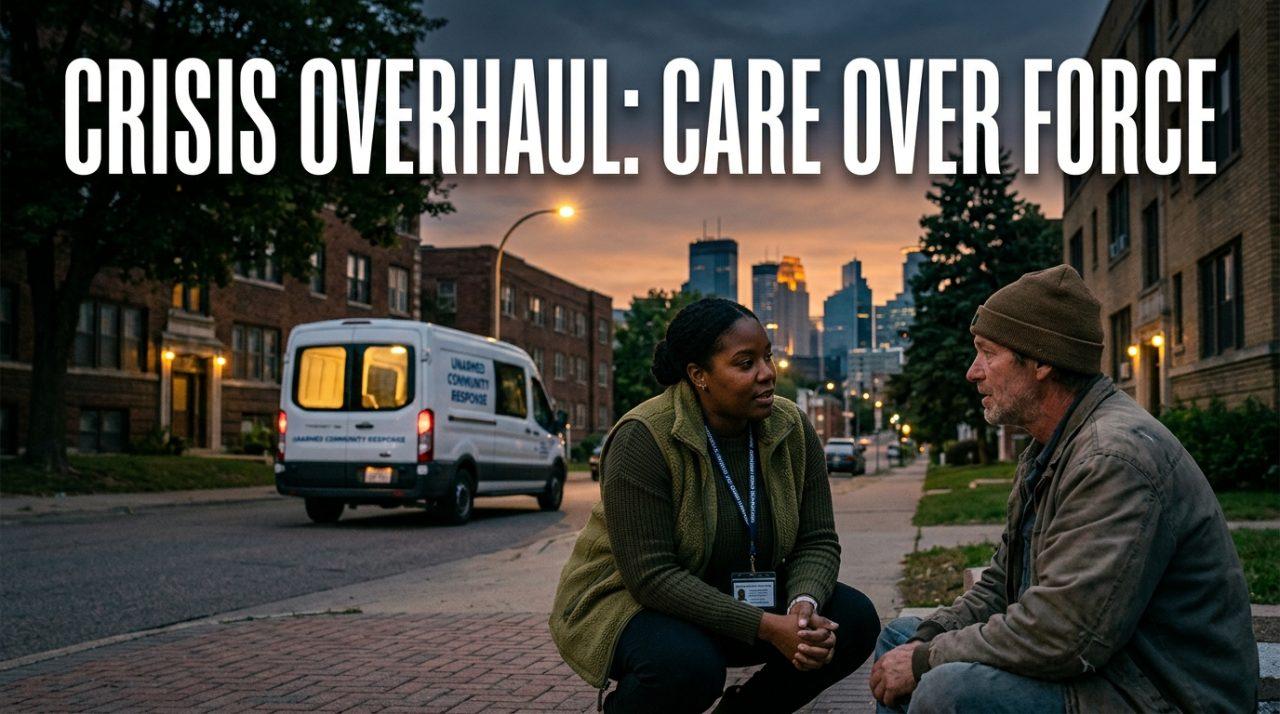
In August 2021, city leaders authorized a six-million-dollar pilot initiative. They partnered with Canopy Roots, a local, majority Black-owned mental health agency (mprnews.org, canopyrootsmn.com). By December 2021, the Behavioral Crisis Response program began rolling out unarmed vans across neighborhood streets. These clinicians traveled without sirens, bulletproof gear, or sidearms (mprnews.org, nlc.org).
Instead of escalating conflicts, frontline staff used calm, restorative dialogue to ground patients. The program quickly proved its worth to neighborhood residents. Responders handled upwards of one hundred twenty calls every week without relying on force or making arrests (mprnews.org, lwvmpls.org). Soon, the city expanded the pilot into an active, round-the-clock emergency team (mprnews.org, minneapolismn.gov).
Legal Mandates and Federal Approval
The Behavioral Crisis Response program was not an optional social service experiment. It soon became a legally binding requirement for the entire municipality. In April 2022, the Minnesota Department of Human Rights found probable cause that local police engaged in systemic racial bias (mn.gov).
Consequently, in March 2023, the state entered into a court-enforceable settlement agreement with municipal leaders. Under this strict mandate, the city must maintain and fund civilian behavioral emergency teams (mprnews.org, mn.gov). The historical struggle to hold institutions legally accountable echoes long-standing efforts seen in earlier civil rights campaigns against systemic inequities.
Three months later, the federal Department of Justice released its own civil rights report. While investigators documented shocking abuses by armed officers, they praised the civilian crisis teams. Direct federal observations confirmed that Canopy Roots provided compassionate, safe crisis de-escalation across Minneapolis (mprnews.org).
The Pivot Toward Corporate Management
Despite federal accolades, municipal administrators made an unexpected move in late 2026. Officials chose to recommend a five-point-nine-million-dollar contract to Community Bridges Inc., an out-of-state provider based in Arizona (mprnews.org). This large corporate organization oversees roughly seventeen hundred workers across several western states (mprnews.org).
The administration asserted that regional expansion required larger infrastructure and specialized facilities. City managers claimed that modern emergency response must integrate long-term addiction recovery and shelter resources (mprnews.org). Furthermore, internal staff raised administrative complaints regarding Canopy Roots. Officials pointed to bookkeeping friction and paperwork challenges as the local agency scaled its operations (mprnews.org).
Nevertheless, community leaders reacted with profound skepticism. The proposal cast aside a successful Black-led institution in favor of an outside corporate firm. Activists noted that big organizations often lack genuine roots in historically oppressed neighborhoods (mprnews.org).
Comparing organizational scale, community roots, and operational structure
Locally based, majority Black-owned agency embedded in Minneapolis neighborhoods with culturally responsive frontline teams.
Arizona-based multi-state behavioral healthcare corporation utilizing large institutional scale and regional shelter facilities.
Community Trust and De-Escalation
Alternative crisis intervention works primarily because of community trust. When residents see clinicians who share their racial backgrounds, defensive barriers dissolve quickly. Shared life experience allows workers to calm acute paranoia without coercion. These methods break generational trauma caused by carceral policing (canopyrootsmn.com, canopyrootsmn.com).
Unarmed specialists understand local slang, family connections, and neighborhood tensions. Consequently, patients feel listened to rather than managed like threats. Over thirty thousand dispatches concluded safely because of this crucial bond (mprnews.org). Trust took years to build among traumatized residents throughout South and North Minneapolis.
Replacing local caregivers with an outside corporate entity creates severe operational hazards. If vulnerable people associate crisis teams with outsiders, they may stop calling entirely. Disconnecting community care from trusted organizations puts marginalized residents back into direct danger with armed police.
The Threat of Mission Drift
The city’s procurement shift highlights a major conflict over public safety priorities. Activists envisioned the crisis program as an emergency shield against police violence. However, municipal officials increasingly view mobile crisis workers through the lens of neighborhood livability (mprnews.org).
This subtle shift redirects mental health teams toward managing public encampments and neighborhood complaints. When teams focus on business disputes and visible poverty, their core mission fractures. Unhoused citizens quickly begin viewing clinicians as enforcement agents rather than medical caregivers (mprnews.org).
In practice, livability sweeps prioritize property comfort over patient health. These tactics replicate punitive patterns seen throughout historical civil rights struggles for genuine safety. Unarmed workers should never become public clearing agents for people surviving on the streets.
The Pushback at City Hall
Elected leaders refused to rubber-stamp the controversial proposal without questions. On September 23, 2026, the City Council Public Health, Safety and Equity Committee froze the decision (mprnews.org). Committee Chair Jason Chavez objected strongly to administrative secrecy surrounding the provider selection process (mprnews.org).
Council President Elliott Payne noted that staff presented no viable transition plan (mprnews.org). Discarding an existing workforce without safeguards risks massive service gaps across neighborhoods. If mobile units go dark, 911 dispatchers will redirect crisis calls directly back to armed police officers (mprnews.org).
This looming disruption directly threatens compliance with state human rights orders (mprnews.org, mn.gov). The Minnesota Department of Human Rights closely tracks emergency response metrics. Any rollback in service capacity could trigger court sanctions against the city (mn.gov). Because of these grave risks, lawmakers delayed the vote until October 7, 2026 (mprnews.org).
Accountability and the Road Ahead
The controversy in Minneapolis reveals the vulnerability of post-2020 municipal reforms. When political momentum cools, bureaucratic procurement can dismantle community programs. Transforming crisis response requires sustained institutional support, not sudden corporate outsourcing (mprnews.org).
True public safety depends on cultural dignity and neighbor-to-neighbor empathy. Community members built this alternative system through determination, sorrow, and organizing. Discarding local caregivers threatens the very foundation of civilian care (mprnews.org). The upcoming council decision will determine whether safety remains truly rooted in community healing.
About the Author
Darius Spearman is a professor of Black Studies at San Diego City College, where he has been teaching for over 20 years. He is the founder of African Elements, a media platform dedicated to providing educational resources on the history and culture of the African diaspora. Through his work, Spearman aims to empower and educate by bringing historical context to contemporary issues affecting the Black community.
