

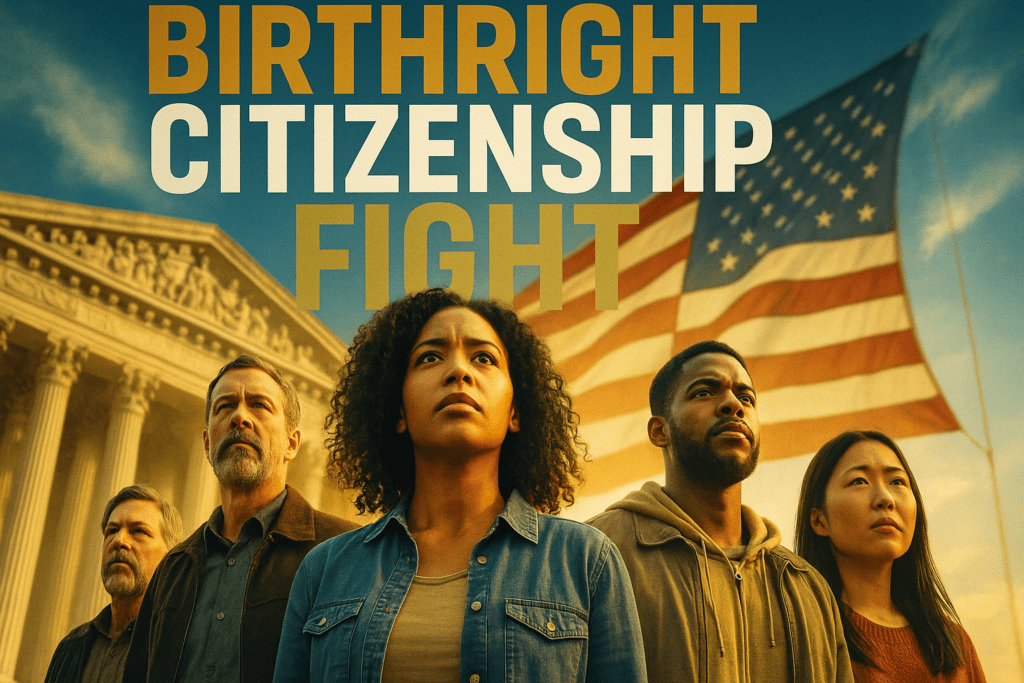
Birthright Citizenship: A Constitutional Crossroads
By Darius Spearman (africanelements)
Support African Elements at patreon.com/africanelements and hear recent news in a single playlist. Additionally, you can gain early access to ad-free video content.
Understanding Universal Injunctions
The Supreme Court recently made a significant ruling that impacts how federal courts can challenge presidential actions. This decision, in the case of Trump v. CASA, focused on a legal tool known as a universal or nationwide injunction. Such an injunction allows a single federal judge to temporarily stop a presidential policy from being enforced across the entire country (The Conversation). This happens even before the courts fully decide if the policy is constitutional.
A typical injunction, by contrast, usually applies only to the specific people or groups directly involved in a lawsuit. Universal injunctions are controversial because some argue they limit the Executive Branch’s ability to do its job. Others believe it is unconstitutional for federal judges to issue such broad orders (The Conversation). The Supreme Court’s 6-3 decision granted a partial stay of these universal injunctions, signaling that they likely go beyond what federal courts are allowed to do (aila.org).
Supreme Court Ruling Split
The Executive Order and Birthright Citizenship
The Supreme Court’s ruling came in response to Executive Order 14160, titled “Protecting the Meaning and Value of American Citizenship” (everycrsreport.com). This order, issued by President Trump, aimed to restrict birthright citizenship. It sought to deny citizenship to children born on U.S. soil if neither parent was a U.S. citizen or a lawful permanent resident at the time of birth (aila.org). This executive order represented a dramatic shift from how the Fourteenth Amendment’s Citizenship Clause has been understood for a very long time (oyez.org).
Birthright citizenship is a fundamental principle in the United States, rooted in the Constitution’s 14th Amendment. This amendment states that everyone “born or naturalized in the United States, and subject to the jurisdiction thereof,” is a citizen (scotusblog.com). This clause was particularly important after the Civil War, as it ensured citizenship for formerly enslaved people. For over 150 years, this amendment has been understood to grant citizenship to nearly all individuals born in the U.S., regardless of their parents’ immigration status (newsone.com). President Trump’s order directly challenged this long-standing understanding.
Judicial Power and the Rule of Law
The Supreme Court’s decision did not actually rule on whether President Trump’s executive order on birthright citizenship is constitutional. Instead, the Court focused on the procedural question of whether federal judges have the authority to issue nationwide injunctions (npr.org). This means the core question of birthright citizenship’s legality remains unanswered by the highest court. The Trump administration argued that these broad injunctions prevent the Executive Branch from carrying out its duties and are unconstitutional for judges to issue (The Conversation).
Critics argue that this ruling creates significant problems for the rule of law. Justice Sotomayor, in her powerful dissent, stated that “No right is safe in the new legal regime the Court creates” (aila.org). This decision makes it much harder for courts to stop the Trump administration from implementing its plans to revoke birthright citizenship for those it deems “not white” (thenation.com). It forces individuals who are affected to sue in every single court jurisdiction to protect their rights, which could lead to different applications of the Constitution depending on where a person lives (newsone.com). Elie Mystal of The Nation called the ruling “utter legal chaos” and a “five-alarm catastrophe” (thenation.com).
States Challenging the Order
Advocacy and Ongoing Resistance
Immigrant rights advocates and civil liberties organizations have strongly condemned the Supreme Court’s decision. Before this ruling, immigrant rights groups and 22 states had already sued over President Trump’s executive order (npr.org). Three different federal district court judges had previously invalidated the order and issued universal injunctions to block its enforcement (npr.org). Despite the Supreme Court’s partial stay, these groups are not backing down.
A coalition of advocates, including the ACLU and the Legal Defense Fund, immediately filed a nationwide class-action lawsuit to challenge the executive order (newsone.com). This action tests the limits of the majority’s opinion. Tianna Mays, legal director for State Democracy Defenders Fund, emphasized that “Birthright citizenship is a clear principle of U.S. law. Any challenge to this is an attack on the rule of law and the protections of the 14th Amendment” (aclu.org). Stop AAPI Hate also condemned the decision, urging representatives to support the “Born in the USA Act,” which would prevent federal funds from being used to fulfill President Trump’s executive order (stopaapihate.org).
An Attack on the 14th Amendment and Democracy
Many see President Trump’s executive order and the Supreme Court’s recent ruling as a direct assault on the 14th Amendment and a dangerous step towards authoritarianism. President Trump’s belief that automatic citizenship does not exist for people born in the U.S. goes against a Supreme Court ruling from 127 years ago that has never been overturned (npr.org). Karla McKanders, director of LDF’s Thurgood Marshall Institute, stated that the executive order attempts to illegally rewrite the 14th Amendment (aclu.org). This amendment granted citizenship to all persons born or naturalized in the U.S., including formerly enslaved people, and McKanders views the order as an unlawful attempt to create racial hierarchies (newsone.com).
The 14th Amendment, one of the Reconstruction Era amendments, has been a cornerstone for equal protection, due process, and various civil and human rights in the United States (newsone.com). Challenging it is seen as erasing a core American promise. Judith Browne Dianis, executive director of the Advancement Project, called the decision “one of the most dangerous and blatantly unconstitutional attacks on immigrant communities and the rule of law in modern history” (newsone.com). She also described it as a “calculated step toward authoritarianism” (newsone.com). Justice Ketanji Brown Jackson, in her dissent, asserted that this “perverse burden shifting cannot coexist with the rule of law” and puts the judiciary and the system of government in “grave jeopardy” (newsone.com).
Historical Foundations of Birthright Citizenship
The Path Forward for Affected Families
The Supreme Court’s decision to limit universal injunctions has significant practical implications. Since the ruling did not address the constitutionality of President Trump’s executive order, the legal battle over birthright citizenship will continue in lower courts (americanprogress.org). This means that individuals and families affected by the executive order may need to pursue multiple lawsuits across different jurisdictions to protect their rights. The government has suggested that class-action lawsuits could be an alternative to nationwide injunctions, where a ruling could bind an entire group of affected individuals (scotusblog.com).
However, if one challenge for a nationwide injunction fails, it does not stop others from trying again (scotusblog.com). This situation could create a complex and lengthy legal process for families seeking to affirm their citizenship. The ruling is seen as a calculated move to disempower communities of color, particularly Latine, AAPI, African, and Caribbean immigrant families (newsone.com). It comes alongside other executive orders that critics say aim to dismantle racial equity, voting rights, and immigration protections, all designed to chip away at collective power (newsone.com).
ABOUT THE AUTHOR
Darius Spearman has been a professor of Black Studies at San Diego City College since 2007. He is the author of several books, including Between The Color Lines: A History of African Americans on the California Frontier Through 1890. You can visit Darius online at africanelements.org.
