
Listen to this article
Download AudioTrump’s Africa Pivot: Trade Over Aid
By Darius Spearman (africanelements)
Support African Elements at patreon.com/africanelements and hear recent news in a single playlist. Additionally, you can gain early access to ad-free video content.
A New Chapter in U.S.-Africa Relations
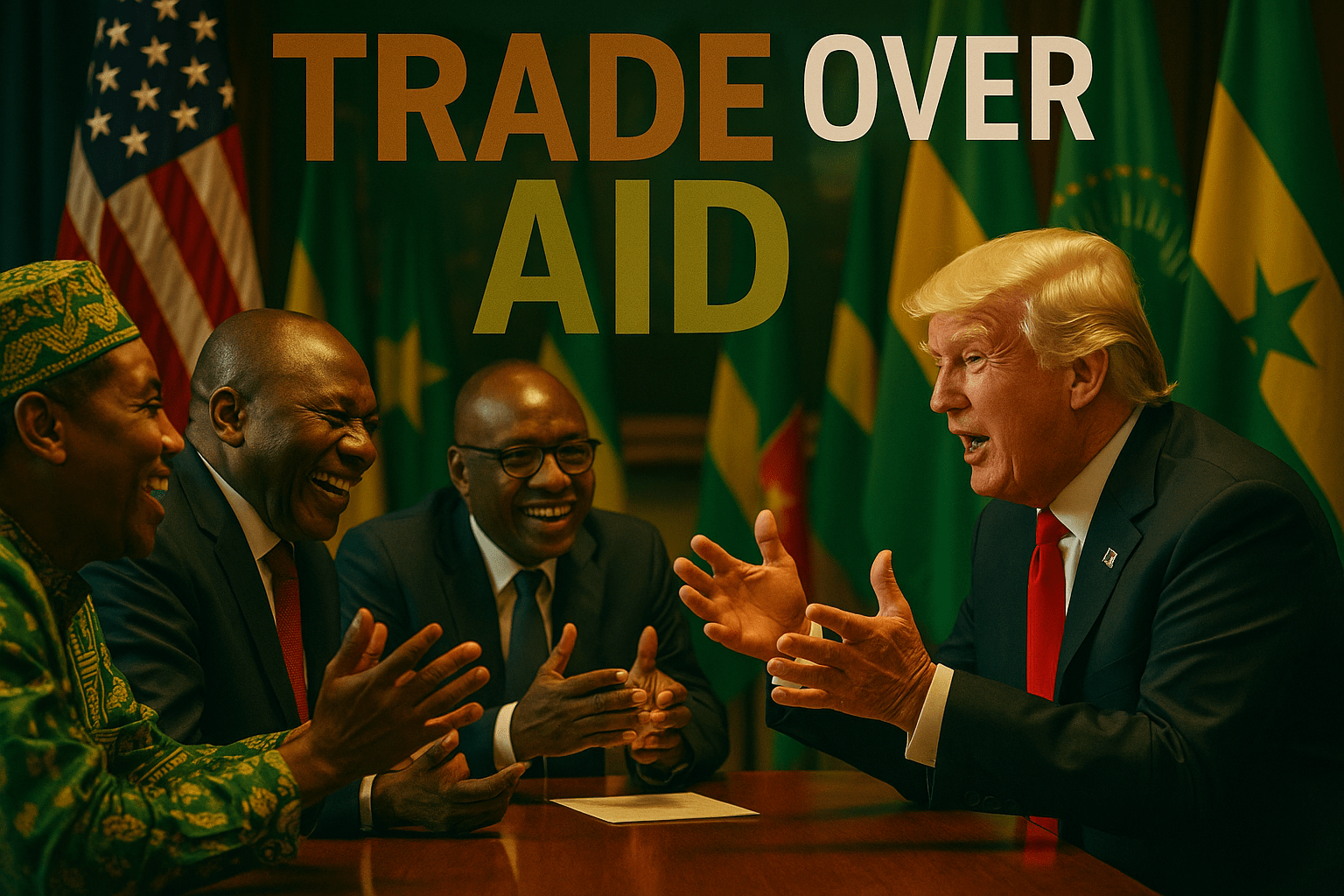
President Donald Trump recently hosted leaders from five West African nations at the White House. This meeting marked a significant shift in how the United States approaches its relationship with the African continent. The focus has moved away from traditional aid and toward building stronger trade and commercial ties (npr.org). The leaders present were from Senegal, Liberia, Guinea-Bissau, Mauritania, and Gabon (npr.org).
This three-day mini-summit was described by the White House as a push to deepen “commercial opportunities” between the U.S. and African nations (npr.org). Discussions centered on business opportunities (reuters.com). The Trump administration has taken radical steps to reshape this relationship, moving away from a “charity-based foreign aid model” (aljazeera.com). This new approach emphasizes partnerships with nations that show “both the ability and willingness to help themselves” (aljazeera.com).
Understanding the Transactional Approach
The “transactional approach” to foreign policy, embraced by the Trump administration, represents a major change. It prioritizes trade, commercial opportunities, and securing U.S. interests over traditional aid-based models. This differs from past U.S. policy by focusing on direct benefits and mutual agreements, often using economic incentives and disincentives (csis.org). The “America First” policy guides this shift, aiming to secure U.S. access to critical minerals, counter terrorism, and challenge China’s growing economic influence in Africa (csis.org).
African countries are also using this transactional approach to create new opportunities for themselves. For example, the Democratic Republic of Congo (DRC) has engaged in a “minerals-for-security deal” (brookings.edu). Somalia has also proposed a port access agreement (brookings.edu). This new strategy focuses on market reforms and infrastructure projects designed to create market opportunities for American companies (devex.com). It is a clear move away from traditional development aid (devex.com).
U.S. Policy Shift
How America’s engagement with Africa has moved from aid-focused to trade-driven strategies.
Previous: Aid-Based Model
Decades of U.S. foreign assistance centered on grants, development projects, and humanitarian aid to address immediate needs.
Current: Trade & Commercial Opportunities
New emphasis on investment, market access, and private-sector partnerships to foster sustainable economic growth and mutual prosperity.
The End of USAID and Its Impact
A major part of this policy change was the dissolution of the U.S. Agency for International Development (USAID) earlier this month (aljazeera.com). USAID was once a key player in U.S. foreign aid, providing development and humanitarian assistance worldwide. Its dissolution signals a move away from the “charity-based foreign aid model” (apnews.com). This means African countries could see a reduction in direct development and humanitarian support. They may need to find other sources of funding or rely more on market-based partnerships (apnews.com).
For U.S. global influence, this change could lessen its soft power and humanitarian reach. However, it might also strengthen economic ties with certain nations (apnews.com). West African countries, like Liberia, have been particularly affected by USAID’s dissolution. U.S. support in Liberia previously amounted to 2.6% of the country’s gross national income, which was the highest percentage anywhere in the world (apnews.com). Other institutions like the U.S. Millennium Challenge Corporation, which helped facilitate trade, have also been “gutted” or “dismantled” (devex.com).
Critical Minerals and Global Competition
The focus on trade and commercial opportunities is closely tied to the abundant natural resources found in these African nations (abc7ny.com). Critical minerals are essential for advanced technologies, renewable energy, and defense industries in the U.S. Their importance is even greater because of the competition with China (csis.org). China currently controls much of the global supply chain for many of these minerals, creating a strategic vulnerability for the U.S. (csis.org).
The Trump administration has made securing U.S. access to critical minerals a key part of its foreign policy in Africa (csis.org). For instance, the effort to broker a peace deal between Rwanda and the Democratic Republic of Congo (DRC) is significant (aljazeera.com). The DRC holds some of the world’s largest reserves of critical and rare earth minerals (csis.org). This peace deal was widely seen as a step towards a rare earth minerals agreement (npr.org). The DRC’s “minerals-for-security deal” shows how African countries are using the transactional approach to their advantage (brookings.edu).
Why Critical Minerals Matter to the U.S.
Used in electronics, computers, and high-tech devices.
Essential for batteries, solar panels, and wind turbines.
Crucial for military equipment and national security.
Securing supply chains reduces reliance on dominant suppliers like China.
Critical minerals are vital for various U.S. industries and strategic interests, especially in the context of global competition for resources. Source: (csis.org)
Migration, Drug Trafficking, and Security
Beyond trade, migration and drug trafficking were also important topics for the Trump administration. Senegal and Mauritania are significant transit and origin countries for migration (abc7ny.com). These nations, along with Guinea-Bissau, are struggling to control drug trafficking (abc7ny.com). These issues are a concern for the U.S. administration, highlighting their impact on regional stability and international security (abc7ny.com).
President Trump mentioned making “progress on the safe third country agreements” with the five African nations (npr.org). However, he did not share specific details (npr.org). A “safe third country agreement” means that asylum seekers who pass through a country considered “safe” before reaching their intended destination can be sent back to that “safe” country to claim asylum there. This policy aims to reduce the number of asylum claims in the destination country. In June, reports surfaced about a potential U.S. travel ban affecting Gabon, Liberia, Mauritania, and Senegal (france24.com). This was part of a larger list of 36 countries under scrutiny (france24.com).
African Leaders’ Perspectives and Praise
The visiting African leaders expressed optimism about the economic opportunities presented by this new approach. Mauritania President Mohamed Ould Ghazouani praised President Trump’s commitment to the continent (france24.com). Guinea-Bissau’s President Umaro Sissoco Embalo stated, “Economically, this is a great opportunity opening for us” (france24.com). Senegal’s President Bassirou Diomaye Faye even suggested investment opportunities in tourism, including a golf course (france24.com).
President Trump made comments about “anger” on the African continent, claiming his administration had solved much of it (npr.org). He referenced a recent peace deal between the Democratic Republic of Congo and Rwanda, brokered by the U.S. (aljazeera.com). While the specific terms of this deal are not fully detailed, its significance lies in the U.S. effort to secure access to critical minerals (csis.org). This highlights the U.S.’s transactional approach, linking regional stability to strategic resource interests (brookings.edu).
Trade Volume and Future Summits
It is important to note that the five nations whose leaders met President Trump represent only a small fraction of overall U.S.-Africa trade (abc7ny.com). While specific comparative figures are not available, the focus on these countries suggests their untapped natural resources and their strategic importance for migration and drug trafficking, rather than their current trade volume (abc7ny.com). In 2023, over half of African exports to the U.S. were mineral fuels and precious stones (brookings.edu).
Africa experts are looking forward to President Trump announcing dates for a broader summit with African leaders (reuters.com). This larger meeting might happen in September, around the time of the United Nations General Assembly (reuters.com). Given the administration’s “America First” and transactional approach, such a summit would likely aim to further U.S. economic interests and secure access to critical resources (csis.org). It would also likely address shared security concerns and counter rival influences like China (csis.org). The U.S. also aims to re-energize support for U.S. companies and small and medium-sized enterprises to invest in Africa (brookings.edu). Supporting the African Continental Free Trade Area (AfCFTA) could also be a topic, as it would give U.S. investors access to one of the world’s largest free trade areas (brookings.edu).
U.S. Trade with West African Nations
The five West African nations represent a small portion of total U.S.-Africa trade, yet their untapped resources and strategic importance drive current U.S. engagement. Source: (abc7ny.com)
President Trump’s Travel Plans
President Trump stated he would “very much like” to go to Africa “at some point” (npr.org). However, he added that he would need to check his schedule first (npr.org). His predecessor, President Joe Biden, promised to visit Africa in 2023. He only fulfilled that promise by visiting Angola in December 2024, just weeks before leaving office (npr.org).
This shift in U.S. foreign policy towards Africa is a significant development. It moves away from traditional aid and toward a more transactional relationship based on trade, resources, and mutual interests. For the African diaspora, this change means watching closely how these new partnerships will affect the continent’s development, self-determination, and its place in global power dynamics. The focus on commercial opportunities and critical minerals suggests a future where economic partnerships, rather than aid, will define the relationship between the U.S. and African nations.
ABOUT THE AUTHOR
Darius Spearman has been a professor of Black Studies at San Diego City College since 2007. He is the author of several books, including Between The Color Lines: A History of African Americans on the California Frontier Through 1890. You can visit Darius online at africanelements.org.
