
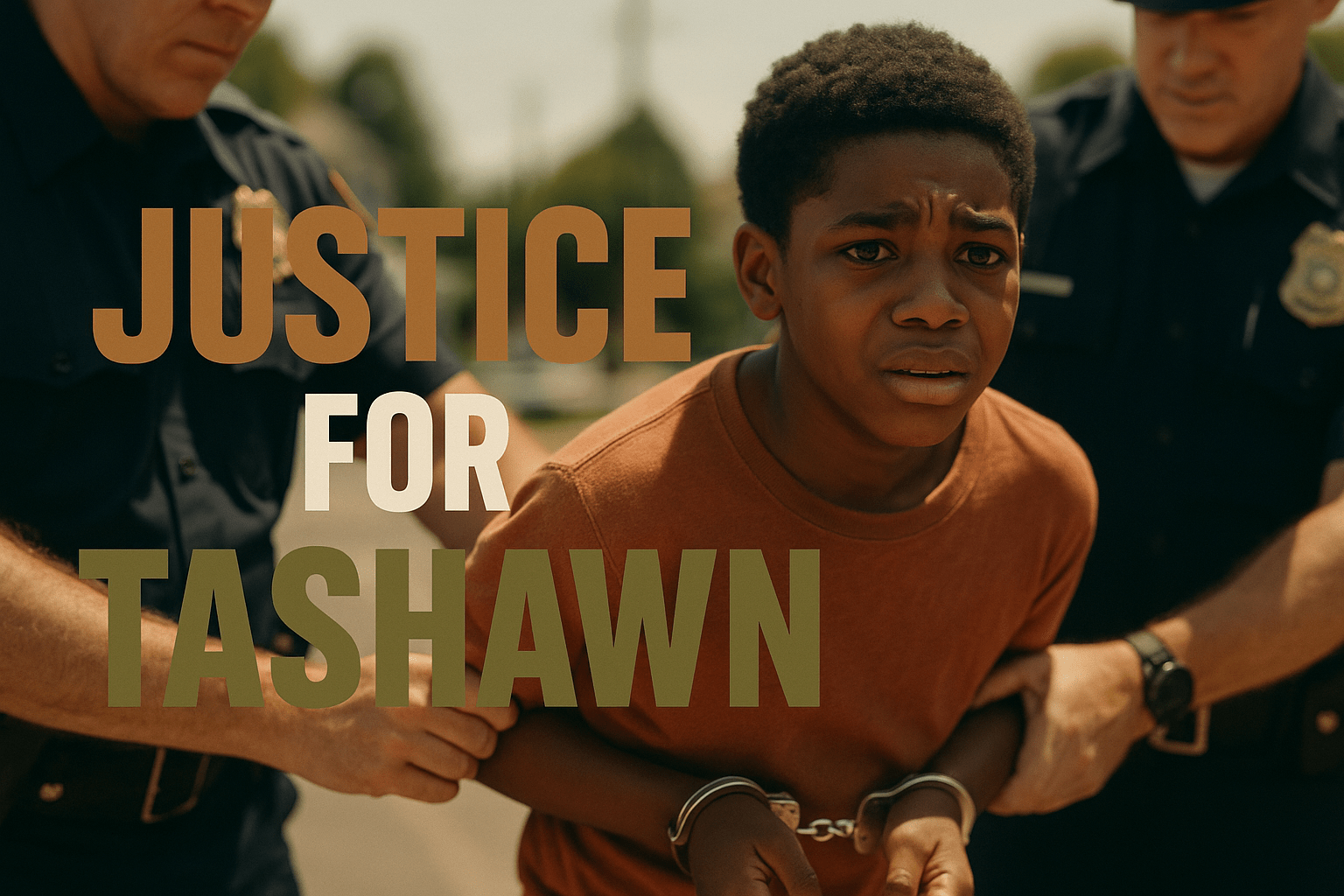
Justice for Tashawn Bernard
By Darius Spearman (africanelements)
Support African Elements at patreon.com/africanelements and hear recent news in a single playlist. Additionally, you can gain early access to ad-free video content.
Mistaken Identity
Imagine sending your child out to do a simple chore, like taking out the trash, only to find them moments later in handcuffs, surrounded by police officers. This terrifying scenario became a reality for Michael Bernard, a father in Lansing, Michigan. His 12-year-old son, Tashawn Bernard, was handcuffed and detained by Lansing police in a case of mistaken identity (washingtonpost.com). The incident occurred on August 10, 2023, after police had confronted a suspect who then fled (washingtonpost.com).
Police accused Tashawn of matching the description of an adult Black male suspected of stealing cars (washingtonpost.com). The real suspect was an adult wearing neon shorts and a white t-shirt, while Tashawn was wearing similar colored shorts but a bluish-gray shirt (washingtonpost.com). Officer Damon Culver pulled out his gun and ordered Tashawn to place his hands behind his back before handcuffing him (washingtonpost.com). Officer Stacey Myers then placed the handcuffed boy in the back of a patrol car (washingtonpost.com). Tashawn, crying, asked, “What did I do?” as he was being led to the patrol car (washingtonpost.com). Another officer later informed Myers that they had detained the wrong person, leading to Tashawn's release (washingtonpost.com). Myers told Tashawn he was “at the wrong place at the wrong time” (washingtonpost.com).
Legal Action
A federal lawsuit has been filed on behalf of Tashawn Bernard, seeking damages for the trauma he experienced (washingtonpost.com). The lawsuit was filed by the Michigan-based law firm Grewal Law PLLC (washingtonpost.com). It accuses officers Damon Culver and Stacey Myers of unreasonable search and seizure, false arrest, negligence, assault and battery, and excessive force (washingtonpost.com). The city of Lansing and its former police chief, Ellery Sosebee, are also named as defendants, accused of inadequate training, particularly concerning Black children (washingtonpost.com).
The lawsuit highlights that the suspect police were looking for was a grown man, and officers should have recognized the significant age difference (washingtonpost.com). Tashawn has experienced panic/anxiety attacks, difficulty sleeping, and has required counseling due to the incident (washingtonpost.com). The lawsuit states that Tashawn has increasing difficulty interacting with police authority figures and is frightened by them (washingtonpost.com). The lawsuit also alleges that the body camera video released by the Lansing Police Department is missing vital minutes of audio from the initial detainment (washingtonpost.com).
Policy Violations
The handcuffing of Tashawn Bernard violated the Lansing Police Department's policy regarding the detention of children under 13 (washingtonpost.com). Departmental policy states that handcuffing youths under 13 requires approval from LPD 61 command, unless there are exceptional circumstances related to safety, a court order, or other circumstances cleared by a supervisor (washingtonpost.com). The lawsuit alleges that Officer Pulver (Culver) knew Tashawn did not match the description of the suspect when he handcuffed him (washingtonpost.com).
This incident is not isolated. Police often rely on descriptions, but these can lead to mistaken identity, especially when individuals share similar characteristics. For example, in suburban Denver, four Black girls aged 6 to 17 were detained at gunpoint after being wrongly suspected of being in a stolen car (apnews.com). Aurora police apologized after a video showed Black children handcuffed face down on the pavement due to a mistaken identity incident involving a stolen car (cbsnews.com). Similarly, an 11-year-old girl was handcuffed by deputies after being mistaken for a car theft suspect, with the sheriff's office stating that ascertaining a person's age is part of the detainment process and handcuffing juveniles in this circumstance is lawful and common practice (wdbj7.com). The Onondaga County Sheriff's Office defended detaining and handcuffing an 11-year-old girl, stating that “handcuffing juveniles in this circumstance is lawful, within policy, and common practice in law enforcement” (wdbj7.com). The sheriff's office also indicated that moving forward, it will be policy to notify a parent or guardian if a juvenile is detained as part of a criminal investigation (wdbj7.com).
Apologies and Rejection
Lansing police and the mayor issued apologies for the incident, but Tashawn's father has stated he will not accept them (cnn.com). Former Chief Ellery Sosebee apologized, stating, “I want to apologize that this incident had such an effect on this young man and his family” (cnn.com). He also asked the community to consider “all the facts of the situation before making a judgment” (cnn.com). Lansing Mayor Andy Schor also apologized, acknowledging that “a mistake was made” and that the department had been in contact with the family to offer resources and support (cnn.com).
However, Michael Bernard, Tashawn's father, told CNN he would “never accept an apology,” stating his son did not deserve to be treated that way and that he only wants “justice for my son” (cnn.com). The incident gained national attention after a witness posted a video on TikTok (abcnews.go.com). Tashawn Bernard spoke out about the “traumatic” wrongful detention in an interview on “Good Morning America” (abcnews.go.com).
Disproportionate Policing
The lawsuit also cites statistical data suggesting a disproportionate arrest rate of Black juveniles by the Lansing Police Department (washingtonpost.com). A study cited in the lawsuit found that in 2020, 83% of juveniles arrested by the Lansing Police Department were Black, despite Black individuals making up only 28% of the population (washingtonpost.com). This disparity raises serious concerns about systemic issues within law enforcement practices.
The incident in Aurora, where Black children were handcuffed, led to the police chief stating the department was looking into new practices and training for high-risk stops (cbsnews.com). The president of the Rochester police union stated that officers were following department protocol when dealing with a difficult situation involving a child (apnews.com). These instances highlight the ongoing need for improved training and accountability within police departments, especially concerning interactions with minors and communities of color.
The Human Cost
The impact of such incidents on young individuals like Tashawn cannot be overstated. The trauma of being wrongly accused, handcuffed, and detained by armed officers can have lasting psychological effects. Tashawn's experience of panic/anxiety attacks, difficulty sleeping, and the need for counseling underscores the severe emotional toll (washingtonpost.com). Furthermore, his increasing fear of police authority figures is a tragic consequence that can erode trust between law enforcement and the communities they serve (washingtonpost.com).
The father's unwavering demand for justice, rather than an apology, reflects the deep-seated pain and frustration that many Black families experience when their children are subjected to such treatment (cnn.com). This case serves as a powerful reminder of the urgent need for comprehensive police reform, including better training on de-escalation, implicit bias, and appropriate protocols for interacting with children. It also emphasizes the importance of accountability for officers who violate policies and cause harm.
Understanding Disparities
The statistical data presented in the lawsuit, indicating that 83% of juveniles arrested by the Lansing Police Department in 2020 were Black, despite Black individuals making up only 28% of the population, is alarming (washingtonpost.com). This disparity is not unique to Lansing; it reflects a broader national pattern of disproportionate policing of Black children and communities. These statistics are not merely numbers; they represent countless individual stories of young Black people whose lives are impacted by interactions with the justice system.
Addressing these disparities requires a multifaceted approach. It involves scrutinizing police practices, implementing robust training programs that emphasize cultural competency and de-escalation, and holding officers accountable for misconduct. Additionally, it necessitates community engagement and collaboration to build trust and foster positive relationships between law enforcement and the communities they are sworn to protect. The fight for justice for Tashawn Bernard is a fight for all Black children who deserve to live without fear of being wrongly targeted and traumatized by those who are meant to serve and protect them.
Lansing Juvenile Arrests vs. Population (2020)
Accountability and Reform
The apologies from Lansing police and Mayor Andy Schor, while acknowledging a mistake, fall short for Tashawn's family (cnn.com). Michael Bernard's refusal to accept an apology without justice speaks volumes about the community's demand for tangible change, not just words (cnn.com). This incident, amplified by a viral TikTok video and Tashawn's interview on “Good Morning America,” brought national attention to a systemic issue (abcnews.go.com).
The lawsuit's focus on inadequate training for officers, especially concerning Black children, points to a critical area for reform (washingtonpost.com). The fact that officers failed to recognize the significant age difference between Tashawn and the adult suspect they were pursuing is a clear indicator of a breakdown in judgment and training (washingtonpost.com). The call for justice extends beyond this single case, urging police departments nationwide to re-evaluate their protocols, particularly when interacting with minors and individuals from marginalized communities.
The Broader Context
Tashawn's experience is a stark reminder of the challenges Black children face when encountering law enforcement. The disproportionate arrest rates of Black juveniles in Lansing, as highlighted in the lawsuit, are not an anomaly but rather a reflection of systemic issues that contribute to the over-policing of Black communities (washingtonpost.com). This pattern often leads to negative outcomes, including psychological trauma, distrust of authority, and a heightened sense of vulnerability among young Black individuals.
The legal claims of unreasonable search and seizure, false arrest, negligence, assault and battery, and excessive force against the officers and the city of Lansing underscore the severity of the alleged misconduct (washingtonpost.com). These legal terms represent fundamental rights that were allegedly violated, and the pursuit of damages aims to provide some measure of redress for the harm inflicted upon Tashawn. Beyond financial compensation, the lawsuit seeks to compel systemic changes that will prevent similar incidents from occurring in the future, ensuring that no other child has to endure what Tashawn did.
Understanding Mistaken Identity in Policing

Mistaken Identity: Occurs when law enforcement wrongly identifies an individual as a suspect, often based on vague descriptions or implicit biases. This can lead to wrongful detentions, arrests, and significant trauma for the innocent party. It highlights the critical need for precise identification protocols and unbiased policing practices. Source: (youtube.com)
The Path Forward
The case of Tashawn Bernard serves as a powerful catalyst for discussions about police accountability and the treatment of Black children in America. The missing audio from the body camera footage, as alleged in the lawsuit, raises questions about transparency and the completeness of evidence in such incidents (washingtonpost.com). Ensuring that all interactions are fully recorded and accessible is crucial for building public trust and holding officers accountable for their actions.
Furthermore, the Lansing Police Department's policy on handcuffing children under 13, which requires supervisory approval unless in exceptional circumstances, was clearly violated (washingtonpost.com). This violation, coupled with the officers' alleged knowledge that Tashawn did not match the suspect's description, points to a disregard for established protocols and the well-being of a child. The ongoing legal proceedings will hopefully shed more light on these critical issues and pave the way for meaningful reforms that protect the rights and safety of all children, especially those who are disproportionately targeted.
Lansing Police Handcuffing Policy Violation
ABOUT THE AUTHOR
Darius Spearman has been a professor of Black Studies at San Diego City College since 2007. He is the author of several books, including Between The Color Lines: A History of African Americans on the California Frontier Through 1890. You can visit Darius online at africanelements.org.
