

Sudan Famine and Displacement: The Hidden Roots
By Darius Spearman (africanelements)
Support African Elements at patreon.com/africanelements and hear recent news in a single playlist. Additionally, you can gain early access to ad-free video content.
A Manufactured Catastrophe Sweeps Sudan
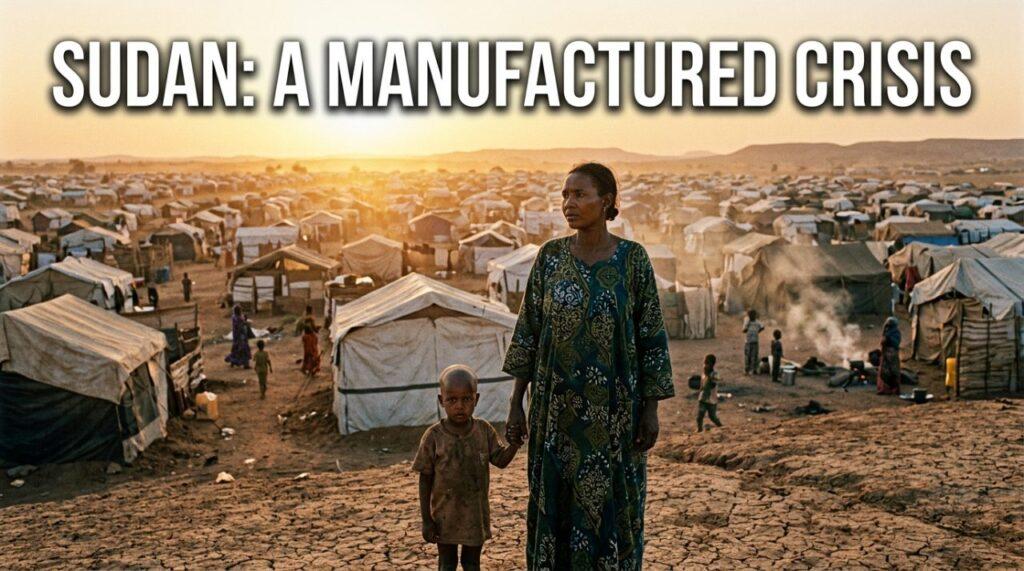
A staggering humanitarian disaster is unfolding across Sudan at breakneck speed. New United Nations assessments confirm that catastrophic famine conditions now grip significant swaths of the population (ipcinfo.org). Millions of families find themselves caught between indiscriminate aerial bombardment and brutal ground sieges. Essential corridors for medicine and sustenance have been choked off by warring armies, leaving remote regions completely isolated from global aid deliveries (unocha.org).
The conflict pits the Sudanese Armed Forces, commanded by General Abdel Fattah al-Burhan, against the paramilitary Rapid Support Forces, led by Mohamed Hamdan Dagalo. Their collision has turned major cities into ash and emptied agrarian communities (kvue.com). The United Nations reports that the country now represents the largest displacement crisis on Earth, with more than eleven million people uprooted from their family homes (iom.int, iom.int). Understanding this tragedy requires looking past recent headlines and examining generations of historical oppression.
Sudan Displacement and Food Emergency
Colonial Roots of Center and Periphery Divide
The contemporary conflict reflects an unequal political structure established long before the current generals picked up weapons. During the period of Anglo-Egyptian condominium rule that began in 1899, colonial administrators concentrated infrastructure, modern schools, and capital around Khartoum and the Nile river basin. This deliberate policy created an affluent riverine elite while treating the outer provinces as mere resource reservoirs. The surrounding peripheries of Darfur, Kordofan, and the Blue Nile were neglected and excluded from civil investments.
When Sudan secured independence in 1956, this colonial design remained completely intact. The riverine ruling class inherited state institutions and preserved the economic subordination of the rural populations. Wealth flowed steadily into the capital, while remote farmers and pastoralists suffered under deep poverty. Similar to the ways historical exploitation has trapped sovereign states across the continent, Sudan experienced domestic extraction that turned peripheral lands into disenfranchised colonies within their own borders.
The Invention of Racial Hierarchies in Darfur
Racial distinctions inside Sudan do not follow Western ideas of physical appearance. Western observers frequently perceive all Sudanese citizens as Black, yet domestic political systems have long enforced sharp distinctions between self-identified Arab and non-Arab communities. Pastoralist Arab populations trace their lineage to Arabian genealogies and speak Arabic as a mother tongue. Conversely, agrarian groups such as the Fur, Masalit, and Zaghawa speak indigenous African languages and maintain deep ancestral landholdings known locally as Hawakir.
Successive regimes in Khartoum weaponized these cultural differences to protect central authority. In the late twentieth century, the government promoted an Arab-supremacist doctrine known as Quraysh ideology to crush regional dissent. State leaders mobilized nomadic Arab herders against indigenous farmers during disputes over drought-stricken pastures. Paramilitary fighters openly used derogatory slurs like zurqa and abid to demean sedentary African populations. This state-sponsored bigotry transformed customary disputes over grazing land into violent, existential clashes over ethnic survival.
The 2003 Genocide and the Janjaweed Legacy
By 2003, decades of systematic marginalization pushed rebel movements in Darfur to initiate an armed uprising demanding basic infrastructure, civil rights, and political voice. Rather than addressing these demands through authentic negotiation, the regime of President Omar al-Bashir unleashed a campaign of terror. The Sudanese military provided high-altitude bombardments, while ground operations were assigned to nomadic militias notoriously called the Janjaweed, meaning devils on horseback.
The Janjaweed executed horrific operations against non-Arab civilians. They burned villages to the ground, poisoned municipal wells, destroyed food stockpiles, and systematically used sexual violence as a weapon. Hundreds of thousands of Black Darfuris were killed, and millions fled into emergency camps like the Zamzam settlement near El Fasher. The ongoing fight to preserve human dignity reveals how freedom defines survival for displaced populations, exposing a cycle of cruelty that still haunts the region two decades later.
How Bashir Built a Parallel Paramilitary Army
Fearing a military coup from his own armed forces, President al-Bashir chose to formalize the Janjaweed into an official state organ in 2013. He rebranded these irregular fighters as the Rapid Support Forces and elevated Mohamed Hamdan Dagalo, known as Hemedti, to direct command. The dictator showered the paramilitary commander with resources, granting the new force independence from the regular army hierarchy. This parallel army served as the personal security shield for the palace.
The Rapid Support Forces swiftly expanded their operations into massive commercial empires. Hemedti seized control of artisanal and industrial gold deposits in Darfur, most notably the Jebel Amer mines. Bullion was exported through regional networks, generating private cash reserves. Furthermore, the paramilitary sent thousands of infantry soldiers to fight in foreign wars across Yemen and Libya. These foreign deployments provided modern weaponry and independent financial strength, laying the groundwork for a confrontation with the regular armed forces.
Healthcare System Collapse in Conflict Zones
Failed Justice and the Cost of Impunity
The current warfare directly reflects the complete failure of international legal mechanisms. Between 2007 and 2010, the International Criminal Court issued historic arrest warrants against Omar al-Bashir and his top deputies, charging them with genocide and war crimes in Darfur. Nevertheless, global powers and regional alliances failed to execute those legal orders. Dictators and allied diplomats welcomed al-Bashir across international borders without fear of detention.
This lack of enforcement sent an unmistakable message to military commanders. Janjaweed officers realized that slaughtering civilians brought zero legal consequences. Rather than facing justice in The Hague, perpetrators were integrated into formal government cabinets. When popular protests toppled al-Bashir in 2019, General al-Burhan and Hemedti formed a military junta that quickly crushed pro-democracy demonstrations. The lack of accountability established the operational blueprint for the massacres occurring across Sudan today (ohchr.org).
Weaponized Starvation and the Siege of Transit Corridors
Warfare erupted on April 15, 2023, following deep disputes over integrating the Rapid Support Forces into the regular military. The violence immediately devolved into starvation tactics that deliberately targeted vulnerable populations. In North Darfur, paramilitary units surrounded El Fasher and the massive Zamzam displacement camp, cutting off humanitarian convoys, commercial food trucks, and life-saving nutritional supplies (ipcinfo.org, ipcinfo.org).
The Sudanese Armed Forces answered with aerial campaigns that frequently devastated civil infrastructure. Fighter jets, barrel bombs, and artillery pounded transportation corridors, markets, and municipal water purification facilities (un.org, unocha.org). These bombardments destroyed critical transit hubs and made routine humanitarian relief impossible. In areas where civilians face famine conditions, between seventy and eighty percent of local health facilities are shuttered or destroyed (un.org, reliefweb.int). The destruction of domestic breadbaskets in Al Jazirah State eliminated commercial grain stores, producing an acute nutritional emergency (foodsecurityportal.org).
Childhood Malnutrition Crisis Indicators
Foreign Proxy Interests Fuel the Fire
This war is sustained by foreign governments pursuing geopolitical influence and valuable natural resources. External powers have turned Sudan into a proxy battleground, funneling sophisticated weapons directly to the frontlines. The Rapid Support Forces receive significant support through illicit networks linked to the United Arab Emirates, which purchases smuggled gold and supplies modern drones through airfields in Chad. At the same time, Russian mercenary networks have traded military armaments for mining concessions.
Conversely, the Sudanese Armed Forces rely on military assistance from Egypt, Turkey, and Iran. Tehran has supplied advanced Mohajer-6 combat drones to the military, enabling devastating strikes around Khartoum and Omdurman. Just as shared struggles link oppressed communities worldwide, outside imperial meddling consistently destroys internal sovereignty. Foreign weapons maintain a military deadlock, while Sudanese civilians pay the price with starvation, displacement, and death (europa.eu).
Diaspora Solidarity and the Path Forward
For the African diaspora, the emergency in Sudan is a matter of profound humanitarian and historical importance. The famine unfolding in Darfur, Kordofan, and Khartoum is not an inevitable natural disaster caused by climate or bad luck. It is a man-made tragedy created by an extractive elite, fueled by foreign weapons, and accelerated by absolute impunity. More than seven hundred thousand children currently face imminent starvation because military factions treat hunger as a weapon of war (unicef.org).
True peace will never arrive through backroom negotiations between rival generals who orchestrated war crimes. A sustainable future demands an unconditional end to foreign interference, the opening of humanitarian corridors, and the return of authority to civilian democratic movements. The global community must hold human rights abusers legally accountable. The people of Sudan deserve sovereignty, safety, and self-determination on their ancestral lands.
About the Author
Darius Spearman is a professor of Black Studies at San Diego City College, where he has been teaching for over 20 years. He is the founder of African Elements, a media platform dedicated to providing educational resources on the history and culture of the African diaspora. Through his work, Spearman aims to empower and educate by bringing historical context to contemporary issues affecting the Black community.
