


K’aun Green Settlement: Behind the Headlines
By Darius Spearman (africanelements)
Support African Elements at patreon.com/africanelements and hear recent news in a single playlist. Additionally, you can gain early access to ad-free video content.
The headlines out of San Jose, California, tell a story of a massive financial transaction. City leaders are preparing to approve an $8 million settlement for K’aun Green, a young Black man shot by police in 2022 (apnews.com). On the surface, this appears to be the conclusion of a tragic “mistaken identity” case. However, for those who look closer at the history behind the headlines, the payout represents something much darker. It serves as an expensive admission of systemic failure, involving a “Good Samaritan” act punished by gunfire and a police department shaken by the exposure of deeply racist text messages (hoodline.com).
This settlement, which ranks as the second-largest in the history of the city for police misconduct, closes the civil litigation chapter of a saga that began at a popular taqueria (sfchronicle.com). Yet, the scars left on the community and the victim remain. The incident derailed the promising football career of a young athlete and exposed the “Wild West” mentality some officers harbored toward the Black residents they were sworn to protect (latimes.com). To understand why San Jose is paying such a high price, one must examine the specific events of that night, the legal battles that stripped the police of their immunity, and the disturbing digital trail that ultimately destroyed the city’s defense.
The Incident at La Victoria Taqueria
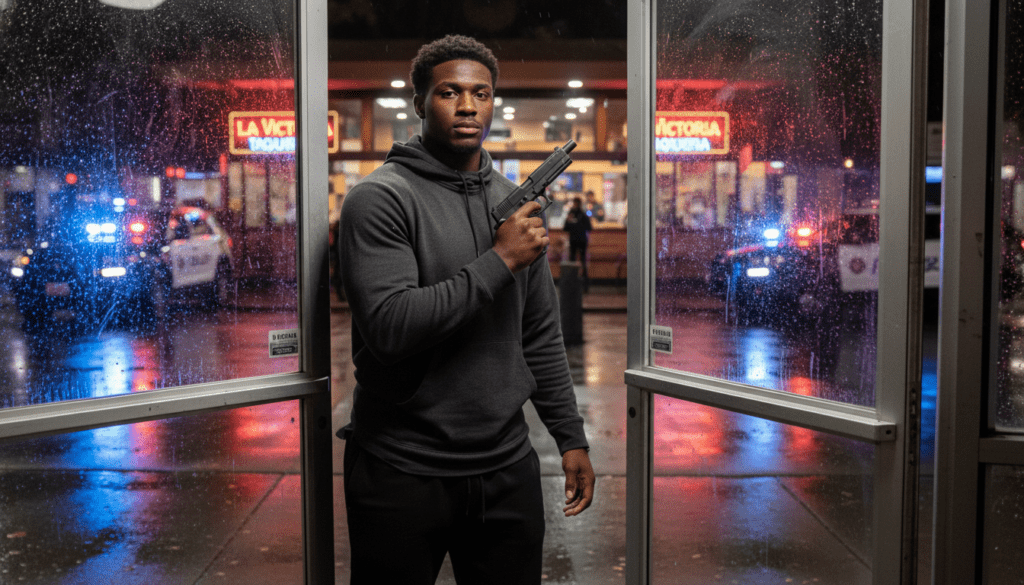
The events of March 27, 2022, unfolded in a matter of seconds, but they were the result of a chaotic environment that law enforcement struggled to manage. It was early morning at La Victoria Taqueria, a well-known eatery near San Jose State University (hoodline.com). The location was crowded, a common sight for late-night diners. However, the atmosphere turned violent when a fight broke out involving a firearm. An individual, later identified as Brian Carter, introduced a gun into the conflict (sfchronicle.com).
K’aun Green, a 20-year-old quarterback for Contra Costa College at the time, made a split-second decision to intervene. Acting as a peacemaker, Green physically wrestled the firearm away from the aggressor (independent.co.uk). In the eyes of many, this was a heroic act. He had successfully disarmed a threat in a crowded room. Green then attempted to leave the establishment, backing out of the front door. Surveillance footage confirms that as he exited, he was holding the confiscated weapon in his left hand with the barrel pointed upward, signaling that he was not using it aggressively (hoodline.com).
As the doors opened, San Jose police officers arrived on the scene. Within moments of seeing Green, Officer Mark McNamara fired his service weapon. He shot Green four times, striking him in the abdomen, knee, and arm (hoodline.com, youtube.com). Green was not given a verbal warning or a reasonable opportunity to drop the weapon before lethal force was deployed. In the immediate aftermath, officers handcuffed the severely wounded athlete to his hospital gurney, treating the man who had disarmed the gunman as if he were the criminal (wikipedia.org). While Green fought for his life and recovery, the narrative of “mistaken identity” began to take shape, but the community demanded answers regarding why lethal force was the first option.
The Legal Battle and Denial of Immunity
For more than a year following the shooting, the City of San Jose and its police department defended Officer McNamara’s actions. They relied on a legal concept known as “Qualified Immunity.” This doctrine often protects government officials from being held personally liable for constitutional violations, provided their conduct does not violate clearly established statutory or constitutional rights (uscourts.gov). The defense argued that the officer made a reasonable mistake in a tense, rapidly evolving situation.
However, the legal landscape shifted dramatically when the case reached the 9th U.S. Circuit Court of Appeals. In a ruling that proved critical to the settlement, the federal court denied the officer’s request for qualified immunity (apnews.com). The judges determined that a reasonable jury could find that McNamara’s use of force was excessive and unconstitutional. The court noted that Green was backing out of the restaurant and did not pose an immediate threat that justified four gunshots without warning (apnews.com).
This ruling stripped away the legal shield that typically protects officers in shooting cases. It exposed the city to a public trial where the details of the shooting would be scrutinized by a jury. The denial of immunity signaled that the judiciary viewed the officer’s conduct as a potential violation of the Fourth Amendment, which protects citizens against unreasonable seizures (aclu.org). With the threat of a trial looming, the city faced the prospect of a verdict that could far exceed the settlement amount, especially given the evidence that was about to come to light.
The “Smoking Gun”: Racist Texts Exposed
While the physical shooting was tragic, the discovery of digital evidence turned the case into a scandal of corruption and bias. During an unrelated criminal investigation into Officer McNamara, internal affairs investigators uncovered a series of text messages sent by the officer in the days and months following the shooting (hoodline.com). These messages provided a window into the mindset of the man who pulled the trigger.
In one text message, McNamara referenced the shooting with a chilling disregard for human life, writing, “N— wanted to carry a gun in the Wild West. Not on my watch” (latimes.com). In another exchange, he explicitly stated, “I hate black people” (independent.co.uk). These communications were not isolated incidents but part of a dialogue with other officers, suggesting a culture where such racism was tolerated or even encouraged. The messages included multiple uses of the N-word and other derogatory slurs directed at the Black community (hoodline.com).
The revelation of these texts destroyed the city’s ability to defend the shooting as a colorblind error of judgment. It provided Green’s legal team with powerful evidence that racial bias played a significant role in the officer’s quick decision to shoot a Black man holding a gun, while potentially hesitating for a white suspect in a similar scenario (newsone.com). McNamara resigned in November 2023, shortly after the texts were brought to light, but the damage to the department’s reputation was already done (latimes.com). The settlement essentially became a way for the city to avoid having these hateful words read aloud in a federal courtroom.
Timeline of Justice
K’aun Green disarms a gunman at La Vic’s. Police arrive and Officer McNamara shoots Green 4 times.
Racist texts by McNamara (“I hate black people”) are found during an unrelated probe. He resigns.
9th Circuit Court denies Qualified Immunity. The case is cleared for a jury trial.
San Jose leaders prepare to approve $8 million payout to avoid trial.
Systemic Failures and “Ghost Guns”
The incident also highlights the growing danger of “ghost guns” in American cities. The weapon that K’aun Green wrestled away from the aggressor was a privately made firearm lacking a serial number (sfchronicle.com). These weapons are untraceable and often acquired without background checks, making them a preferred choice for individuals prohibited from owning firearms. The original aggressor, Brian Carter, was charged with being a felon in possession of this ghost gun (sfchronicle.com). While Carter was the one who brought the danger to the restaurant, it was Green who bore the physical brunt of the police response.
The systemic failure extends beyond the hardware to the software of the police department—its culture. The investigation that caught McNamara revealed that he was not the only officer participating in racist banter. Another employee was placed on administrative leave, and a former officer who had moved to a department in Minnesota resigned after his involvement was discovered (hoodline.com). This suggests that the “Wild West” mentality was shared among a clique of officers, creating an environment where bias could thrive unchecked. The $8 million settlement is paid by taxpayers, but the cost of this culture is paid in blood by citizens.
Resilience Through Education and Sport
Despite the trauma and the permanent injuries to his arm and knee, K’aun Green has demonstrated remarkable resilience. His dream of playing in the NFL was jeopardized, but his spirit was not broken. Following the shooting, Green received a full scholarship to play football at the University of Arkansas at Pine Bluff (kansas.com). This institution is a Historically Black College and University (HBCU).
For generations, HBCUs have served as sanctuaries for Black excellence, adapting through oppression to provide safe spaces for students to grow. Green’s transition to an HBCU connects his personal story to a larger narrative of Black survival. In an environment built to support him rather than target him, Green continues to pursue his athletic and academic goals. His journey from a hospital bed in San Jose to a football field in Arkansas serves as a testament to his determination to define his own life, regardless of the violence inflicted upon him.
The Financial Toll of Police Misconduct
The financial implications of this case are staggering for the City of San Jose. The $8 million agreement is the second-largest settlement for police misconduct in the city’s history (hoodline.com). It sits behind only the $12 million paid to Lionel Rubalcava for a wrongful conviction (hoodline.com). When combined with the $3.35 million paid to settle claims from the George Floyd protests in 2020, where police were accused of using excessive force against demonstrators, a pattern of expensive liability emerges (sfchronicle.com).
City Attorney Nora Frimann recommended the settlement to “conclude the litigation without further cost” (hoodline.com). This language is standard in such proceedings, but it translates to a simple reality: the city knew it would lose in court. The combination of the video evidence showing Green’s non-threatening posture and the text messages revealing the officer’s racial animus created an indefensible position. In civil rights cases, when the veil of immunity is pierced and the evidence of bias is clear, the checkbook often opens to prevent further public exposure.
Conclusion
The $8 million settlement for K’aun Green is more than a financial transaction; it is a historical marker. It documents a moment when a “Good Samaritan” was treated as a threat because of the color of his skin and the bias of an officer. The case exposes the fragility of justice when policing cultures allow racism to fester behind the “blue wall.” While the money provides compensation for Green’s injuries and lost potential, it cannot erase the trauma of that night at La Victoria Taqueria.
As the current political climate shifts under the administration of Donald Trump, the debate over qualified immunity and police accountability continues to rage in federal courts. However, in San Jose, the local history has been written. A young man stood up to stop violence, was shot down by those sent to help, and forced the system to acknowledge its failure through the discovery of undeniable racism. Green’s survival and continued success at his university stand as a powerful counter-narrative to the hatred found in those text messages—a reminder that while systems may fail, the resilience of the human spirit endures.
For further context on how historical systems of control evolve into modern injustices, readers might consider how involuntary servitude and legal frameworks have historically disadvantaged Black citizens. Additionally, understanding the deep roots of resilience requires looking at how families have adapted to life in the Deep South, a region where Green now builds his future.
About the Author
Darius Spearman is a professor of Black Studies at San Diego City College, where he has been teaching for over 20 years. He is the founder of African Elements, a media platform dedicated to providing educational resources on the history and culture of the African diaspora. Through his work, Spearman aims to empower and educate by bringing historical context to contemporary issues affecting the Black community.
