


Why Israel’s Recognition of Somaliland Changes Everything in 2026
By Darius Spearman (africanelements)
Support African Elements at patreon.com/africanelements and hear recent news in a single playlist. Additionally, you can gain early access to ad-free video content.
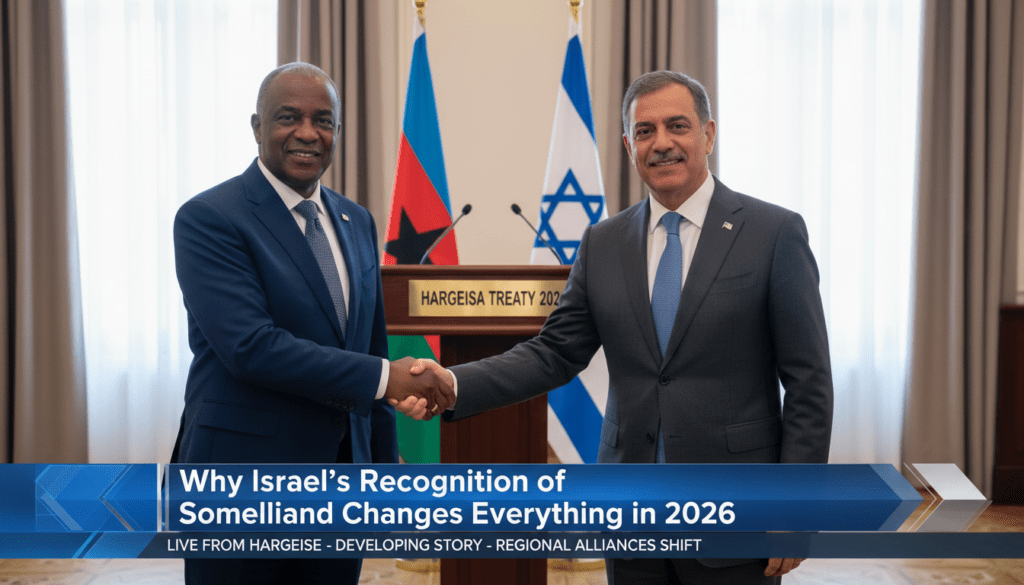
The dawn of 2026 brought a political earthquake to the Horn of Africa. On January 6, Israel’s foreign minister arrived in the city of Hargeisa. This visit followed a historic decision by the Israeli government to recognize Somaliland as a sovereign nation. For many, this seemed like a sudden shift in global alliances. However, the story behind this headline is decades old. It is a tale of a brief independence, a terrible genocide, and a long search for justice (somalilandsun.com, timesofisrael.com).
The city of Hargeisa welcomed Foreign Minister Gideon Sa’ar with open arms. The visit finalized plans for an Israeli embassy and new deals in farming and technology. Meanwhile, the Federal Government of Somalia in Mogadishu reacted with anger. Somalia called the move a flagrant assault on its territory. They warned that the step would create friction across the entire region. This tension is not merely about borders. It is about a people who have lived as a ghost state for over thirty years (timesofisrael.com, aljazeera.com).
The Five Days of Sovereignty in 1960
To understand the current recognition of Somaliland, one must look back to 1960. Many people do not realize that Somaliland was once a fully recognized independent state. On June 26, 1960, the British Somaliland Protectorate gained its freedom. During its five days of independence, thirty-five countries recognized it. These nations included the United States, the United Kingdom, and Israel. This history provides the legal foundation for Somaliland’s current claims (wikipedia.org, wikipedia.org).
The leaders of the new State of Somaliland chose to join with the Trust Territory of Somalia on July 1, 1960. They wanted to create a Great Somalia. However, this union was problematic from the very beginning. The northern clans soon felt marginalized by the government in the south. Political power and resources shifted toward Mogadishu. This imbalance created deep resentment that eventually led to a desire for separation. The union that began with hope quickly turned into a struggle for survival (tandfonline.com, saxafimedia.com).
Economic Comparison (Est. 2026)
The Dark Chapter of the Isaaq Genocide
The relationship between the north and south collapsed under the dictatorship of Mohamed Siad Barre. During the late 1980s, the regime launched a campaign of violence against the Isaaq clan. This event is known as the Isaaq Genocide. It was a systematic effort to destroy a specific group of people. Military forces used heavy artillery and planes to bomb civilian cities. Hargeisa was nearly destroyed, earning it the tragic nickname of the Dresden of Africa (wikipedia.org, isaaqgenocide.info).
Between 50,000 and 200,000 civilians lost their lives during this period. The regime created a special unit called the Isaaq Exterminators to carry out these killings. Many families fled toward the Ethiopian border to escape the slaughter. While the world looked away, Israel was one of the few nations to speak up. In 1990, Israel formally denounced the genocide at the United Nations. This early moral support created a bond between the people of Somaliland and Israel that remains strong today (isaaqgenocide.info, youthtransform.org).
Seeking justice for these crimes has been a long process for the survivors. Because Somaliland is not a recognized state, it cannot use the International Criminal Court. Instead, victims have used courts in the United States to sue former officials. These legal battles are part of a larger movement to address historical racial injustices across the globe. Although some officials offered apologies, no formal reparations program exists. The scars of the genocide continue to shape the political identity of the region (isaaqgenocide.info, africanlegalstudies.blog).
The Reassertion of Sovereignty in 1991
When the regime of Siad Barre finally collapsed in 1991, Somaliland took its fate into its own hands. Leaders met at the Grand Conference in Burao to decide their future. They chose to revoke the 1960 union and reassert their independence. Since that moment, Somaliland has operated as a de facto independent state. This means it functions like a country even though other nations did not recognize it legally. It has its own currency, a standing army, and its own passports (somalilandsun.com, fairobserver.com).
While Somalia faced decades of civil war and instability, Somaliland remained peaceful. The people built a democratic system from the ground up. They have held multiple competitive elections and seen peaceful transfers of power. International observers have often praised these democratic efforts. For example, Somaliland was the first African nation to use iris-scan technology to prevent voter fraud. This commitment to democracy has made it a unique partner in a volatile region (gisreportsonline.com, saxafimedia.com).
The difference between de facto and de jure independence is a central part of this story. Somaliland has all the factual markers of a state. However, it lacked the formal legal recognition that allows for international trade and aid. Without de jure status, the government could not access loans from the World Bank. The 2026 recognition by Israel changes this dynamic completely. It signals to the world that the era of isolation may be coming to an end (timesofisrael.com, africanlegalstudies.blog).
Strategic Control: Bab-el-Mandeb
A vital chokepoint where 12% of global trade passes.
A Strategic Partnership in the Red Sea
The motivation for Israel to recognize Somaliland is deeply strategic. The geography of the region plays a major role in this decision. Somaliland sits along the Gulf of Aden near the Bab-el-Mandeb Strait. This narrow waterway is one of the most important shipping lanes in the world. Thousands of ships pass through it every year carrying oil and goods to Europe. Ensuring the security of this strait is a top priority for global powers (iiss.org, eritrea-focus.org).
In recent years, security in the Red Sea has become more fragile. Attacks from groups like the Houthis in Yemen have threatened international shipping. Israel needs stable partners on the African coast to monitor these threats. Somaliland offers a long coastline and a stable government that can help secure the waters. By recognizing Somaliland, Israel gains a friend in a very important location. This partnership is built on the shared history of those who must sacrifice for freedom in hostile environments (hornreview.org, eritrea-focus.org).
Economic interests also drive this new relationship. The United Arab Emirates has already invested hundreds of millions of dollars into the Port of Berbera. This port is becoming a major hub for trade in East Africa. Israel wants to be part of this growing economic network. Cooperation in agriculture and water technology will also help Somaliland develop its resources. These projects will provide jobs and modernize the local economy. The two nations see themselves as natural partners because they have both faced regional isolation (timesofisrael.com, somalilandstandard.com).
The Role of the Abraham Accords
The recognition of Somaliland is also connected to the Abraham Accords. These agreements began in 2020 to normalize relations between Israel and Arab nations. They shifted the focus toward shared security and economic goals. Prime Minister Benjamin Netanyahu has worked to expand this circle of friends. President Donald Trump has also supported these diplomatic breakthroughs. They believe that building new alliances is the key to regional stability (politicstoday.org, timesofisrael.com).
Somaliland fits into this “outside-in” diplomacy model perfectly. As a Muslim-majority nation with democratic leanings, it is an ideal candidate for the accords. The leaders in Hargeisa have expressed a desire to join this regional framework. They believe that normalization with Israel will bring more investment from the West. This move shows how African nations are now making independent choices about their foreign policy. It reflects a broader perspective often explored within distinct academic disciplines like Black Studies (reddit.com, timesofisrael.com).
The Abraham Accords represent a shift away from old conflicts. Instead of waiting for every regional dispute to be solved, nations are moving forward with bilateral deals. This approach has allowed Israel to build ties with the UAE, Morocco, and now Somaliland. These agreements focus on practical things like clean energy and food security. For Somaliland, the accords offer a path to international legitimacy that was blocked for decades. It is a new way of doing business in the Middle East and Africa (politicstoday.org, youthtransform.org).
Regional Backlash and the African Union
While Somaliland celebrates, the rest of the region is on edge. Somalia views the Israeli recognition as a threat to its very existence. The government in Mogadishu believes that the world must respect its borders as they were established in 1960. They have the support of countries like Turkey and Egypt. Turkey has a large military presence in Somalia and does not want to see Israel gain influence there. This competition for power could lead to more conflict (africanews.com, aljazeera.com).
The African Union is also very concerned about this development. The AU follows a rule called the inviolability of inherited borders. This means that the borders created by colonial powers should stay the same. They fear that if Somaliland becomes independent, other groups across Africa will try to do the same. This “Pandora’s Box” could lead to instability in many countries. However, Somaliland argues that its case is different. They are not creating a new border but returning to an old one (actionaid.org.uk, africanews.com).
A 2005 report from the African Union actually admitted that Somaliland’s situation is unique. It acknowledged that the people have a strong legal argument for their independence. Despite this, the AU has been slow to change its position. The 2026 recognition by Israel forces the AU to confront this issue again. Other nations may now feel more comfortable following Israel’s lead. The diplomatic pressure is building for a permanent solution to the status of Somaliland (africanews.com, nation.africa).
The Road Ahead for a New Nation
The visit by Foreign Minister Sa’ar is just the beginning of a new chapter. Somaliland still faces many challenges on its road to full global acceptance. It must continue to prove that it is a stable and democratic partner. The government will need to manage the anger of its neighbors while building new friendships. However, the recognition by a major power like Israel provides a massive boost to its confidence and its economy (somalilandsun.com, timesofisrael.com).
For the people of Somaliland, the 2026 events are the result of thirty-five years of patience. They have survived genocide and decades of being ignored by the world. They have built a functioning society without much outside help. Now, they are finally seeing the rewards of their hard work. The “history behind the headlines” shows that their claim to independence is not a new whim. It is a restoration of a sovereignty that was lost and then fought for with great courage (saxafimedia.com, somalilandstandard.com).
As the international community watches, the Horn of Africa is being reshaped. The alliance between Israel and Somaliland could change the balance of power in the Red Sea. It could also encourage other nations to reconsider their stance on unrecognized states. The friction with Somalia will likely continue for some time. However, the reality on the ground has changed. Somaliland is no longer a ghost on the map; it is a player on the world stage (timesofisrael.com, aljazeera.com).
About the Author
Darius Spearman is a professor of Black Studies at San Diego City College, where he has been teaching for over 20 years. He is the founder of African Elements, a media platform dedicated to providing educational resources on the history and culture of the African diaspora. Through his work, Spearman aims to empower and educate by bringing historical context to contemporary issues affecting the Black community.
