


Will Bonaire Climate Justice Finally End Centuries of Colonial Neglect?
By Darius Spearman (africanelements)
Support African Elements at patreon.com/africanelements and hear recent news in a single playlist. Additionally, you can gain early access to ad-free video content.
The island of Bonaire rests in the blue waters of the Caribbean Sea. It is a place of beauty and deep history. However, the residents of this island have spent years fighting for their very survival. On January 28, 2026, the Hague District Court delivered a landmark decision. The court ruled that the Dutch state acted in a discriminatory manner toward the people of Bonaire. This ruling focused on the lack of climate adaptation measures for the island (climatechangenews.com). For many, this victory is more than an environmental win. It is a moment of reckoning for a colonial history that stretches back four hundred years.
The Dutch state has a legal duty to protect its citizens. This protection should not depend on where those citizens live. The court found that the government violated the European Convention on Human Rights (voelkerrechtsblog.org). Specifically, the state failed to respect the private lives and homes of Bonaire residents. It also violated the prohibition against discrimination. While the mainland of the Netherlands has world-class sea defenses, Bonaire was left vulnerable (theguardian.com). This decision marks the first time a European court has ordered a state to create a specific climate plan for an overseas territory. The ruling requires the government to act with urgency.
Scientific projections show one-fifth of the island could be submerged without intervention (climatechangenews.com).
Four Centuries of Colonial Roots and Modern Neglect
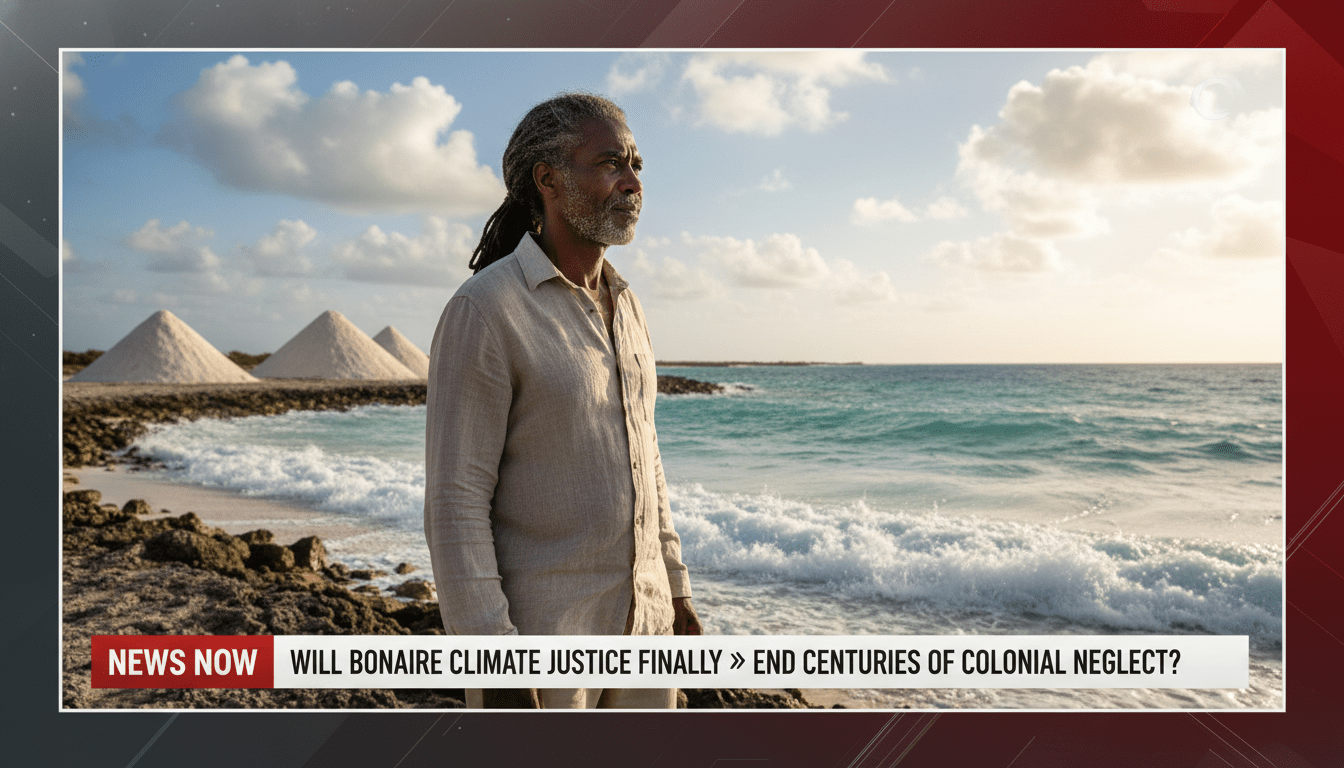
To understand the headlines of today, one must look at the past. The relationship between the Netherlands and Bonaire began nearly four hundred years ago. During the era of the transatlantic slave trade, the island served as a government plantation (wikipedia.org). Enslaved people were forced to work in the salt flats. These salt flats are still visible today. They stand as a silent reminder of the pain and labor that built Dutch wealth. The salt was a valuable resource for the plantation economy in neighboring Curaçao. This history of exploitation created a foundation of inequality that persists in modern times.
In December 2022, the Dutch government issued a formal apology for its role in slavery. Prime Minister Mark Rutte called slavery a crime against humanity (justiceinfo.net). However, many residents of Bonaire felt the apology was not enough. They noted that the government continued to ignore the existential threat of climate change. Activists like Jackie Bernabela argued that the current neglect is a continuation of colonial disregard. The experience of life on the slave plantations may have ended, but the systemic lack of value for Black lives remains a concern. The court case highlighted this connection directly.
The island population is primarily of Afro-Caribbean descent. Most of the 26,000 residents speak Papiamentu. This language is a beautiful blend of African, European, and Indigenous influences (wikipedia.org). It represents the resilience of a people who have survived centuries of change. Yet, these citizens have often felt like second-class members of the Dutch Kingdom. They receive lower social benefits than those living in the European Netherlands. Poverty rates on the island remain high. When the sea begins to rise, these residents have fewer resources to protect themselves. The court recognized that geographic distance is no excuse for unequal treatment.
The Constitutional Pivot of 2010
The legal status of Bonaire changed significantly on October 10, 2010. This date is often called 10-10-10. On this day, the Netherlands Antilles was dissolved (wikipedia.org). The Netherlands Antilles was a group of six islands that functioned as a single country within the Kingdom. However, political friction led to the end of this union. Curaçao and St. Maarten became independent countries within the Kingdom. In contrast, Bonaire, Saba, and St. Eustatius chose closer integration with the Netherlands. They became special municipalities, or public bodies (thedailyherald.sx).
This new status was supposed to bring stability and equal rights. In theory, a resident of Bonaire should have the same protections as a resident of Amsterdam. However, the reality has been different. Special municipalities are governed directly by the central government in The Hague (wikipedia.org). This structure allows the government to apply different laws to the islands. These are known as the BES laws. While Bonaire residents vote for the Dutch House of Representatives, they do not have a provincial government (wikipedia.org). This lack of a provincial layer has made it harder for the island to secure funding for major infrastructure projects.
For over a decade, the island lacked a defined social minimum. This means there was no official calculation of what a person needs to survive. Many households struggled to afford basic necessities like food and electricity. While the minimum wage was recently increased, it still trails behind the mainland (thedailyherald.sx). This economic gap makes climate adaptation even more difficult. Individual farmers like Onnie Emerenciana cannot afford to build sea walls on their own. They rely on the state to provide the necessary infrastructure. The 2010 constitutional change promised integration, but it delivered a double standard in safety and welfare.
The Legend of the Delta Works versus Caribbean Neglect
The Netherlands is famous for its battle against the sea. In 1953, a massive flood killed over 1,800 people in the European Netherlands. In response, the country built the Delta Works (ice.org.uk). This system of dams and storm surge barriers is an engineering marvel. It is often called one of the Seven Wonders of the Modern World. The Dutch state spends approximately one billion euros every year to maintain these defenses (climatechangenews.com). This commitment ensures that the mainland remains safe from rising tides for generations to come.
The situation on Bonaire is a stark contrast. Despite being a low-lying island, it has almost no man-made flood protections. Scientific research from Vrije Universiteit Amsterdam showed that sea levels could rise by up to 127 centimeters by the year 2100 (climatechangenews.com). Large parts of the southern coast are at risk. This area includes critical infrastructure and nature reserves. Without action, the sea will reclaim the land. The court noted that the state has known about these risks for many years. However, the government only recently allocated a tiny amount of money for planning (climatecasechart.com). This disparity is what the plaintiffs called a “double standard.”
The fight for economic justice is central to this environmental struggle. The Dutch government argued that geographic differences justified the lack of a plan. The court flatly rejected this argument. It ruled that the higher and more immediate risks on Bonaire required more urgency, not less (climatechangenews.com). The state cannot claim to be a leader in water management while leaving its Caribbean citizens to drown. The Delta Works prove that the Netherlands has the technology and the wealth to protect its people. The failure to do so in Bonaire was a choice, not a necessity.
The Scientific “Smoking Gun” and Economic Impact
The legal case against the Dutch state relied on firm evidence. Greenpeace Netherlands commissioned a study to quantify the dangers facing the island. This research revealed a terrifying future. By the year 2050, as much as 8 square kilometers of land could be permanently underwater (climatechangenews.com). This inundation would destroy homes and heritage sites. It would also wipe out the coral reefs that surround the island. These reefs are the backbone of the local economy. They draw thousands of tourists every year for diving and snorkeling.
If the coral reefs disappear, the economic consequences will be severe. Projections suggest a 25 percent contraction of the island’s gross domestic product (climatechangenews.com). This loss represents over 174 million dollars. Furthermore, the island could lose 118,000 dive tourists (yahoo.com). For a community that depends on tourism, this is a death sentence for many small businesses. The heat is also rising. Temperatures have increased by 0.2 degrees Celsius every decade since the 1980s (climatechangenews.com). By the end of the century, average annual temperatures could reach dangerous levels. This heat threatens the health of the elderly and the livelihood of farmers.
The cultural cost is perhaps even higher than the financial one. Bonaire has a unique identity rooted in the land and sea. Many families have lived in the same coastal areas for generations. As the water rises, they face the loss of their history and their way of life. The court decision recognized that the state must protect more than just the economy. It must protect the right to a private and family life (coe.int). The resilience of these families has been tested many times before. However, they cannot fight the global climate crisis without the help of the government that claims them as citizens.
Projected Temperature Rise
Annual averages are climbing, threatening public health and agriculture (climatechangenews.com).
Human Rights as a Tool for Climate Justice
The ruling in the Bonaire case did not happen in a vacuum. It built upon years of international legal progress. One of the most important precedents was the 2019 Urgenda ruling (climatecasechart.com). In that case, the Dutch Supreme Court ordered the government to cut emissions to protect its citizens. It established that the state has a “duty of care.” This means the government must take action to prevent dangerous climate change. The Bonaire ruling took this logic a step further. It applied these human rights obligations to adaptation, not just mitigation (kvdl.com).
The court focused on Articles 8 and 14 of the European Convention on Human Rights. Article 8 guarantees the right to a private and family life (coe.int). The court decided that failing to build sea defenses on Bonaire directly threatened this right. If a person’s home is flooded, their private life is destroyed. Article 14 prohibits discrimination (hrw.org). This was a crucial victory for the plaintiffs. By ruling that the state discriminated against Bonaire residents, the court sent a clear message. The government cannot prioritize European citizens over Caribbean citizens. All lives within the Kingdom must be protected equally.
This legal victory provides a blueprint for other vulnerable communities. Around the world, the survival as invention of Black and Indigenous people is being tested by environmental shifts. Similar lawsuits are being prepared in other territories. The decision from The Hague shows that human rights law is a powerful tool. It can force governments to act when they would rather ignore the problem. Even with political changes in the United States under President Donald Trump, international law continues to evolve. The court affirmed that climate change is not just a policy issue. It is a fundamental human rights crisis.
The Path Forward: Mandates and Global Precedents
The court order is very specific about what the Dutch state must do next. First, the government must create a comprehensive adaptation plan for Bonaire by the year 2030 (climatechangenews.com). This plan cannot be a simple set of suggestions. it must include concrete measures and the funding to pay for them. Second, the state must set binding greenhouse gas reduction targets. The court wants the Dutch economy to reach net-zero emissions more quickly (voelkerrechtsblog.org). The goal is now aimed for 2040 or 2045 instead of 2050. This change reflects the extreme urgency of the situation in the Caribbean.
There are mechanisms to ensure the government complies with this ruling. While Dutch courts rarely impose immediate fines on the state, the ruling is legally binding. If the government fails to meet its deadlines, the plaintiffs can return to court (thedailyherald.sx). They can ask for financial penalties or a contempt ruling. Historically, the Dutch government has complied with climate orders to maintain its international reputation. The pressure from the global community is also significant. The eyes of the world are now on the Netherlands to see if it will live up to its promises of equality.
For the people of Bonaire, this is a moment of hope. Farmer Onnie Emerenciana stated that the ruling “draws a line in the sand.” It signifies that the island’s culture and people are no longer viewed as disposable. The “history behind the headlines” is a story of a long journey from the salt flats of slavery to the halls of justice in The Hague. This case proves that even a small island can stand up to a powerful state. As the climate continues to change, the lessons from Bonaire will guide others in the fight for a fair and safe future. The water may be rising, but the voices of the people are rising even higher.
About the Author
Darius Spearman is a professor of Black Studies at San Diego City College, where he has been teaching for over 20 years. He is the founder of African Elements, a media platform dedicated to providing educational resources on the history and culture of the African diaspora. Through his work, Spearman aims to empower and educate by bringing historical context to contemporary issues affecting the Black community.
