


Why Judge Ana Reyes Blocked Trump Haitian TPS Termination
By Darius Spearman (africanelements)
Support African Elements at patreon.com/africanelements and hear recent news in a single playlist. Additionally, you can gain early access to ad-free video content.
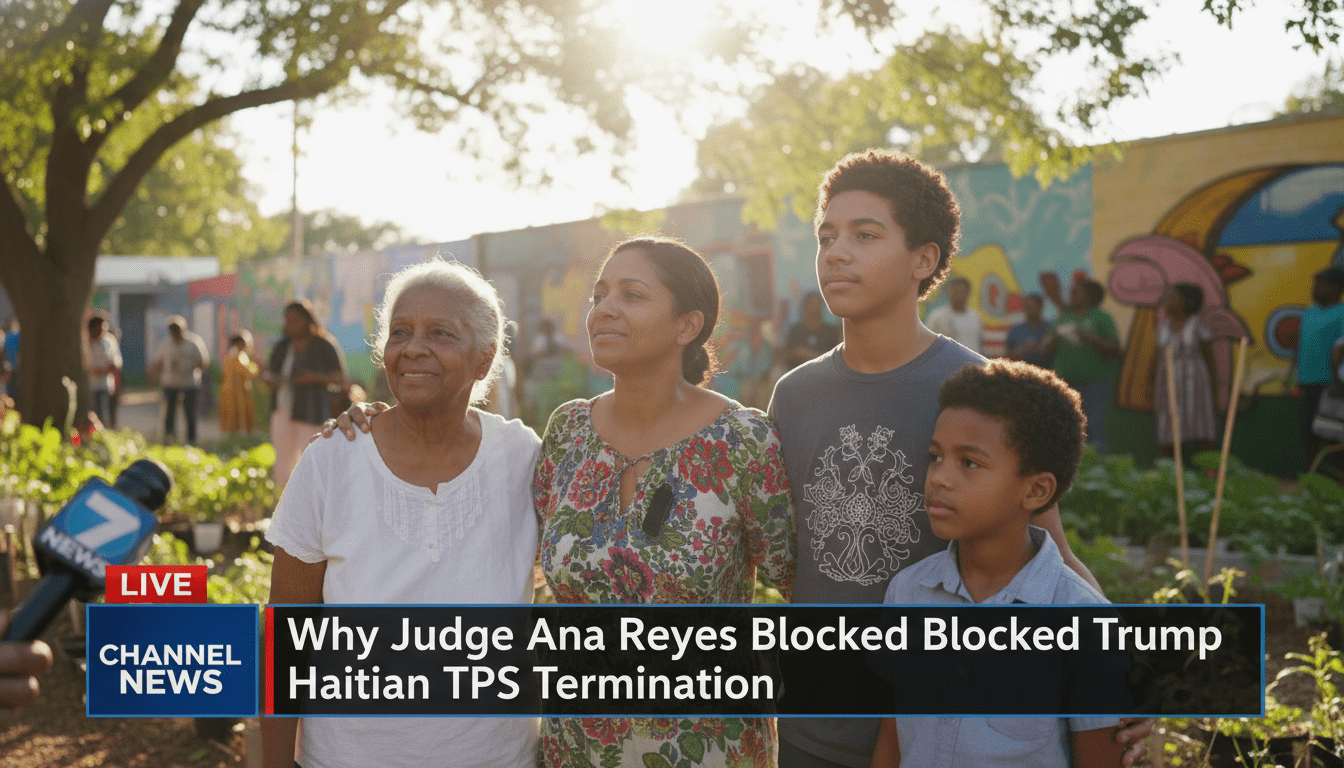
The ticking clock stopped just hours before a catastrophe for over 350,000 people. On February 2, 2026, U.S. District Judge Ana Reyes stepped in to halt a massive deportation plan. The Trump administration intended to end Temporary Protected Status (TPS) for Haitian nationals on February 3. This ruling provides a vital breathing room for thousands of families who have built lives in the United States over the last decade (cbsnews.com). The decision highlights a growing tension between executive power and the legal rights of immigrants from the Black Diaspora.
Judge Reyes issued a preliminary injunction that prevents the Department of Homeland Security (DHS) from stripping these protections away. The ruling suggests that the administration likely skipped essential legal steps when it decided to terminate the program. For the families living in the shadows of this policy, the news brought a wave of relief mixed with caution. While the immediate threat of deportation is gone, the legal battle for their future is far from over. This case reminds the world of the complex history of Haitian migration and the long struggle for dignity in American law (yahoo.com).
The Legal Foundation of Temporary Protected Status
To understand the current crisis, one must look back to the Immigration Act of 1990. Congress created TPS during the administration of President George H.W. Bush. It was designed to offer a safe haven to foreign nationals who were already in the United States when their home countries suffered major disasters (wikipedia.org). This status is not a permanent visa. It does not lead directly to a green card. However, it does provide a legal work permit and protection from being sent back to a dangerous environment (evrimagaci.org). Many families who survived life on the slave plantations of history have sought similar refuge from systemic violence and natural disasters in modern times.
The Secretary of Homeland Security has the power to designate a country for TPS if conditions such as armed conflict or environmental catastrophes make a safe return impossible. For Haiti, this designation has been a lifeline for over fifteen years. The program was never meant to be a permanent solution, yet the reality of Haiti has rarely allowed for a safe return. Critics of the program argue that it has been extended far beyond its original intent. Proponents, however, argue that the law requires a neutral assessment of current safety, which the administration allegedly ignored in its rush to end the program (dhs.gov).
Haitian TPS Growth: A Decade of Protection
Source: DHS and Court Filings
A History of Catastrophe in Haiti
Haiti received its initial TPS designation in January 2010 after a magnitude 7.0 earthquake leveled much of the country. That disaster killed between 220,000 and 300,000 people. The Haitian government was unable to handle the return of its citizens living abroad (cbsnews.com). Since that day, Haiti has faced a relentless cycle of turmoil. A massive cholera outbreak and several devastating hurricanes followed the earthquake. Each event made the argument for extending TPS stronger, as the nation struggled to rebuild its basic infrastructure (evrimagaci.org).
The situation worsened significantly in 2021 following the assassination of President Jovenel Moïse. Since his death, violent gangs have taken control of nearly 80 percent of the capital, Port-au-Prince. These groups use kidnapping and violence to maintain power, creating a state of emergency that remains active today (cfr.org). The Department of State currently maintains a “Do Not Travel” warning for the country. Returning 350,000 people to this environment was a primary concern for the court. Judge Reyes noted that the administration’s own safety warnings contradicted its decision to end the protections (cbsnews.com).
The Administrative Procedure Act and Why It Matters
Judge Reyes based her ruling on the Administrative Procedure Act (APA). This federal law governs how executive agencies make decisions. It requires agencies to provide a rational explanation for changing long-standing policies. In this case, the court found that DHS Secretary Kristi Noem failed to follow these rules. The judge ruled that the decision to end TPS was “arbitrary and capricious.” This legal term means the decision was made without a proper look at the facts or the law (cbsnews.com).
Secretary Noem allegedly failed to consult with the State Department about the actual safety conditions in Haiti. Under the APA, the government cannot ignore “overwhelming evidence of present danger” when making a decision that affects hundreds of thousands of lives. The court also pointed out that the government did not consider the “reliance interests” of the families involved. These families have lived in the United States for years, paying taxes and raising children. The law requires the government to explain why those interests are no longer important before it upends their lives (yahoo.com, forumtogether.org).
Racial Animus and the Equal Protection Clause
A central part of the legal challenge involved the motive behind the policy. The plaintiffs argued that the decision was driven by “racial animus,” or prejudice against non-white immigrants. Judge Reyes found it “substantially likely” that the termination of TPS was motivated by hostility toward the Haitian people. The ruling cited public comments from President Trump and Secretary Noem as evidence of this bias. These comments often described immigrants in derogatory terms, which suggested the outcome was preordained regardless of the facts on the ground (cbsnews.com, theguardian.com).
This finding connects to the Equal Protection Clause of the 14th Amendment. This part of the Constitution guarantees that all people receive equal treatment under the law. When a government policy targets a specific group because of their race or national origin, it violates this principle. For the Black Diaspora, this case is part of a larger pattern of exclusion. Historical accounts of life on the slave plantations show how legal systems have long been used to marginalize Black communities. The court’s focus on racial bias acknowledges that immigration policy does not exist in a vacuum (naacp.org).
The Economic Impact of Haitian TPS
$5.2B
Annual Tax Revenue
108,000+
Labor Force
27,000
U.S. Born Children
A sudden termination would drain billions from the U.S. economy.
The Economic Importance of Haitian Workers
The impact of the ruling extends far beyond the legal system. It reaches into the heart of the American economy. Over 108,000 Haitian TPS holders are active participants in the labor force. They work in critical sectors such as healthcare, nursing, and software engineering. Removing these workers would create a sudden labor shortage in many parts of the country. The court noted that turning hundreds of thousands of lawful workers into “unlawful immigrants overnight” would harm the national economy (cbsnews.com, miamiherald.com).
Haitian TPS holders also contribute an estimated $5.2 billion in annual tax revenue. This money supports schools, roads, and public services in the communities where they live. In South Florida and Massachusetts, the concentration of Haitian families is especially high. Many business owners and local leaders have expressed fear about the economic void that would be left if these protections disappeared. The ruling recognizes that these individuals are not just residents but essential contributors to the stability of their regions (yahoo.com, wgbh.org).
The Focus on Springfield, Ohio
Springfield, Ohio, became a focal point for the “racial animus” debate during the recent election cycle. Approximately 15,000 Haitian residents live in the city, many of whom have TPS. During the 2024 campaign, political rhetoric often targeted this specific community. High-profile figures amplified conspiracy theories about the residents, which led to a climate of fear and tension. The court examined whether this political climate influenced the DHS decision to end their legal status (signalohio.org, springfieldohio.gov).
Five of the plaintiffs in the lawsuit are from Springfield, including a neuroscientist and a software engineer. These individuals moved to the city for its low cost of living and available jobs. Faith leaders in Springfield have even had to prepare “power of attorney” training for parents who fear being separated from their children. The ruling mentions that the rhetoric surrounding Springfield contributed to a sense of “racial terror.” This context was crucial in showing that the termination order was not a neutral policy shift but a response to political pressure (wyso.org, 10tv.com).
The Plight of U.S.-Born Children
Perhaps the most emotional aspect of the case involves the children. There are approximately 27,000 U.S.-born children who have at least one parent with Haitian TPS. These children are American citizens under the 14th Amendment. If their parents are deported, these families face an impossible choice. They must either take their children to a violent war zone in Haiti or leave them behind in the U.S. foster care system. This “de facto” deportation of American citizens was a major concern for advocacy groups (cbsnews.com, miamiherald.com).
Legal filings highlighted the “tremendous mental and emotional health issues” these children face. The threat of forced separation creates constant stress for families. Some families are descendants of people who fled life on the slave plantations and have a long memory of family separation. Birthright citizenship is a cornerstone of American democracy, yet it offers little comfort if a parent is removed by force. Judge Reyes’s ruling prevents this trauma from becoming a reality for thousands of households for the time being (cbsnews.com, theguardian.com).
Where Haitian TPS Holders Live
The ruling affects every corner of the United States.
The Future of the Case and the Supreme Court
What happens now for the 350,000 TPS holders? Because the ruling came before the February 3 expiration, their current status remains valid. They do not need to reapply for work permits immediately. The court order freezes their protections in place while the full trial proceeds. Employers have been notified that Haitian employees remain eligible to work legally. For the moment, the status quo is preserved, and the threat of immediate detention is gone (cbsnews.com).
However, the Trump administration has already signaled that it will appeal the decision. DHS officials labeled the ruling as “lawless activism” and intend to take the case to the Supreme Court. An appeal could potentially lift the injunction, though that process usually takes months. The status of these families is still “temporary,” and they remain in a state of legal limbo. Advocates continue to push for a permanent solution, such as a path to residency, arguing that no one should live under a “temporary” status for decades (aa.com.tr, forumtogether.org).
The struggle for Haitian TPS holders is a modern chapter in the long history of the Black Diaspora in America. Just as people once sought to escape life on the slave plantations, today’s immigrants seek a fair chance to live without fear. Judge Reyes’s decision is a significant victory for the rule of law and human rights. It stands as a reminder that executive power has limits and that the courts can be a shield against discriminatory policies. The eyes of the world will remain on the legal system as it decides the fate of 350,000 people who simply want a safe place to call home (cbsnews.com).
About the Author
Darius Spearman is a professor of Black Studies at San Diego City College, where he has been teaching for over 20 years. He is the founder of African Elements, a media platform dedicated to providing educational resources on the history and culture of the African diaspora. Through his work, Spearman aims to empower and educate by bringing historical context to contemporary issues affecting the Black community.
