

Inside Africa’s $2.5 Billion Green Energy Revolution
By Darius Spearman (africanelements)
Support African Elements at patreon.com/africanelements and hear recent news in a single playlist. Additionally, you can gain early access to ad-free video content.
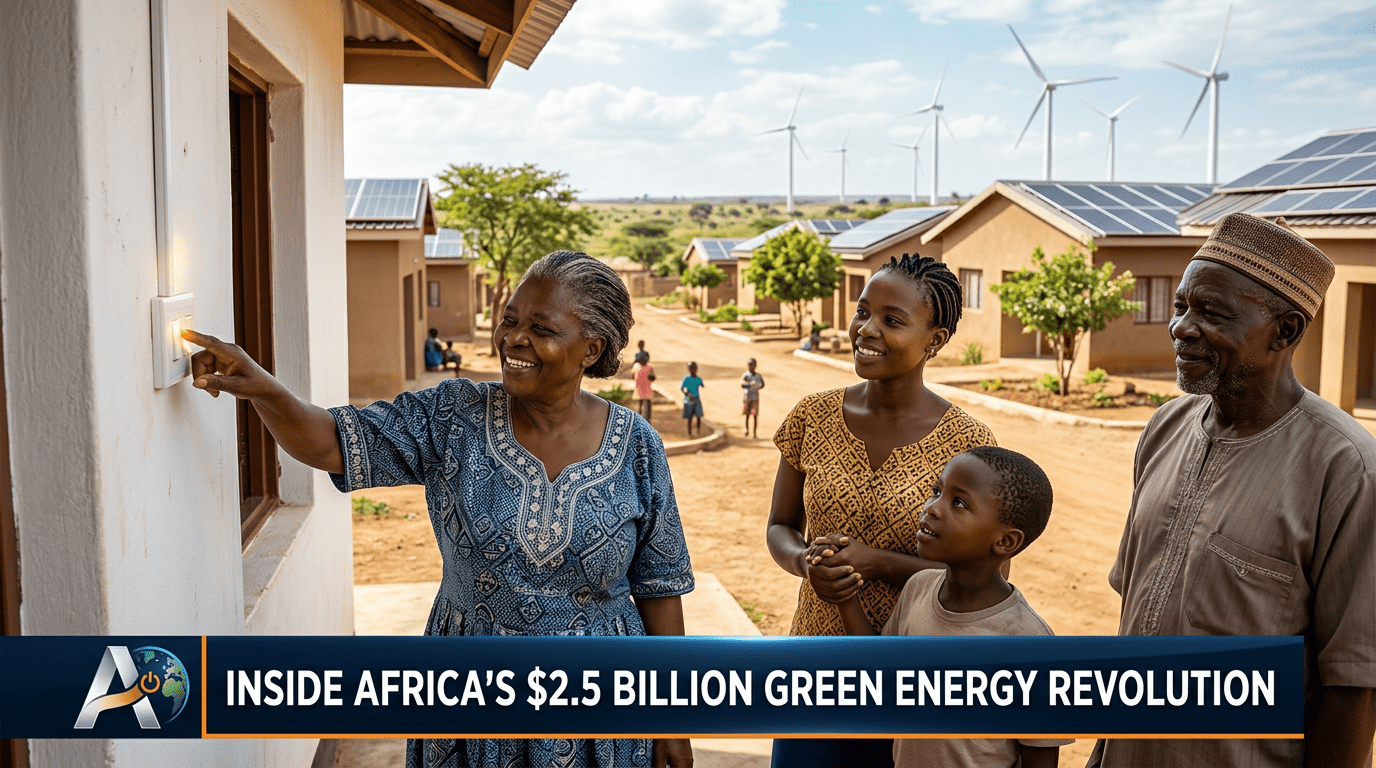
On March 4, 2026, the African Development Bank issued a major announcement. Its flagship facility, the Sustainable Energy Fund for Africa, is on track to mobilize $2.5 billion in new financing over the next two years (afdb.org). This announcement marks a critical acceleration in the energy transition across the continent. The goal remains clear: to bridge the gap in universal energy access while pivoting away from traditional, high-carbon fossil fuel dependency (afdb.org).
The significance of this capital mobilization extends beyond the headlines. To understand the weight of this investment, one must look at the history of how energy infrastructure was formed in Africa. For generations, the continent lived with systems designed for extraction rather than service (tni.org). The current surge represents a break from that colonial past. It is an effort to move toward a future where energy access serves as a fundamental human right (tni.org).
The Evolution of SEFA
The journey toward this financial milestone began years ago. The Sustainable Energy Fund for Africa started in 2011 through a partnership between the African Development Bank and the government of Denmark (afdb.org). The initial commitment was $56 million (afdb.org). At that time, the mandate was specific. The fund sought to scale up engagement in small-to-medium renewable energy and energy efficiency sectors (afdb.org). These areas often faced neglect from larger, risk-averse institutional lenders.
The fund underwent a significant transformation on October 31, 2019, when it became a Special Fund (afdb.org). This change allowed it to operate as a multi-donor facility. It transformed the fund into a more agile, catalytic vehicle for change (afdb.org). Even during the economic uncertainty of the global pandemic in 2020, the fund proved its resilience. It secured $90 million in new commitments and managed a high number of impactful transactions (afdb.org).
SEFA Funding Growth (2011-2026)
Visualization of capital escalation. Bronze: Initial, Black: Current Surge.
The fund serves as a primary implementation arm of the New Deal on Energy for Africa (afdb.org). This strategy aims to achieve universal access to energy across the continent. By focusing on green baseload power, mini-grids, and efficiency, the fund has evolved. It moved from a niche support program to become a central pillar of the transition (afdb.org). This path reflects the resilience needed to overcome obstacles, similar to the enduring strength that families must cultivate to thrive in difficult circumstances.
The Meaning of Energy Justice
Energy access is a technical metric, but energy justice is a social framework. Many people assume that energy access means only stringing wires to a home. However, researchers define energy poverty as the inability to access essential energy services (tni.org). This prevents people from participating fully in modern life. The lack of electricity limits access to clean water, education, and economic mobility (tni.org). It creates a cycle that keeps people trapped in poverty.
True energy justice demands more than just providing electricity. It requires that these systems be affordable, inclusive, and equitable (tni.org). The current initiative aims to address this by moving away from assumptions that every household needs a massive centralized grid connection. Instead, the strategy employs a mix of on-grid, mini-grid, and off-grid solutions (afdb.org). This approach specifically reaches rural, marginalized populations who were historically deemed too expensive to connect (afdb.org). It serves as a developmental model rather than an extractive one (tni.org).
This push for equality in energy mirrors other struggles for civil rights. Just as reconstruction efforts failed because they lacked the necessary economic foundation, energy access projects can fail if they ignore social needs. By prioritizing the last mile of connectivity, the African Development Bank is attempting to rewrite the narrative. It focuses on the people rather than just the industrial hubs (afdb.org).
De-risking and Financial Sovereignty
A major concept in this energy shift is de-risking. This term refers to the use of financial tools to shield private investors from the perceived risks of emerging markets (tni.org). Many commercial investors view African renewable energy projects as too volatile. They often fear instability or regulatory uncertainty (afdb.org). Consequently, they avoid these markets despite the immense potential for growth (afdb.org).
De-risking acts as a tool to bridge this gap. Instruments such as government guarantees and blended finance lower the barriers to entry (tni.org). When an institution like the African Development Bank provides these guarantees, it signals to the market that a project is safe. This shift in capital is vital (afdb.org). It helps African nations break free from colonial-era dependencies on imported fossil fuels (tni.org). This is essential, as the continent faces a growing debt crisis that complicates development.
This process of financial mobilization is a form of reparative investment. It corrects decades of underinvestment and the exploitation of resources (tni.org). By fostering local, homegrown industries and the productive use of energy, nations can keep wealth within their borders (tni.org). This prevents the historical pattern of exporting value while importing finished goods. It is a step toward true economic sovereignty (tni.org).
The Multiplier Effect
Bronze: Direct Investment. Black: Mobilized Private Capital.
The Colonial Electrical Geography
To understand the current energy situation, one must look at the physical layout of electrical grids. Many African electrical grids were historically designed for export-oriented economics (tni.org). Colonial powers built infrastructure to extract raw materials from the interior to the coast. The goal was to ship resources to Europe (tni.org). These grids were never meant to support domestic industry or residential access for the local population (tni.org).
This electrical geography created a structural reliance on fossil fuels. It left the continent dependent on imported, polluting energy models to sustain its economy (tni.org). The push for renewable energy today acts as a decolonization project. It seeks to dismantle these extractive systems (tni.org). Replacing them with energy architectures that prioritize local economic needs is a form of self-determination. This is the history of the continent before colonial interference, where local economies thrived on their own terms.
When the fund focuses on green baseload power, it addresses this historical weakness. Green baseload refers to reliable, 24/7 energy sources (afdb.org). Unlike intermittent renewables such as solar or wind, which require storage, baseload power provides the stability needed for heavy industry and consistent local manufacturing (afdb.org). It prevents the frequent outages that currently cost African economies significant amounts in lost GDP (afdb.org).
Carbon Finance and Modern Innovation
In July 2025, the fund expanded into the carbon finance space (afdb.org). This innovation supports electric cooking programs. These programs utilize carbon credits to lower costs for low-income households (afdb.org). Traditional, smoky biomass—such as wood and charcoal—remains a primary driver of household air pollution. This creates a public health crisis that disproportionately affects women and children (afdb.org).
Carbon credits provide an alternative to government taxation for subsidies. They effectively tax the polluter to pay for the transition of the low-income household (afdb.org). This mechanism allows companies to sell clean cooking devices at a 50–90% discount (afdb.org). It transforms a luxury technology into an affordable necessity. This is how the fund moves beyond simple grants to sustainable, market-based financial models (afdb.org).
This approach shows a maturation of the fund. It recognizes that financial solutions must be linked to social outcomes. Just as there is a need for new ways of learning, there is a need for new ways of financing development. Carbon finance provides a path to move up the energy ladder without falling into further debt (afdb.org).
Energy Access Challenge
600 Million Without Electricity
1 Billion Without Clean Cooking
The Road Ahead
The numbers illustrate the scale of the challenge. Approximately 600 million people in Africa still lack electricity access (who.int, iea.org). Over 1 billion people lack access to clean cooking solutions (afdb.org). In 2024, approved projects added roughly 840 megawatts of new generating capacity. These projects provided 1.5 million new electricity connections across countries like Kenya, Nigeria, Burkina Faso, Ethiopia, and Chad (afdb.org).
The mobilization target of $2.5 billion is a major step. By 2030, the bank projects its portfolio will yield over $10 billion in total mobilized private capital (afdb.org). This will require sustained donor confidence and consistent project success. European Union member countries have already increased their contributions to $88 million in 2025 (afdb.org). This influx reflects a renewed global commitment to the African energy transition.
The history behind these headlines shows that the energy transition is a project of economic sovereignty. It allows African nations to reclaim control over their development (tni.org). It is a move to build a self-sufficient, equitable future. While the path to universal energy access by 2030 remains an uphill climb, the financial and regulatory tools are catching up to the continent’s potential (afdb.org). The transition is no longer a distant goal. It is an active, ongoing process of reshaping the energy landscape.
About the Author
Darius Spearman is a professor of Black Studies at San Diego City College, where he has been teaching for over 20 years. He is the founder of African Elements, a media platform dedicated to providing educational resources on the history and culture of the African diaspora. Through his work, Spearman aims to empower and educate by bringing historical context to contemporary issues affecting the Black community.
