


Why Activists Seek a UCLA Black Panther Memorial Now
By Darius Spearman (africanelements)
Support African Elements at patreon.com/africanelements and hear recent news in a single playlist. Additionally, you can gain early access to ad-free video content.
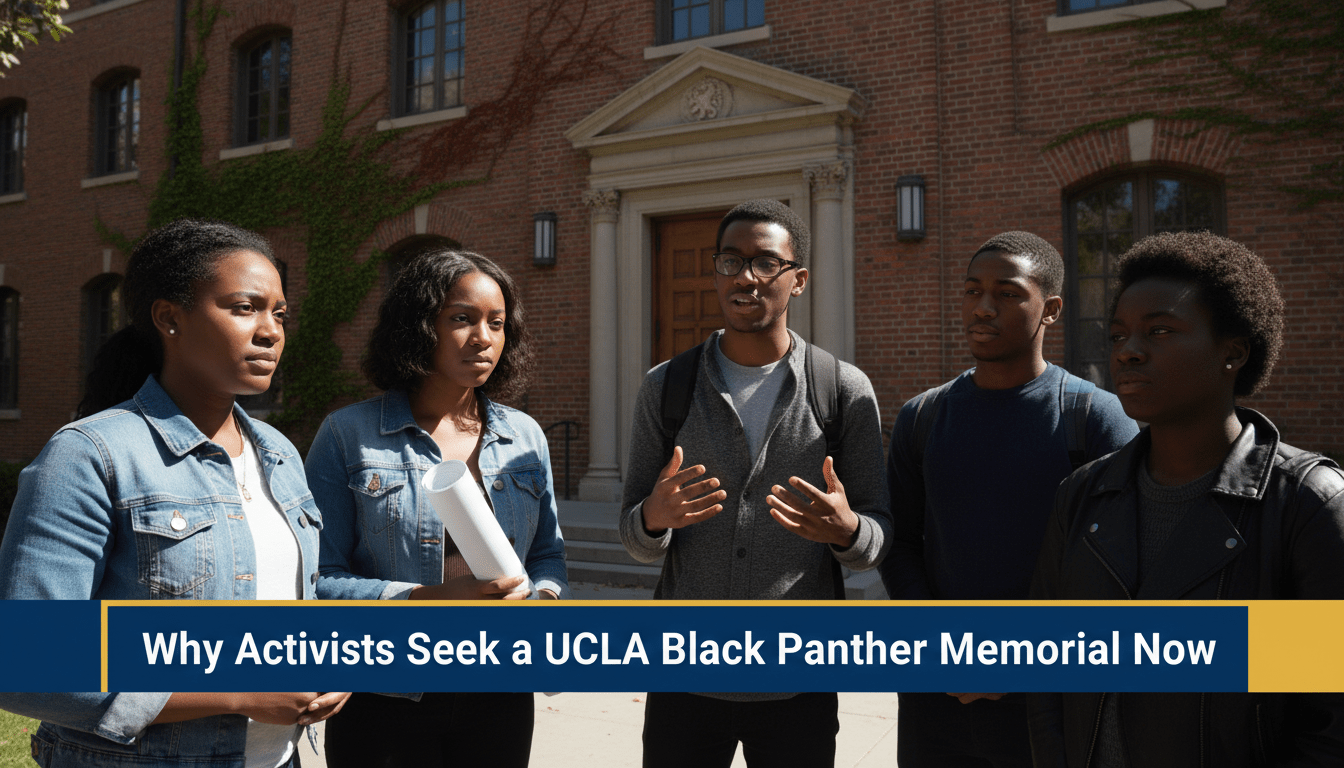
The brick walls of Campbell Hall at UCLA hold a heavy history. Today, the building serves as a hub for student support services. However, a growing movement of students and activists wants everyone to remember what happened inside those walls decades ago. They gathered recently to demand that the university rename the building to honor two fallen leaders. These men were Alprentice “Bunchy” Carter and John Huggins Jr., who were prominent figures in the Black Panther Party (dailybruin.com).
The atmosphere at these protests is one of determination and deep memory. Participants argue that the current name of the building does not reflect the struggles of the Black community. They believe that official recognition is a vital part of restorative justice. This movement has gained significant momentum recently. A petition for the change has already collected more than 5,000 signatures (squarespace.com). Under the current administration of President Donald Trump, issues of national identity and historical memory remain at the forefront of public debate. At UCLA, this debate is centered on a single hallway where history took a violent turn in 1969.
The Fatal Dispute in Room 1201
On January 17, 1969, a meeting took place in Room 1201 of Campbell Hall. The Black Student Union gathered there to discuss a very important topic. They were trying to decide who would lead the newly created Afro-American Studies Center (ucla.edu). This center was the result of intense student activism. However, two different groups had very different ideas about the direction of Black studies. These groups were the Black Panther Party and the US Organization (blackpast.org).
The meeting was intended to resolve a leadership dispute. Instead, it ended in tragedy. A physical confrontation broke out between members of the two groups. In the chaos, shots were fired. Bunchy Carter and John Huggins Jr. were killed during the shootout. This event sent shockwaves through the campus and the nation. For many years, the university treated the incident as a simple case of inter-group violence (blackpast.org). Today, students argue that this narrow view ignores the larger forces that were at play behind the scenes.
Nearly 80% of documented FBI actions targeted the Black Panther Party (truthout.org).
The Hidden Hand of the FBI
Modern research has revealed that the conflict between the Panthers and the US Organization was not an accident. The Federal Bureau of Investigation (FBI) played a major role in fueling the fire. Through a program called COINTELPRO, the FBI worked to destroy Black nationalist groups (truthout.org). J. Edgar Hoover, who led the FBI at the time, viewed the Black Panthers as a major threat to national security. He ordered his agents to neutralize the party by any means necessary.
The FBI sent forged letters and cartoons to both groups. These messages were designed to make the leaders believe the other group was planning to kill them. This psychological warfare was very effective. It created a climate of fear and paranoia that led directly to the shooting at Campbell Hall (blackpast.org). The [rise and fall of a revolutionary movement](https://www.africanelements.org/news/the-black-panther-party-the-rise-and-fall-of-a-revolutionary-movement/) was often shaped by these secret government operations. By acknowledging this, activists hope to show that the deaths of Carter and Huggins were part of a state-sanctioned tragedy rather than a random act of crime.
Who Were Carter and Huggins?
Alprentice “Bunchy” Carter was a powerful organizer in Los Angeles. Before joining the Panthers, he was a leader in the Slauson gang. This group was one of the largest territorial street organizations in the city during the 1950s (streetgangs.com). After spending time in prison, Carter transformed his life. He turned his focus toward political activism and founded the Southern California chapter of the Black Panther Party. He was known for his charisma and his ability to bring people together for community programs.
John Huggins Jr. was also a dedicated activist. He served as the party’s Deputy Minister of Information. Huggins was a student at UCLA and had been recruited through a special program for marginalized students (blackpast.org). Both men believed in revolutionary socialism. They wanted to fix the capitalist system to help poor communities. Their work focused on [intersectional oppression](https://www.africanelements.org/news/huey-p-newton-and-the-revolutionary-black-nationalist-position-on-gay-and-womens-liberation-movements-2/) and providing basic needs like food and healthcare. Their deaths left a massive void in the leadership of the Black Power movement in California.
■ Black Students
■ Other Student Demographics
Black students represent a small fraction of the total student body (dailybruin.com).
The Battle Over Building Names
Currently, Campbell Hall is named after Lily Bess Campbell. She was a very successful English professor at UCLA from 1922 to 1950. She specialized in the works of William Shakespeare and was the first woman to give a prestigious faculty lecture at the university (wikipedia.org). While her academic achievements are impressive, protesters argue that her name does not belong on this specific building. They point out that she has no connection to the current mission of the Academic Advancement Program (AAP) housed there (uniwriter.ai).
The AAP serves students who come from underrepresented and low-income backgrounds. Many of these students are the first in their families to attend college. Activists believe the building should honor people who fought for the rights of these very students. They argue that renaming it to “Carter-Huggins Hall” would provide a sense of belonging. It would also serve as a permanent reminder of the radical history that helped create Black studies at UCLA. This change is seen as a way to move toward the [success of African American students](https://www.africanelements.org/news/how-will-blacks-students-fare-in-the-era-of-online-learning-and-covid-19/) by acknowledging their past struggles.
Ideological Conflicts: BPP vs. US Organization
The conflict in 1969 was fueled by deep ideological differences. The Black Panther Party followed the ideas of revolutionary socialism. They believed that the struggle for Black liberation was part of a larger class struggle against capitalism (uniwriter.ai). They were willing to work with people of all races who shared their goal of economic justice. The Panthers are famous for their community programs, such as providing free breakfast to children and opening health clinics.
In contrast, the US Organization, led by Maulana Karenga, focused on cultural nationalism. They believed that Black people needed to reclaim their African culture and identity before they could be truly free (blackpast.org). This group created the celebration of Kwanzaa and emphasized the “Nguzo Saba,” or the seven principles of Blackness. They were less interested in class-based revolution and more focused on cultural unity. The FBI exploited these differences to turn the two groups against each other. This manipulation turned a healthy debate into a deadly rivalry (organizefor.org).
The Legacy of the High Potential Program
Both Carter and Huggins entered UCLA through the High Potential Program (HPP). This was a revolutionary initiative started in 1968. It was designed to admit students who did not meet traditional academic requirements but showed great leadership potential (uniwriter.ai). The goal was to train these students to become community organizers and leaders. This program eventually evolved into the Academic Advancement Program that exists today. It remains one of the largest programs of its kind in the United States.
Because Campbell Hall houses the AAP, it is considered sacred ground by many activists. They see a direct line between the radical students of the 1960s and the diverse student body of today. The demand for renaming the building is about more than just a sign on a wall. It is about honoring the [kinship resilience tradition](https://www.africanelements.org/patreon/threads-of-resilience-tracing-the-unbreakable-history-of-the-black-family/) of those who fought for educational access. By reclaiming the building, students hope to ensure that the university never forgets the price that was paid for the programs they use every day.
Unfinished Justice: The Escape and the Search
The legal aftermath of the 1969 shooting was complicated and left many questions unanswered. Three members of the US Organization were convicted of conspiracy and second-degree murder. These men were Donald Hawkins and the brothers George and Larry Stiner (wikipedia.org). However, the story did not end with their convictions. In 1974, the Stiner brothers escaped from San Quentin State Prison. They managed to flee during a family visit and disappeared for many years.
Larry Stiner eventually surrendered to authorities in 1994 after living in South America for decades. However, George Stiner remains a fugitive to this day (wikipedia.org). Furthermore, the man believed to be the primary shooter, Claude “Chuchessa” Hubert, fled the country and was never caught. Many people in the community feel that true justice was never served. This sense of unfinished business fuels the current movement at UCLA. Activists argue that since the legal system failed to provide full accountability, the university must step up and provide historical accountability through renaming the building.
Demands for Restorative Justice
The student-led movement has a clear list of demands for the UCLA administration. The primary goal is renaming Campbell Hall to Carter-Huggins Hall. However, they also want to see other changes. They are asking for the installation of permanent statues of the two leaders (organizefor.org). Additionally, they want the history of the 1969 incident and the High Potential Program to be included in the orientation for all new students. They believe that every student should know the radical roots of the campus they attend.
The university has historically resisted these changes. Officials often point to the contributions of Lily Bess Campbell as a reason to keep the current name. However, the Undergraduate Students Association Council (USAC) and the Afrikan Student Union (ASU) continue to pass resolutions in favor of the renaming (dailybruin.com). They argue that the university’s silence on this issue for over 50 years is a form of negligence. They view restorative justice as an active process that requires the institution to admit past mistakes and honor those who were harmed by them.
UCLA’s Diversity and Extractive Inclusion
Today, the percentage of Black students at UCLA remains relatively low. Figures show that Black students make up between 3.6% and 6.7% of the total student body (dailybruin.com). Activists often contrast this small number with the high number of Black student-athletes. Historically, up to 65% of Black male students at the university were athletes. This has led to accusations of “extractive inclusion.” This term describes a situation where an institution recruits Black people for their labor or talent but does not invest in their long-term success or community (uniwriter.ai).
The movement at Campbell Hall seeks to replace this model with “restorative inclusion.” This means creating an environment where Black history is celebrated and Black students feel represented in the physical landscape of the campus. By renaming the building, the university would signal that it values the political and intellectual contributions of Black activists. It would be a step toward repairing the relationship between the institution and the Black community. Students are determined to keep pushing until their voices are heard and their history is honored.
About the Author
Darius Spearman is a professor of Black Studies at San Diego City College, where he has been teaching for over 20 years. He is the founder of African Elements, a media platform dedicated to providing educational resources on the history and culture of the African diaspora. Through his work, Spearman aims to empower and educate by bringing historical context to contemporary issues affecting the Black community.
