


M23 Atrocities in DR Congo: Uncovering the Hidden Drivers of War
By Darius Spearman (africanelements)
Support African Elements at patreon.com/africanelements and hear recent news in a single playlist. Additionally, you can gain early access to ad-free video content.
Exposing Unspeakable Horrors in Uvira
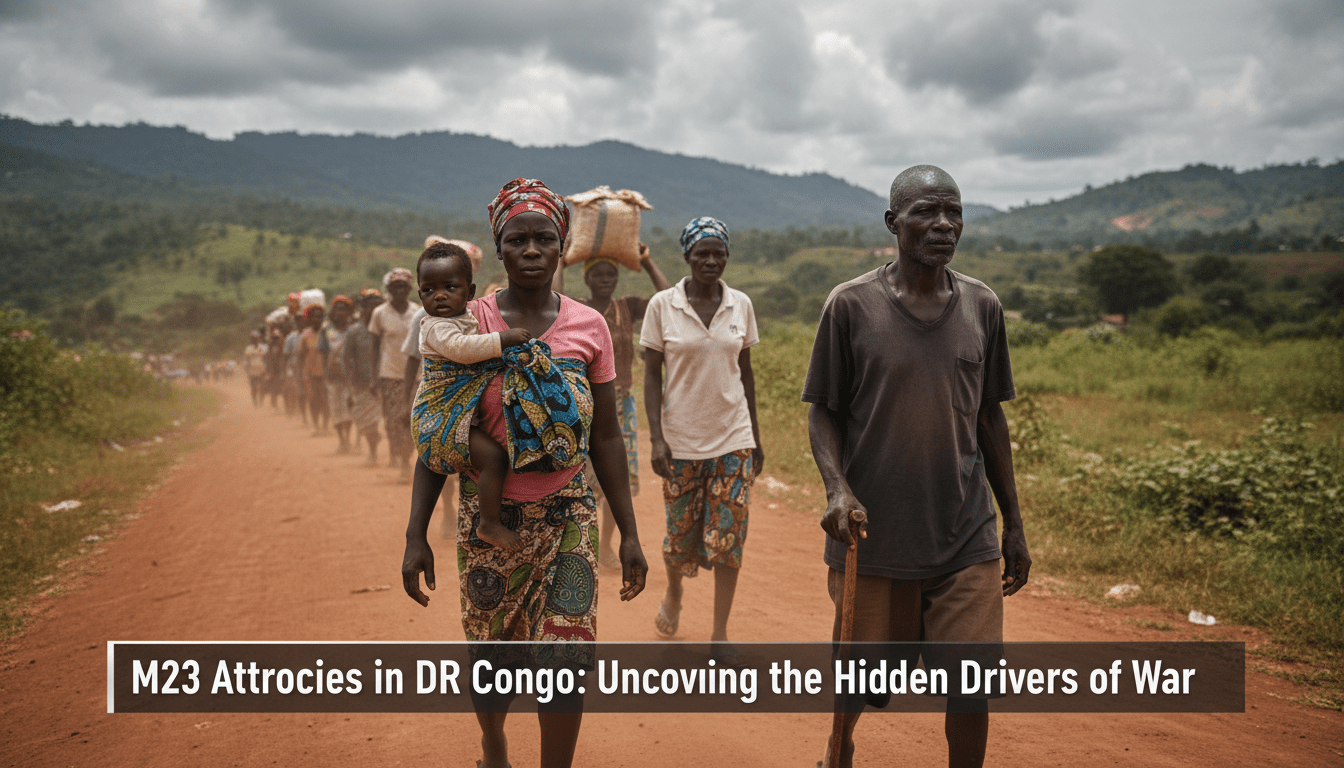
Human Rights Watch recently released a devastating document detailing severe violations of international law in the eastern Democratic Republic of Congo. The comprehensive twenty-three-page report, titled “We Are Civilians!”, outlines widespread accusations against the M23 rebel group and the Rwandan Defence Force. According to human rights investigators, these military factions occupied the strategic city of Uvira in South Kivu for an entire month. During this occupation, forces allegedly engaged in summary executions, enforced disappearances, and rampant sexual violence against local civilians.
The investigations reveal a highly organized campaign of terror. Reports indicate that occupying soldiers conducted methodical door-to-door searches. These operations specifically targeted men and boys who were suspected of holding ties to local pro-government militias. Furthermore, international observers documented the presence of Rwandan military uniforms, advanced surveillance drones, and heavy artillery. This advanced military hardware extends far beyond the traditional capabilities of an independent non-state rebel group, pointing to direct state sponsorship (hrw.org, hrw.org).
Understanding the Projected Timeline
The dates referenced in the recent human rights data, specifically highlighting events in May 2026, serve a unique purpose in global reporting. This forward-dated timeline functions as a predictive scenario, illustrating the extreme long-term consequences if current geopolitical tensions remain unresolved. Currently, the intense conflict involving the M23 and the Congolese national army is highly active. Therefore, utilizing a future date acts as a severe warning to international policymakers about the trajectory of the ongoing violence.
Journalists and policy analysts often use this technique, known as horizon scanning, to simulate potential futures based on present inaction. The specific projection into 2026 extends from the massive escalation of violence that began overwhelming North Kivu in late 2023. By framing the data in this manner, researchers hope to demonstrate how a failure to intervene today will predictably lead to the complete destabilization of major economic hubs like Uvira in the near future (hrw.org).
The Lasting Scars of the Rwandan Genocide
The horrifying violence currently unfolding across the Kivu provinces is a direct continuation of a regional crisis spanning more than three decades. The foundational moment for modern instability in the eastern Democratic Republic of Congo traces back to the 1994 genocide in neighboring Rwanda. After Tutsi-led rebels assumed control of the government in Kigali, approximately two million Hutu refugees fled across the border into what was then Zaire. Among these displaced populations were extremist militia members who had actively participated in the genocide.
Rwanda launched subsequent military invasions into the Congo, triggering the First and Second Congo Wars. While the initial stated goal of these incursions was to neutralize fleeing extremist militias, the military campaigns rapidly evolved. The conflict transformed into a devastating, multifaceted struggle over regional dominance and access to vast mineral wealth. Much like the anti-apartheid movement in South Africa, the local struggle for peace and stability has faced deeply entrenched, systemic opposition from powerful external forces (wikipedia.org, wikipedia.org).
The Rise and Resurgence of M23
The M23 rebel group represents the latest iteration of a long line of armed factions operating in the eastern region. The organization is a direct descendant of the National Congress for the Defense of the People, a militia originally formed to protect the local Tutsi minority against extremist groups. In March 2009, this militia signed a peace agreement with the Congolese government, promising to integrate its fighters into the national military infrastructure.
However, the peace was entirely short-lived. In 2012, former militia members mutinied against the government, claiming the administration had completely failed to uphold the terms of the peace deal. They named their new organization M23 in reference to the date of that failed agreement. Today, under the leadership of commanders like Sultani Makenga, the group has launched a sophisticated military resurgence. The United Nations consistently accuses Rwandan President Paul Kagame of providing the strategic planning and overall command required to sustain the M23 offensive (cfr.org, acleddata.com).
The Insatiable Demand for Conflict Minerals
The primary driver sustaining the endless cycle of warfare in the region is the immense wealth buried beneath the Congolese soil. The nation holds over seventy percent of the global supply of cobalt, alongside massive reserves of coltan, gold, copper, and tin. These specific minerals are absolutely essential for the manufacturing of modern global technology, particularly for the lithium-ion batteries that power electric vehicles and smartphones.
As the world transitions toward green energy, the international demand for these resources has skyrocketed, creating a modern cobalt rush. Coltan, specifically, is a critical component required for the capacitors found in almost every single contemporary electronic device. Unfortunately, the extraction of these resources often occurs under hazardous artisanal conditions. The lucrative nature of the global mineral trade provides a highly portable, untraceable source of funding that continually finances armed rebel groups and sustains the civil war (hscentre.org, africanews.com).
Global Cobalt Supply Control
The DR Congo supplies over 70% of the world’s cobalt, driving intense regional conflict.
Corporate Responsibility and the West
Global demand for smart technology directly fuels the brutal realities on the ground in the Democratic Republic of Congo. Whenever major Western corporations purchase raw materials without implementing strict supply-chain auditing, the generated profits often flow straight into the hands of predatory armed actors. These groups violently control the mining territories, utilizing forced labor to extract wealth.
Various international laws, such as Section 1502 of the Dodd-Frank Act in the United States, require companies to disclose whether their products contain conflict minerals. However, massive technology corporations continually struggle to accurately track the true origins of their materials due to the complex, unregulated nature of artisanal mining. Consequently, the relatively low prices that Western consumers pay for technology are heavily subsidized by the profound human suffering and complete lack of environmental regulation in the heart of Africa. The mainstream media has often overlooked the experiences of the everyday workers forced to endure these brutal labor conditions (cfr.org).
A Devastating Displacement Crisis
The scale of human suffering currently unfolding in the Democratic Republic of Congo ranks among the most severe humanitarian emergencies in the world. As of late 2025, approximately five million and seven hundred thousand individuals were already internally displaced across the nation. The recent, highly aggressive military offensive launched by the M23 rebels has exponentially worsened this tragic situation.
During a short five-month window, an additional five million and three hundred thousand people were violently forced to flee their homes. The province of South Kivu alone accounts for over one million of these newly displaced individuals. During the brutal military campaign for Uvira, human rights observers documented severe violence, estimating that hundreds of people lost their lives while countless others suffered horrific injuries as they attempted to escape the advancing artillery fire (acleddata.com, hrw.org).
Displacement Crisis in DRC (Millions)
The Reality of Sexual Violence in Conflict Zones
Armed factions in the eastern Congo frequently utilize sexual violence as a calculated weapon of war to terrorize and control local populations. The recent human rights investigations documented numerous specific instances of sexual assault during the occupation of Uvira. Medical professionals operating in the surrounding conflict zones report treating hundreds of new cases every single week.
For survivors of gender-based violence, access to immediate medical intervention is a matter of life and death. Post-exposure prophylaxis is a crucial short-term course of medication designed to prevent the transmission of HIV following an assault. However, to be effective, individuals must begin taking the medication within a strict seventy-two-hour window. Due to the total collapse of medical infrastructure in the region, only thirteen percent of survivors currently have access to this vital, life-saving treatment (hrw.org, unfpa.org).
Access to Critical Care in North Kivu
Only 13% of survivors receive treatment within the required 72-hour window.
Irregular Militias and the Congolese Army
The defense of the Congolese territory relies heavily on a chaotic mixture of official military forces and unregulated community defense groups. The term Wazalendo refers to a massive coalition of pro-government community militias that have mobilized to fight against the advancing rebel forces. While these groups portray themselves as grassroots patriots defending their homeland, they consist of often conflicting elements with dark histories of ethnic violence and severe human rights abuses.
The official state military frequently struggles with massive logistical failures, internal corruption, and poor command structures. Soldiers frequently go completely unpaid or under-supplied, leading to high rates of desertion. Because the national army lacks the necessary resources to hold territory independently against the well-equipped rebel forces, the government heavily relies on the irregular Wazalendo militias. This reliance severely complicates the conflict, as these militias frequently engage in extortion and forced recruitment within the very communities they claim to protect (britannica.com, hrw.org).
The Strategic Importance of Lake Tanganyika
The intense military focus on Uvira is no coincidence, as the city serves as a highly strategic economic gateway for the entire region. Located at the northern tip of Lake Tanganyika, Uvira operates as a vital port city connecting trade routes between the Democratic Republic of Congo, Burundi, and Tanzania. This strategic placement makes the city absolutely essential for the transportation of legal goods, food, fuel, and the massive illicit smuggling of precious minerals.
By seizing control of Uvira, an armed group essentially gains the power to tax the entire local economy. Furthermore, capturing this specific port allows rebel forces to completely cut off southern supply lines to the provincial capital of Bukavu. Control over this regional bottleneck provides immense economic power and substantial geopolitical leverage, giving the occupying forces significant advantages during any future peace negotiations (acleddata.com, hscentre.org).
International Intervention and the Path Forward
Efforts to bring accountability to the Great Lakes region have involved multiple international institutions and diplomatic strategies. The International Criminal Court maintains jurisdiction to investigate and prosecute severe war crimes committed on Congolese territory. In recent years, the court has actively pursued convictions for former rebel leaders, though bringing high-ranking officials to justice remains a monumental challenge. Observers note that similar to the era of mass incarceration, the justice system often struggles to hold the most powerful architects of systemic violence fully accountable.
Diplomatic interventions in late 2023 involved high-level United States officials attempting to broker a temporary humanitarian truce. Today, under the current administration of President Donald Trump, the United States continues to utilize targeted financial sanctions to pressure senior rebel commanders and foreign military officials. Ultimately, human rights advocates insist that lasting peace requires an independent Commission of Inquiry to establish true accountability. Without the complete withdrawal of foreign support for rebel factions, international peace agreements will continue to fail the civilians caught in the crossfire (hrw.org, thestar.com.my).
About the Author
Darius Spearman is a professor of Black Studies at San Diego City College, where he has been teaching for over 20 years. He is the founder of African Elements, a media platform dedicated to providing educational resources on the history and culture of the African diaspora. Through his work, Spearman aims to empower and educate by bringing historical context to contemporary issues affecting the Black community.
