

Why Afro-Diasporic Traditions Are Secret Tools for Liberation
By Darius Spearman (africanelements)
Support African Elements at patreon.com/africanelements and hear recent news in a single playlist. Additionally, you can gain early access to ad-free video content.
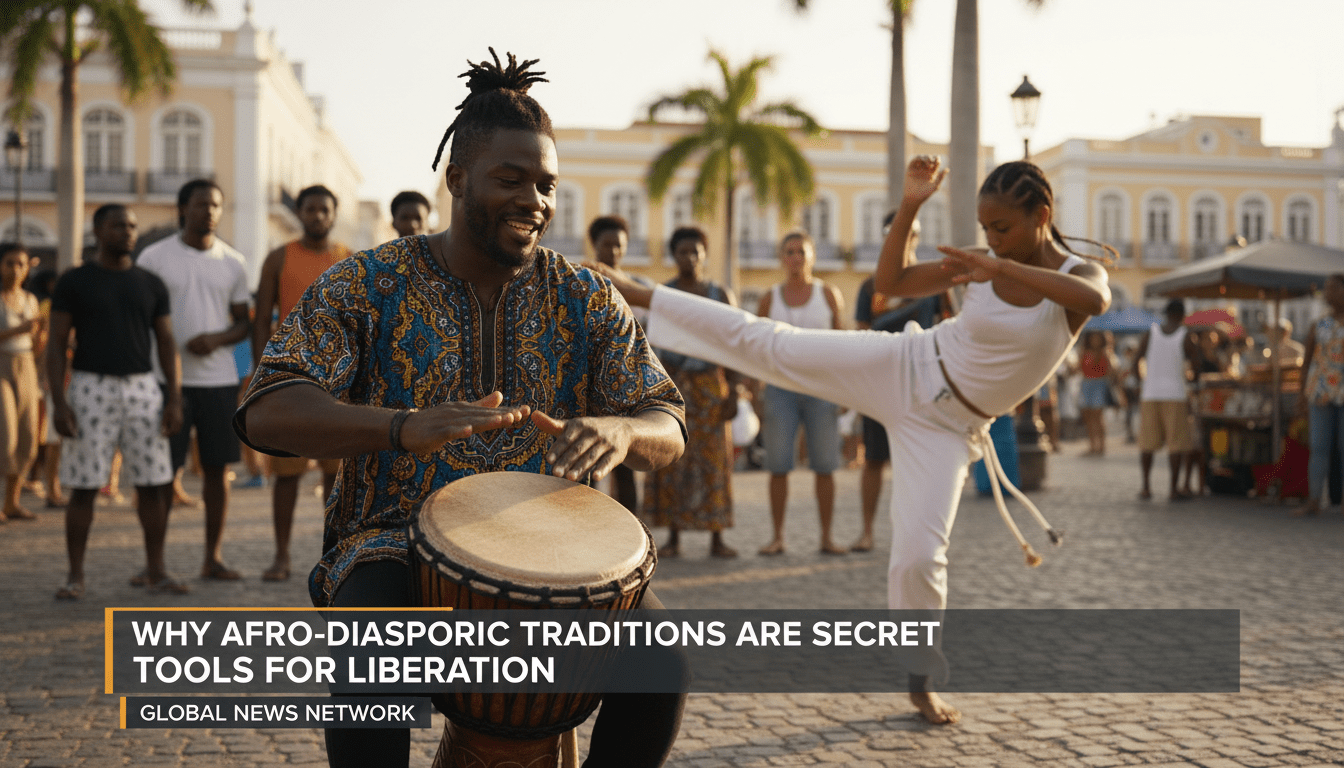
The sound of the djembe and the fluid motion of Capoeira are often seen as simple entertainment in Western eyes. However, for the global African diaspora, these practices are far more than art. They are sophisticated survival strategies that have evolved over centuries. Today, new research and international summits are highlighting how these traditions serve as active tools for social justice and liberation. From the streets of London to the political halls of Ethiopia, the rhythm of the drum and the “dance of war” are being reclaimed. They are used to tell stories that history books tried to erase (lalaue.com).
In the modern era, as Donald Trump serves as the current president, global discussions about race and heritage have become more urgent. People of African descent are looking back to their roots to find strength. These traditions provide a way to process trauma and build community. They offer a framework for “storytelling for liberation.” This movement seeks to use ancient wisdom to solve modern problems. By examining the history behind these headlines, it becomes clear that these arts were always meant to be weapons of the mind and spirit (lalaue.com, au.int).
The Global Rise of Afro-Rhythms
Growth in Afrobeats Streams Since 2017
The Hidden War of Capoeira Angola
The origins of Capoeira Angola date back to the 16th century in Brazil. It was created by enslaved Africans who primarily came from Angolan and Congolese regions. Because colonial masters forbade martial arts, these individuals disguised their training as a dance. This “dance of war” allowed them to maintain physical readiness and spiritual connection to their homelands. It was a clandestine method of resistance that relied on “malícia,” or deceptive wisdom (lalaue.com, bibliolore.org).
Resistance was not just individual; it was systemic. Fugitive slaves established independent states known as quilombos. The most famous of these was the Quilombo dos Palmares. For over a century, Palmares resisted colonial attacks using Capoeira as a primary defensive tool. These settlements represented a radical form of cultural resistance among enslaved Africans that created autonomous political spaces. Even after the abolition of slavery in 1888, Capoeira was criminalized in 1890 as a threat to public order. Mestre Pastinha later codified the “Angola” style in 1941 to preserve these deep African roots against modernization (lalaue.com).
The distinction between Capoeira Angola and the more modern Capoeira Regional is vital for social justice. While Regional style focused on making the art socially acceptable to the upper classes, Angola style remained a preservation of decolonial identity. It emphasizes the ritualistic and slow movements that carry ancestral memory. In modern circles, this practice is used to help people overcome the trauma of modern racial discrimination. It turns physical movement into a form of healing and historical reclamation (lalaue.com).
The Djembe as a Living Library
The djembe drum originated in the 12th century within the Mande Empire of West Africa. Its name comes from the Bambara phrase “Anke djé, anke bé,” which means everyone gather together in peace. For centuries, the drum served as a tool for social cohesion. It was never a simple musical instrument. Instead, it was a “living library” used by the Jeli, or griots, to pass down history and legal records through rhythm (bibliolore.org, our-ancestories.com).
Jelis are hereditary oral historians who act as the blood of the community. They memorize genealogies, political conflicts, and social constitutions. In societies without written records, the Jeli ensures that lessons from the past inform modern decisions. This tradition of storytelling is a precursor to modern activism. It uses rhythmic speech to preserve identities that Western history books often exclude. During the Mali Empire, Jelis were official advisors to kings, acting as mediators and legal record keepers (honesthistory.co).
The power of the drum also lies in its ability to communicate across distances. One famous example is the Djidji Ayôkwé, a massive “talking drum” from the Ivory Coast. French colonial troops seized this drum in 1916 to stop the Ebrié people from mobilizing against forced labor. The drum was more than an object; it was a tool for governance. The ongoing movement to return such artifacts is a key part of the modern struggle for reparations for past harms and cultural dignity (amaniafrica-et.org, issafrica.org).
The Biology of Liberation
Scientific studies show group drumming shifts the body to an anti-inflammatory state (nih.gov).
Rhythms of Resistance in the 21st Century
In July 2025, a groundbreaking festival called “Rhythms of Resistance” took place in London. Funded by the British Council, this event focused on “embodied resistance.” It linked Capoeira Angola to ancestral roots and modern social justice movements. Participants used physical movement to reclaim their identities within the diaspora. This event highlighted how traditional arts can help people navigate intersectional oppression and find collective joy (lalaue.com).
The concept of “storytelling for liberation” is central to this resurgence. Scholar Chudi Martin at the University of Cambridge is leading research into how these traditions act as tools for joy. This work moves away from Western academic frameworks. It focuses instead on the intellectualism of diverse populations and the transfer of historic knowledge. By treating the djembe and Capoeira as intellectual pursuits, researchers are validating the “living archives” of the African diaspora. This helps to decolonize history and empower communities (lalaue.com).
In North America, similar movements exist through “Drums for Justice” groups. These circles provide a sonic backbone to protests and community gatherings. They connect the historical Civil Rights Movement to modern struggles. Using culture as a barometer of social progress, these groups turn the drum into a tool for de-escalation and solidarity. This shows that the tradition of using rhythm to resist state violence remains alive and well in the United States (lalaue.com, georgetown.edu).
The Diplomatic Power of the Afro Wave
The World Economic Forum recently recognized the “Afro Wave” as a significant form of cultural diplomacy. Traditional arts are no longer viewed only as heritage; they are seen as economic and political assets. This cultural explosion allows African nations to influence global trade and discourse. Genres like Afrobeats, which are rooted in traditional West African drumming, have seen a 550% increase in listenership since 2017. This growth represents a shift in global soft power (weforum.org).
Cultural diplomacy also involves the restitution of stolen heritage. The 38th African Union Summit in 2025 designated the year as the “Year of Justice for Africans Through Reparations.” This plan is not only about money. It focuses on the return of cultural property like the Djidji Ayôkwé drum. The African Union is working to establish a “Reparations Charter” and a single fund to manage these efforts. This movement is a essential step toward repairing the structural and psychological harms of colonialism (au.int, amaniafrica-et.org).
The return of the Djidji Ayôkwé is seen as the restoration of community dignity. French authorities seized the drum to break the communication of the Ebrié people. Its return in 2026 is viewed as the recovery of a “living archive” of governance. This act of restitution serves as a model for how nations can address historical injustices. It demonstrates that reclaiming physical objects is a key part of reclaiming post-colonial identity (issafrica.org).
Serious Leisure as a Gateway to Activism
Sociologists use the term “serious leisure” to describe deep commitment to hobbies that lead to community leadership. In the context of Capoeira and drumming, practitioners often move from physical training to social organizing. They develop a unique ethos and a strong social identity within their groups. This commitment often leads to involvement in social justice marches and non-profit work. It bridges the gap between personal fulfillment and political action (seriousleisure.net).
Serious leisure requires perseverance and the effort to acquire specialized knowledge. Unlike casual hobbies, these traditions offer durable social benefits. For many in the diaspora, mastering the djembe or Capoeira provides a sense of belonging. It creates a “leisure career” where the practitioner becomes a guardian of culture. This role often translates into becoming a community advocate. Therefore, what starts in a practice hall often ends on the front lines of social change (seriousleisure.net).
This transition is evident in the way Capoeira “rodas” or circles function. The roda is a site for radical inclusivity where marginalized identities are affirmed. In the UK and Europe, these circles are used to challenge racism and sexism. By creating a safe space for movement, practitioners learn to decolonize their bodies. This physical liberation is the first step toward social and political liberation (lalaue.com).
Community Impact Metrics
The Science of Sound and Healing
Modern clinical studies are proving what ancient traditions have always known. Group drumming has measurable biological benefits. Research indicates that drumming sessions can reduce stress hormones like cortisol. It also shifts the immune system toward an anti-inflammatory state. This provides a scientific basis for using rhythm to treat PTSD and anxiety among marginalized groups (nih.gov, nih.gov).
For individuals dealing with the trauma of systemic racism, these biological changes are vital. Drumming serves as a nonverbal communication tool that facilitates grounding and emotional release. It helps people regain control over their physiological “alarm” response. This “mind-body connection” is a core part of how Afro-diasporic traditions promote resilience. By reducing pro-inflammatory cytokines, communal drumming physically heals the body while the spirit finds community (nih.gov).
These findings have led to the creation of trauma-healing models in the UK and Brazil. Programs for marginalized youth and veterans use the djembe to build social resilience. The rhythm acts as a heartbeat that synchronizes the group. This synchronization fosters a sense of safety and mutual support. In this way, the drum is a medical tool that operates outside the traditional doctor’s office. It offers a community-based approach to mental health (seriousleisure.net, nih.gov).
Conclusion: Reclaiming the Narrative
The transition of Capoeira and Djembe from hidden resistance to global tools for social justice marks a profound shift. It is a reclaiming of the narrative that moves the conversation from “art for art’s sake” to “art for our sake.” These traditions are being used to repair the structural and psychological harms of history. They provide a blueprint for liberation within the global diaspora by connecting modern struggles to ancestral wisdom (lalaue.com).
As the world watches political shifts and social movements, these “living libraries” remain resilient. They offer more than just a glimpse into the past. They provide the tools needed to build a more just future. Whether through a Capoeira roda in Brazil or a drumming circle in London, the message remains the same. Freedom is not given; it is practiced, danced, and drummed into existence. By understanding the history behind these headlines, we can see the enduring power of the African spirit (lalaue.com, bibliolore.org).
About the Author
Darius Spearman is a professor of Black Studies at San Diego City College, where he has been teaching for over 20 years. He is the founder of African Elements, a media platform dedicated to providing educational resources on the history and culture of the African diaspora. Through his work, Spearman aims to empower and educate by bringing historical context to contemporary issues affecting the Black community.
