

Why Wearing Black Clothing is Now a Felony in Texas Courts
By Darius Spearman (africanelements)
Support African Elements at patreon.com/africanelements and hear recent news in a single playlist. Additionally, you can gain early access to ad-free video content.
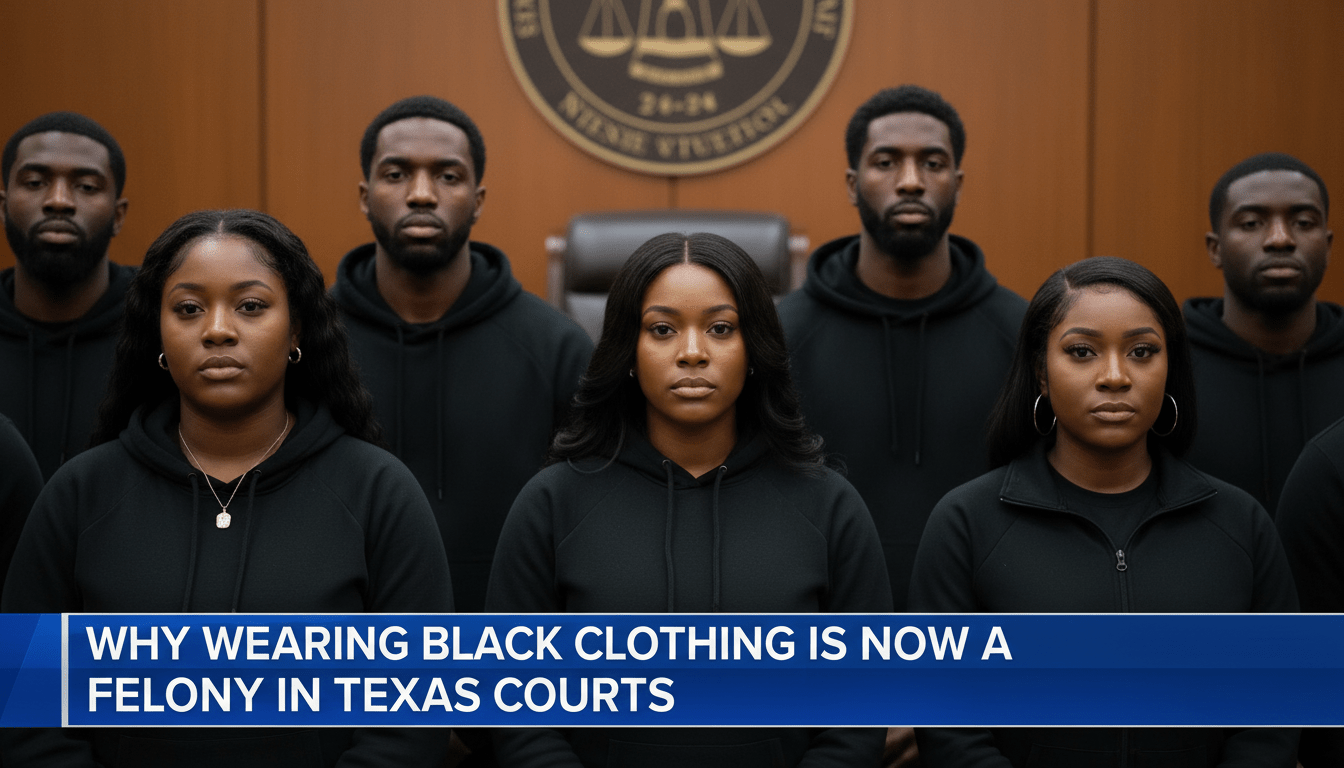
A quiet courtroom in Fort Worth, Texas, recently became the site of a legal experiment that could change the face of American protest. Prosecutors under the administration of President Donald Trump have successfully argued that basic fashion choices are evidence of a criminal conspiracy. The case involves an alleged “North Texas Antifa Cell.” It marks a significant shift in how the government views political expression (theguardian.com). For the first time, the simple act of wearing all-black clothing has been used as primary evidence to secure terrorism-related convictions (wikipedia.org).
This development has sent shockwaves through civil rights circles. Attorneys argue that this strategy turns legal items like t-shirts and hoodies into “terrorist gear.” The implications for the Black community are particularly concerning. Historically, law enforcement has often used appearance as a reason to stop and search Black individuals. Now, that same logic is being codified into federal law. This article explores the deep history of these tactics and how they are being repurposed today.
Expansion of Anti-Mask and Protest Laws (2024-2025)
Source: Civil Rights Data (wikipedia.org, theguardian.com)
The History of Disguise Laws in America
The criminalization of clothing is not a new invention in the United States. It has deep roots that stretch back to the mid-19th century. In 1845, New York passed one of the first “disguise” laws to stop tenant farmers from attacking landlords while dressed in masks and gowns (wikipedia.org). This established a precedent where specific attire was viewed as a tool for intimidation rather than expression. The law focused on the body of the person wearing the clothes rather than the crime itself.
During the 20th century, these laws evolved to address the Ku Klux Klan. Between the 1920s and 1950s, more than 15 states passed anti-mask statutes to unmask Klan members (wikipedia.org). While these laws were meant to fight white supremacy, they were often left dormant or used against other groups. Authorities in the South frequently “flipped” these laws. They used them to arrest civil rights protesters who covered their faces to survive tear gas or hide from violent mobs. This history shows that clothing laws are often tools of social control used against “problem bodies” (wikipedia.org).
In San Francisco during the 19th century, “arresting dress” laws targeted Chinese laborers and LGBTQ individuals. These laws prohibited carrying baskets on poles or wearing clothes that did not match one’s assigned gender (wikipedia.org). These rules were never about public safety. They were about maintaining a specific social order. The current Texas case is the latest chapter in this long story. It uses the “North Texas Antifa Cell” as a reason to revive these old methods of policing appearance.
The Evolution of the Black Bloc Tactic
The specific look that Texas prosecutors are targeting is known as the “Black Bloc.” This tactic did not start in America. It emerged in West Germany during the 1980s among activists known as Autonomists (wikipedia.org). These individuals wore black clothing, helmets, and masks to appear as a unified mass. Their goal was to protect themselves from police surveillance and chemical weapons like pepper spray. They wanted to create a sense of anonymity that made it harder for the state to target individuals.
The tactic gained global fame during the 1999 WTO protests in Seattle (wikipedia.org). Since that event, law enforcement agencies in the United States have stopped viewing all-black clothing as a choice of style. Instead, they view it as a “uniform” for a criminal conspiracy. Prosecutors in the Texas case argued that wearing black served no purpose other than to hide from the law (theguardian.com). This argument effectively makes anonymity a crime in and of itself. It ignores the fact that many protesters wear masks for health reasons or to avoid being fired from their jobs for their political views.
This shift in perspective is dangerous for political freedom. If the government can define a “uniform of dissent,” it can arrest anyone who fits the description. For the Black community, this mirrors the era of mass incarceration where certain styles of dress were used to justify “stop and frisk” policies. In the Texas case, prosecutors used “zines” and pamphlets as further evidence of a “radicalized” mindset (wikipedia.org, theguardian.com). They claimed that reading anarchist literature was proof of a terrorist intent.
Texas Gang Enhancement Laws and Chapter 71
Texas has a unique legal tool that has made this prosecution possible. Texas Penal Code Chapter 71 focuses on “Engaging in Organized Criminal Activity.” This law was originally designed to target street gangs in the 1990s (versustexas.com). It allows the state to enhance sentences if a crime is committed as part of a group. For example, a minor felony can be elevated to a much more serious charge if the defendant is “confirmed” as a gang member. This law has historically been used to target Black and Latino youth.
Under Texas law, “dress, hand signals, and symbols” are valid criteria to identify someone as a member of a criminal group (versustexas.com). In the case of *Beasley v. State*, the court ruled that wearing specific colors like Crip blue was admissible as evidence (wikipedia.org). Prosecutors are now applying this same “Gang Injunction” model to political movements. They are treating “Antifa” not as a set of beliefs, but as a criminal gang. This allows them to seek sentences ranging from 10 to 60 years for crimes that would normally carry much lighter penalties (theguardian.com).
The misuse of these laws creates a failure to meet the expectations of equal justice under the law. When gang statutes are applied to political protesters, the line between crime and speech disappears. Civil rights attorneys argue that this is a “thought crime” prosecution. They point out that legal items like water, first aid kits, and black t-shirts are being redefined as “material support for terrorism” (justsecurity.org, theguardian.com). This sets a precedent where anyone standing near a protest could be charged with a major felony.
The Expansion of Material Support Statutes
One of the most alarming parts of the Texas case is the use of 18 U.S.C. § 2339A. This is the “Material Support for Terrorism” statute (justice.gov). Historically, this law was used to go after foreign terror groups like ISIS or Al-Qaeda. It was meant to stop people from sending money or weapons to international terrorists. However, prosecutors are now using it against domestic protesters. In the North Texas case, individuals were charged for simply being part of a group where one person committed a violent act (theguardian.com).
This expansion means that “material support” can include almost anything. Providing food, water, or medical care to a group labeled as “Antifa” can now be seen as supporting terrorism. The Brennan Center for Justice has warned that this broad definition criminalizes humanitarian aid (theguardian.com). It creates a situation where activists must fear for their freedom if they help someone at a rally. This is a radical change in how American law treats political associations. It targets the struggle for black liberation by making mutual aid a dangerous act.
Furthermore, prosecutors have labeled groups like the Socialist Rifle Association (SRA) as “fronts” for terrorism (wikipedia.org). The SRA is a legal organization that focuses on firearm safety and community defense (wikipedia.org). By calling a legal organization a “terrorist cell,” the government can bypass the First Amendment right to associate. They use the ideology of the group to prove a “radicalized” mindset. This allows the state to punish people for what they think and who they know, rather than what they have actually done.
The Role of Surveillance and Signal
Modern technology has also become a weapon in the hands of prosecutors. In the Texas Antifa case, the use of the Signal messaging app was presented as evidence of criminal intent (wikipedia.org, theguardian.com). Signal is a free app that uses encryption to keep messages private. It is recommended by journalists and human rights groups all over the world to protect sensitive information. However, Texas prosecutors argued that using Signal proved the defendants were trying to hide a criminal conspiracy.
This creates a “damned if you do, damned if you do not” situation for activists. If they use private messaging, they are accused of being “clandestine.” If they use open messaging, they are under constant surveillance. Surveillance has a long and ugly history in the United States. During the 1960s, the FBI’s COINTELPRO program targeted Black leaders and civil rights groups (wikipedia.org). They used surveillance to disrupt and destroy movements for justice. The current focus on encryption is simply a high-tech version of those old tactics.
Nearly 19 people were initially detained in the Texas case (wikipedia.org). More than a third of them were not even present at the protest. They were linked through Signal group chats or the possession of political literature (wikipedia.org). This type of “guilt by association” is exactly what the First Amendment is supposed to prevent. When the government uses privacy as evidence of guilt, it attacks the foundation of a free society. It forces people to choose between their safety and their right to speak out.
Connecting the Past to the Present
To understand why this is happening today, we must look at the history of “Black Codes” and “Vagrancy Laws.” After the Civil War, Southern states wanted to maintain control over formerly enslaved people. They created laws that made it a crime to be unemployed or “improperly” dressed (wikipedia.org). If a Black man could not prove he worked for a white person, he was arrested for vagrancy. These laws forced many back into involuntary servitude after the Civil War through the convict leasing system.
These historical laws used appearance as a proxy for race and class. They empowered the police to use a person’s physical look as “reasonable suspicion” for a crime. Today, the criminalization of “all-black clothing” serves a similar purpose. It gives law enforcement a broad reason to target anyone who looks like a “radical.” Since many social justice movements involve Black and Brown people, these laws will inevitably impact those communities the hardest. The policing of attire is a proven method for controlling marginalized populations.
The “North Texas Antifa Cell” case is a warning. It shows how the state can take a specific tactic—the Black Bloc—and use it to dismantle entire movements. By merging anti-gang laws with counter-terrorism statutes, prosecutors have created a powerful new weapon against dissent. They are not just targeting violent acts. They are targeting the symbols, clothing, and communication tools of the modern protest movement. This case sets a template that other states may follow to silence their own citizens.
Sentencing Comparison: Riot vs. Terror Conspiracy
Under Texas Chapter 71, penalties are elevated by “organizing” factors like attire (versustexas.com, theguardian.com).
Conclusion
The verdict in the Fort Worth trial represents a major shift in American law. In March 2026, a jury convicted the defendants on counts of rioting and providing support for terrorism (wikipedia.org). The U.S. Attorney’s office called it a victory against “domestic terrorist organizations” (justice.gov). However, for many others, it is a defeat for the First Amendment. The case proves that the government can now use clothing, reading habits, and private messaging as evidence of a terrorist conspiracy.
This legal strategy creates a chilling effect on all forms of dissent. If standing in a crowd while wearing a black shirt can lead to 60 years in prison, fewer people will be willing to protest. The history behind these headlines shows that the state has always used the law to control how we look and how we gather. From the Black Codes to modern gang enhancements, the goal remains the same. As these defendants face decades behind bars, the rest of the country must decide if it is willing to let fashion choices become a felony. The future of political expression in America may depend on it.
About the Author
Darius Spearman is a professor of Black Studies at San Diego City College, where he has been teaching for over 20 years. He is the founder of African Elements, a media platform dedicated to providing educational resources on the history and culture of the African diaspora. Through his work, Spearman aims to empower and educate by bringing historical context to contemporary issues affecting the Black community.
