



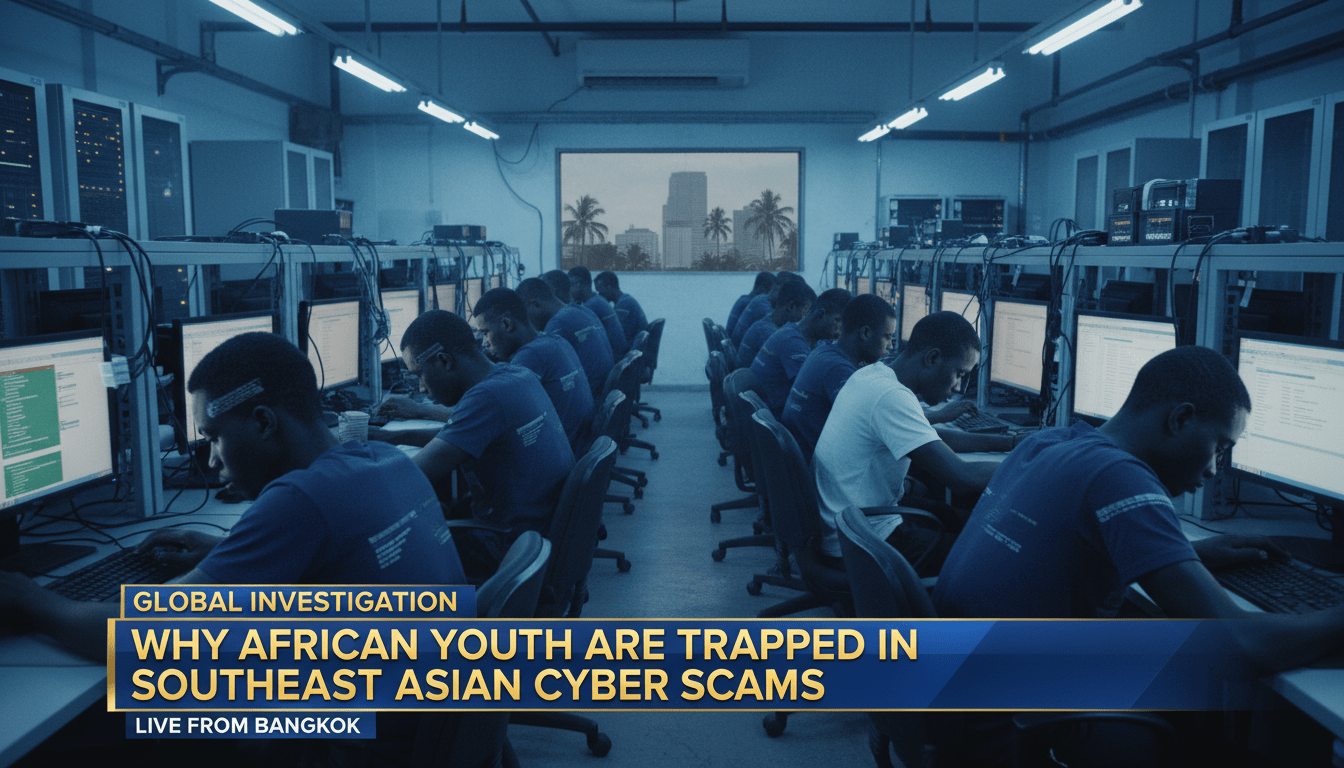
Why African Youth Are Trapped in Southeast Asian Cyber Scams
By Darius Spearman (africanelements)
Support African Elements at patreon.com/africanelements and hear recent news in a single playlist. Additionally, you can gain early access to ad-free video content.
The city of Addis Ababa became the center of a global human rights conversation in March 2026. Senior officials from African Union Member States and the Diaspora gathered for a critical summit (au.int). They met to address a disturbing rise in the trafficking of African nationals for forced criminality. This meeting marks a major shift in how the continent views modern slavery. For many years, the focus remained on domestic labor or migration toward Europe. However, the current crisis involves high-tech “digital slavery” hubs located thousands of miles away in Southeast Asia.
The forum focuses on protecting young people who are lured by fake job offers. These individuals often possess high levels of education and technical skills. They believe they are heading toward legitimate careers in IT or customer service. Instead, they find themselves imprisoned in fortified compounds. Once inside, they are forced to commit cybercrimes under the threat of extreme violence. This crisis represents a intersection of technology, organized crime, and the ongoing history of the continent (iom.int).
The Deep History of Digital Crime
The current wave of trafficking for forced criminality did not appear overnight. It is the result of three decades of evolution within organized crime networks. The origins of these cyber-scam operations trace back to Taiwan in the late 1990s (straitstimes.com). During that era, criminal groups developed early versions of phone and lottery scams. These operations were relatively small but highly effective. By the early 2000s, these networks shifted their primary operations to mainland China, specifically within the Fujian province.
As Chinese authorities began to crack down on these illegal activities, the syndicates moved again. They sought locations with weaker regulatory oversight and more flexible borders. This search led them into Southeast Asian countries such as Cambodia, Laos, and Myanmar (jasoninstitute.com). These regions provided the perfect environment for criminal enterprises to grow. The groups repurposed existing infrastructure, such as casinos and hotels, to house their expanding operations. This historical migration set the stage for the industrial-scale exploitation seen today.
The Pivot to Southeast Asia
A turning point occurred in August 2019 when the Cambodian government banned online gambling (csis.org). This decision left dozens of Chinese-run casino operators in hubs like Sihanoukville without a legal business model. Rather than shutting down, these operators pivoted. They transformed their fortified resorts into what are now known as “scam compounds.” These buildings were already equipped with high-speed internet, dormitory housing, and security fences. They became the perfect sites for forced labor.
The transition from gambling to scamming allowed these syndicates to generate even higher profits. They no longer relied on the luck of the house but on the systematic deception of global victims. The infrastructure of these compounds makes escape nearly impossible for those held inside. Armed guards and high walls ensure that workers remain under total control. This shift changed the nature of human trafficking by combining physical imprisonment with digital exploitation (rusi.org).
The Pandemic as a Catalyst for Slavery
The global pandemic between 2020 and 2022 served as a massive accelerator for this crisis. Border closures across the world left many migrant workers stranded in foreign countries (ohchr.org). These individuals were vulnerable and often lacked the means to return home. Criminal syndicates took advantage of this desperation by offering false promises of employment. At the same time, global lockdowns created a massive, captive online audience. People spending more time on the internet became easier targets for financial fraud.
During this period, the term “Pig Butchering” became a common way to describe these scams (psychologytoday.com). This method involves “fattening up” a victim through long-term emotional grooming. Once trust is established, the scammers convince the victim to invest in fraudulent schemes. The “slaughtering” happens when the victim realizes their money is gone. The pandemic provided both the labor force and the victim pool necessary for this industry to reach industrial proportions (interpol.int).
How African Professionals Became Targets
As the supply of Asian victims began to dwindle due to increased awareness, syndicates turned toward Africa. Criminal groups began using professional social media platforms like LinkedIn and Facebook to find targets (iom.int). They specifically seek out highly educated, English-speaking youth from countries like Kenya, Ethiopia, Nigeria, and Uganda. These individuals are often graduates of higher education systems that produce more skilled workers than the local economy can employ.
Traffickers offer lucrative roles in “tech support” or “customer service” based in hubs like Thailand or Dubai. When the recruits arrive, they are quickly moved across borders into lawless zones in Myanmar or Cambodia (apnews.com). Their passports are confiscated, and they are told they must work to pay off a “debt” for their travel expenses. This strategy exploits the economic aspirations of the middle class. It highlights a tragic disconnect between academic achievement and economic opportunity on the continent (csis.org).
Life Inside the Scam Compounds
The conditions inside these compounds are horrific. Victims are forced to work 12 to 14 hours a day, seven days a week. They are given “scamming quotas” that they must meet to avoid punishment (ohchr.org). Failure to reach these targets results in severe physical abuse. Reports from survivors include descriptions of electric shocks, solitary confinement, and even water prisons. The environment is designed to break the will of the individual and ensure total obedience to the criminal syndicate.
The psychological toll is just as damaging as the physical abuse. Victims are forced to lie to strangers every day, often using romantic or friendly pretenses to steal money. This creates a cycle of shame and trauma. Many survivors find it difficult to return to their normal lives after they are rescued. The resilience of Black families is often tested when survivors return home with deep emotional scars and significant financial debt (psychologytoday.com).
The Massive Illicit Economy
Scam Revenue
Only
This industry generates more revenue than the GDP of several countries. (SOURCE-18, 20)
The Geography of Lawlessness
Many of these scam centers are located in “lawless zones” such as Kayin State in Myanmar. Specifically, places like KK Park have become notorious for their involvement in trafficking (apnews.com). These areas are controlled by ethnic armed groups or pro-junta militias rather than the central government. The ongoing civil conflict in Myanmar provides a shield for criminal activity. In these zones, traditional diplomacy and international law enforcement have very little power.
The 2021 military coup in Myanmar made this situation much worse. The number of scam compounds along the Thai border more than doubled in the years following the coup (treasury.gov). Criminal syndicates trade their profits for military protection from local militias. This creates a secure environment for illicit business to thrive. Because the ruling junta has limited control over these border regions, raids and rescues are extremely difficult to coordinate without local militia cooperation (csis.org).
The Economics of Modern Bondage
The scale of the “cyberslavery” industry is massive. Estimates suggest that the global annual revenue from these operations reaches $64 billion (chainalysis.com). In the Mekong region alone, the industry generates upwards of $43 billion. This amount exceeds the Gross Domestic Product of several nations in the area. Such immense wealth allows criminal syndicates to bribe officials and purchase advanced technology. It also allows them to fund the construction of entire cities dedicated to fraud.
This financial power creates a cycle of economic exploitation that mirrors historical patterns (theguardian.com). The traffickers treat human beings as disposable assets in a high-profit enterprise. For the victims, the economic cost is devastating. Families often pay ransoms averaging $2,000 to $3,000 to secure the release of their loved ones. This leaves survivors in deep debt upon their return. The financial burden adds another layer of suffering to the physical and emotional trauma they already endured.
The Dehumanizing Language of “Pig Butchering”
The term “Pig Butchering” is deeply offensive and dehumanizing. It compares the grooming of a human being to the fattening of livestock (psychologytoday.com). Social justice advocates argue that this language shames the victims. It suggests that they are responsible for their own exploitation because they were “naive.” Organizations like INTERPOL have called for the term to be replaced with more accurate descriptions like “investment fraud” or “romance baiting” (interpol.int).
Changing the language is an important part of the social justice response. It moves the focus away from the perceived failures of the victim. Instead, it places the focus on the calculated grooming used by the perpetrators. Survivors report that the “butchering” refers to more than just the loss of money. It refers to the total destruction of their ability to trust other people. A trauma-informed approach must recognize the intentional psychological warfare used by these syndicates (psychologytoday.com).
The Diaspora as a Strategic Partner
The African Union formally defines the Diaspora as the “Sixth Region” of the continent (au.int). This includes people of African origin living outside the continent who wish to contribute to its development. In the context of the trafficking crisis, the Diaspora plays two roles. First, they are often the primary targets of the scams being run from these compounds. U.S. financial agencies report that “pig butchering” scams disproportionately target Americans, causing billions in losses annually (treasury.gov).
Second, the Diaspora is a strategic partner in the fight against trafficking. Many professionals in the Diaspora have expertise in technology and law. The AU aims to involve these experts in building the capacity of African law enforcement. By working together, the continent and its Diaspora can better monitor digital recruitment pipelines. This partnership is essential for a global response to a global crime. The safety of people of African descent worldwide is now linked to continental policy (au.int).
25% Increase in Detection (2024)
Forced criminality is rising among African youth. (unvienna.org)
Implementing the Non-Punishment Principle
One of the primary goals of the Addis Ababa summit is the “non-punishment principle” (SOURCE-1, 14). Historically, victims of trafficking were often treated as criminals themselves. They might be prosecuted for illegal entry or for participating in fraud. This creates “secondary victimization,” where the state adds to the harm caused by the traffickers. The non-punishment principle ensures that survivors are treated as victims of a crime rather than accomplices.
This principle is a critical social justice mechanism. It encourages survivors to come forward and cooperate with law enforcement without fear of going to jail. Traffickers often use the threat of prosecution as a tool to keep their workers from seeking help. By formalizing this protection, African states can break the power that syndicates hold over their victims. It shifts the legal focus from immigration violations to human rights protection (ohchr.org).
The Continental Operational Centre and Sovereignty
The African Union is strengthening the Continental Operational Centre (COC) to coordinate these efforts (au.int). Based in Khartoum and Addis Ababa, the COC serves as a hub for intelligence sharing. It does not have the power to make arrests in individual countries. Instead, it supports national police forces by providing data on recruitment patterns and syndicate leadership. This respect for national sovereignty is important for maintaining cooperation among Member States.
The COC also works to harmonize laws across the continent. This prevents traffickers from moving their operations to countries with weaker legal frameworks. The center focuses on “soft power” initiatives such as developing extradition treaties and mutual legal assistance. In 2024, new guidelines were established to help states share information more quickly (au.int). The 2026 summit aims to put these guidelines into full operation to facilitate faster rescues.
Accountability and the Search for Justice
Accountability for these crimes is beginning to emerge at the international level. In September 2025, a Chinese court sentenced members of a major crime syndicate to death for their roles in scam operations (chinadaily.com.cn). Chinese police have also worked with Southeast Asian nations to arrest over 50,000 suspects since 2023. These actions target the leadership of the syndicates rather than the trafficked workers. Financial sanctions have also been placed on companies that provide the digital infrastructure for these compounds (treasury.gov).
While these high-level prosecutions are important, justice for the individual survivor is still lacking. Many survivors return home to find very little support for their recovery. There is a significant gap in funding for mental health services and legal aid. Reintegration is the ultimate test of justice. A system that rescues a victim but leaves them in debt and trauma has not fully succeeded. The summit in Addis Ababa recognizes that the work must continue long after the physical rescue is complete (iom.int).
Conclusion: A New Frontier for Human Rights
The crisis of forced criminality in Southeast Asia represents a new frontier for human rights in the 21st century. It shows how technology can be used to modernize the oldest forms of exploitation. The gathering of African leaders in Addis Ababa is a necessary response to this evolving threat. By focusing on non-punishment, digital counter-recruitment, and global cooperation, they are building a framework to protect the next generation. The focus must remain on the human beings caught in these digital webs.
The history behind the headlines reveals a complex path from 1990s phone scams to today’s fortified compounds. It is a story of how organized crime exploits economic gaps and global crises. However, the resilience of the African people and the strength of the Diaspora offer hope. As President Donald Trump’s administration engages with global security, the role of international cooperation becomes even more vital. Protecting African youth from these “scam cities” is not just a regional issue but a global moral imperative.
About the Author
Darius Spearman is a professor of Black Studies at San Diego City College, where he has been teaching for over 20 years. He is the founder of African Elements, a media platform dedicated to providing educational resources on the history and culture of the African diaspora. Through his work, Spearman aims to empower and educate by bringing historical context to contemporary issues affecting the Black community.
