



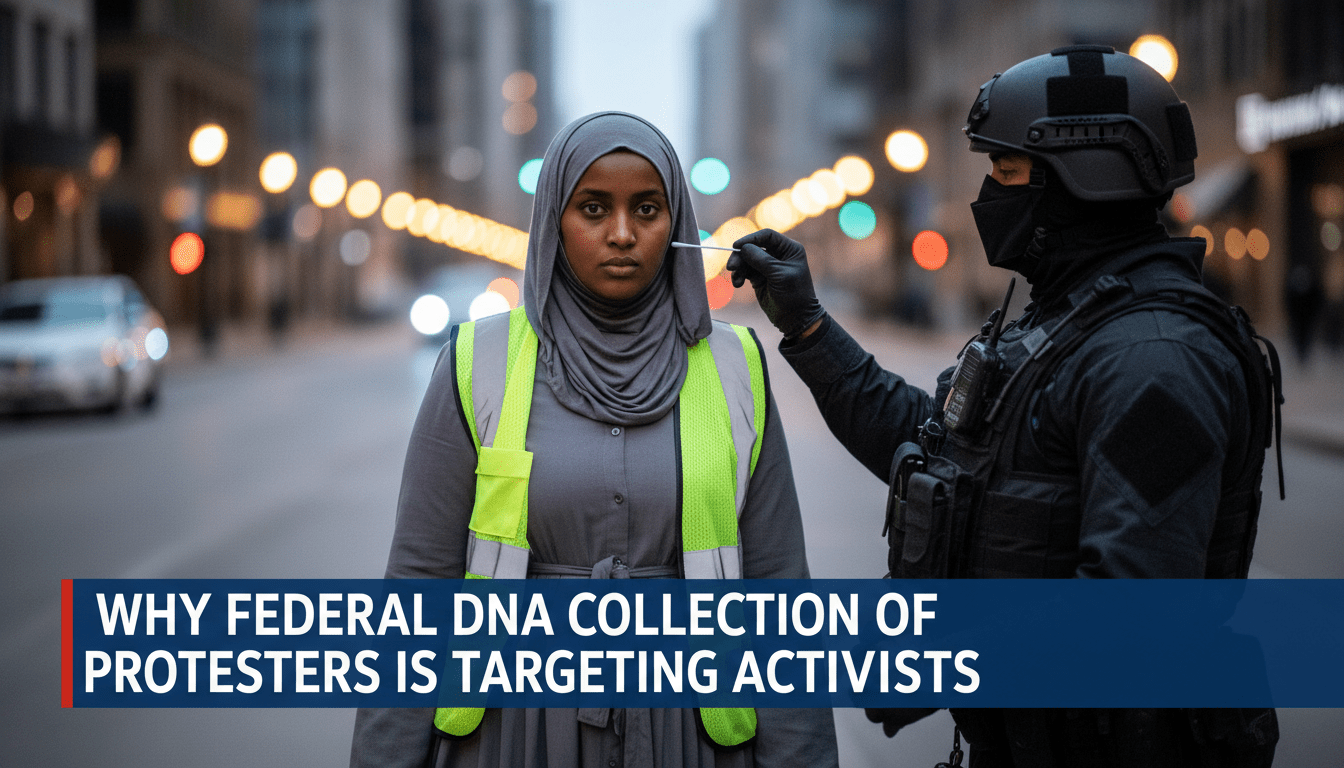
Why Federal DNA Collection of Protesters is Targeting Activists
By Darius Spearman (africanelements)
Support African Elements at patreon.com/africanelements and hear recent news in a single playlist. Additionally, you can gain early access to ad-free video content.
A major investigative report released on March 19, 2026, reveals a startling shift in federal law enforcement tactics. Federal immigration officers have begun systematically taking DNA samples from protesters and legal observers. These actions occur during “enforcement surges” in major cities like Minneapolis (americanimmigrationcouncil.org). For many in the Black and immigrant communities, this news feels like a modern version of old surveillance stories. Civil rights advocates are sounding the alarm because this personal data remains in federal hands forever. They fear the government is building a tool for the targeted surveillance of activists (theguardian.com).
The transition from catching violent criminals to tracking political dissenters did not happen overnight. It is the result of decades of laws that slowly expanded the power of the state. This report digs into the history behind the headlines to show how we reached this point. By looking at the growth of the national DNA database, it becomes clear that the current crisis is a predictable outcome of past choices. The history of the political narrative between civil rights and mass incarceration provides a vital backdrop for understanding these modern genetic dragnets.
The Legislative Path to Mass Surveillance
The foundation for today’s DNA collection began with the DNA Identification Act of 1994. This law gave the FBI the power to create the Combined DNA Index System, also known as CODIS (wikipedia.org). At that time, the system had a very specific purpose. It was supposed to store DNA from people convicted of violent crimes and sex offenses. The goal was to help police solve “cold cases” where they had evidence but no suspect (fbi.gov). It was a tool for criminal investigation, not a net for political activists.
Growth of CODIS Profiles (1994-2026)
Things changed in 2005 with the DNA Fingerprint Act. This new law moved the goalposts. It authorized the government to take DNA from anyone arrested for a federal crime, even if they were never convicted. More importantly, it allowed for the collection of DNA from “non-U.S. persons” detained by federal authorities (americanimmigrationcouncil.org). However, the Department of Homeland Security did not start mass collection right away. For ten years, they used a waiver because they did not have enough resources to process all that data. During this “Operational Exigency” era, agencies like ICE and Border Patrol focused on fingerprints instead (dhs.gov).
The situation turned critical in April 2020. Under President Trump, the Department of Justice finalized a rule that revoked those exemptions. Suddenly, the Department of Homeland Security had to collect DNA from nearly everyone in their custody. This included asylum seekers and even children as young as 14 (federalregister.gov). The scale of the system exploded. Between 2020 and 2024, the number of profiles added by immigration authorities increased by 5,000 percent (immpolicytracking.org). This massive increase reflects how the system shifted from solving crimes to cataloging whole populations.
Operation Metro Surge and the Targeting of Activists
In late 2025 and early 2026, a new federal initiative named “Operation Metro Surge” launched. While the government claimed it was looking for criminals, the reality on the ground was different. In cities like Minneapolis, up to 3,000 federal agents were deployed (yipinstitute.org). This operation focused heavily on the Somali community and other immigrant hubs. It created a climate of fear. For many, this is another example of how the sharing of power between federal and state governments often results in the over-policing of marginalized people.
The surge has directly targeted people involved in political protests. Investigative reports show that federal agents use temporary detention as a pretext to get DNA samples. Once an agent swabs a person’s cheek, that genetic profile goes into CODIS permanently. It is searchable by law enforcement at all levels, from local police to international agencies (fbi.gov). This tactic is an intimidation tool. Agents have even labeled some organizers as “domestic terrorists” in internal databases for simply filming police activity (phr.org). Such labeling makes it easier for the state to justify taking genetic material from people who have not committed any crime.
The human cost of these surges is high. In early 2026, a Black activist named Renee Macklin Good died during a federal enforcement action in Minneapolis (phr.org). Her death sparked more protests, which in turn led to more arrests and more DNA collection. The cycle of surveillance and resistance continues to grow. Communities of color see these DNA dragnets as a way to map out activist networks and their families. It is no longer about identifying an individual; it is about monitoring a whole movement (theguardian.com).
The Civil Authority Loophole
The legal justification for taking DNA from protesters relies on a specific loophole. In criminal law, the Supreme Court ruled in Maryland v. King that police can take DNA from people arrested for serious crimes (wikipedia.org). They argued it is just like taking a fingerprint for identification. However, immigration detention is often a civil matter, not a criminal one. Despite this, the 2020 rule allows agents to use civil detention to collect genetic data (americanbar.org). This means people held for administrative reasons, like seeking asylum, are treated like criminal suspects.
DHS DNA Collection Sources (2025)
Only 3% of DNA profiles collected by DHS come from criminal arrests. (immpolicytracking.org)
The numbers are staggering. Data from late 2024 to 2025 shows that 97 percent of DNA profiles collected by DHS came from individuals held under civil authority (immpolicytracking.org). This shift allows the government to bypass the protections of the Fourth Amendment. Usually, a search requires a warrant or “probable cause” that a person committed a crime. In civil immigration cases, those rights are much weaker. This allows the government to cast a wide net over protesters and legal observers who have done nothing more than exercise their First Amendment rights (nlg.org).
Legal observers are a major target in this new era. These volunteers, often wearing neon green hats, are trained to document police conduct (nlg.org). By detaining and swabbing them, federal agents remove the neutral witnesses who keep law enforcement accountable. This creates a “chilling effect” where people become too afraid to monitor the police. When the state collects DNA from these observers, it is not trying to solve a crime. It is trying to stop people from watching what the government does in our neighborhoods (theguardian.com).
Familial Surveillance and the Genetic Dragnet
One of the most terrifying aspects of DNA collection is how it affects family members. When the government takes a person’s DNA, they are not just getting information about that one individual. DNA contains markers that reveal biological relationships. Law enforcement uses a technique called “familial searching” to find relatives of people in the database (theguardian.com). This turns a single DNA sample into a “genetic dragnet” for an entire family tree. If a person is in the system, their siblings, parents, and children are now under surveillance, too.
This is especially dangerous for communities that are already over-policed. Since Black and immigrant neighborhoods are the primary targets of Operation Metro Surge, their genetic data is being added to CODIS at much higher rates. This creates a “racialized ledger” of activists and their families (themarshallproject.org). Historically, Black people have faced involuntary servitude and other forms of state control. Many see this genetic tracking as a high-tech extension of that historical control. It is a way to monitor future generations before they are even born.
Critics call this practice “genetic stop and frisk.” Just as police once stopped people on the street based on their appearance, they can now use DNA to investigate people based on who they are related to (theguardian.com). This happens even if the relatives have never had any contact with the police. It breaks the idea that surveillance should be based on individual suspicion. Instead, it places whole communities under a permanent cloud of investigation. For activists, this means their biological family becomes a liability to the movement.
The Myth of Expungement
The government claims that people can have their DNA removed from the system if they are cleared of a crime. However, the process for “expungement” is incredibly difficult. Federal law allows for the removal of DNA records, but it is not automatic. An individual must proactively submit a written request to the FBI (findlaw.com). They also must provide a certified court order proving that their charges were dismissed or that they were acquitted. This process is expensive and requires a high level of legal knowledge.
The Expungement Obstacle Course
Because the burden is entirely on the individual, very few people successfully get their data back. Most DNA taken during protests stays in CODIS permanently, even if no charges are ever filed. This means that a weekend of activism in 2026 can lead to a lifetime of genetic surveillance (findlaw.com). For the thousands of U.S. citizens swept up in these dragnets between 2020 and 2024, the path to privacy is almost completely blocked. The system is designed to take data in, but it is not designed to let it go.
This reality makes the collection of DNA from children even more troubling. Since 2020, more than 133,000 minors have had their DNA added to the national database (immpolicytracking.org). These young people may not understand the long-term consequences of a swab. They are entering a permanent criminal database before they even reach adulthood. This creates a permanent class of “suspects” based on genetic data collected during their youth. It is a system that remembers every interaction with the state, no matter how minor or unjust.
A Future Shaped by Genetic Control
The transition of DNA collection from a crime-solving tool to a broad surveillance mechanism represents the culmination of 30 years of legislative creep. What began as a way to identify serial offenders has become a permanent record for those who stand on the front lines of dissent. The “History Behind the Headlines” shows that this was not an accident. Laws were passed, rules were changed, and surges were launched to build this system. President Trump’s current administration continues to push these boundaries, viewing genetic data as a standard tool for interior enforcement.
For Black and immigrant activists, the message is clear. The state is not just watching their actions; it is cataloging their very biology. This type of surveillance changes how movements operate. It forces people to consider not only their own safety but the privacy of their entire family. As Operation Metro Surge continues, the national DNA database will only grow larger. The challenge for the future is whether these communities can push back against a system that treats their genetic code as government property. The struggle for civil rights has now moved into the very cells of the people fighting for justice.
About the Author
Darius Spearman is a professor of Black Studies at San Diego City College, where he has been teaching for over 20 years. He is the founder of African Elements, a media platform dedicated to providing educational resources on the history and culture of the African diaspora. Through his work, Spearman aims to empower and educate by bringing historical context to contemporary issues affecting the Black community.
