



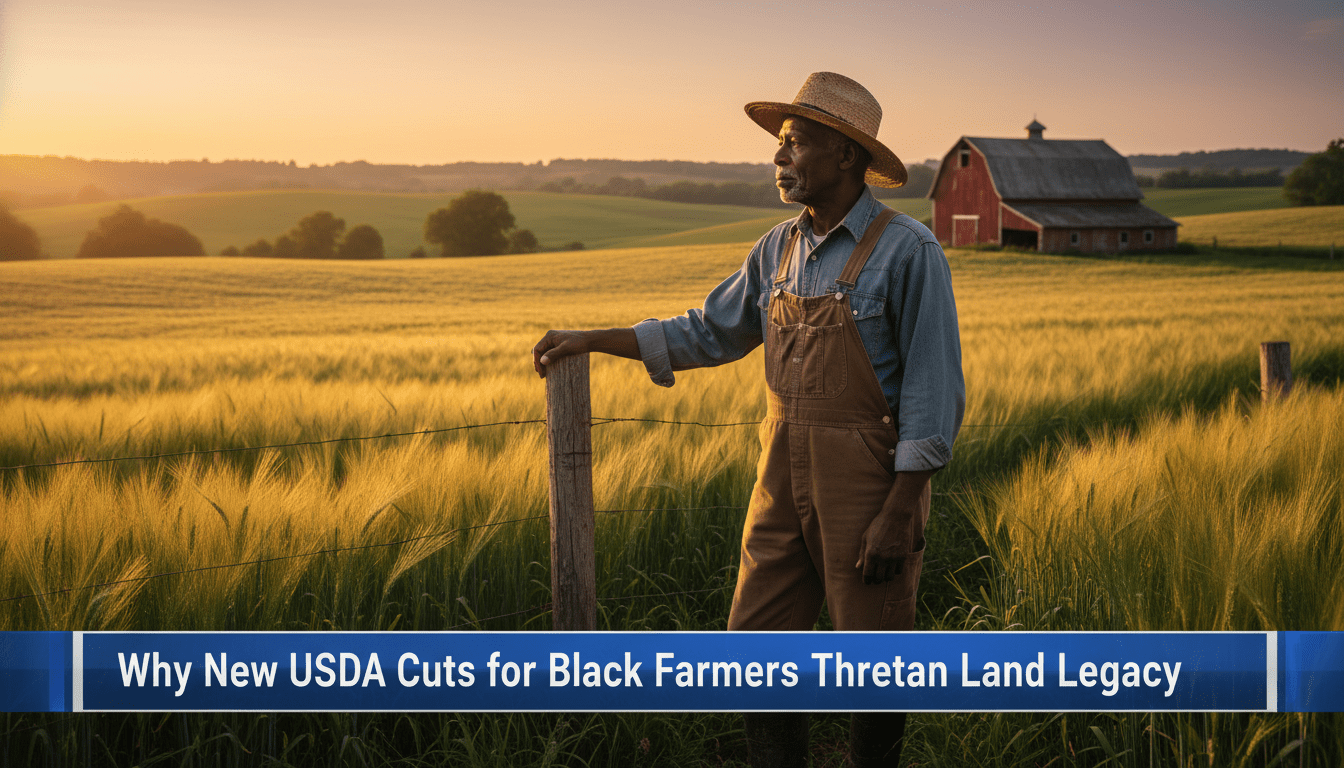
Why New USDA Cuts for Black Farmers Threaten Land Legacy
By Darius Spearman (africanelements)
Support African Elements at patreon.com/africanelements and hear recent news in a single playlist. Additionally, you can gain early access to ad-free video content.
The relationship between the United States Department of Agriculture and Black farmers is facing a new crisis. Recently, the administration under President Donald Trump moved to slash hundreds of millions of dollars from agricultural programs. These initiatives were built to help Black, immigrant, and indigenous farmers keep their land. The USDA claims these cuts are necessary to remove preferences for diversity, equity, and inclusion. However, for many families, these programs represented a rare chance to fix a century of systemic loss.
The history of this struggle is long and painful. It did not start with a single budget cut or a new policy memo. Instead, it is a story of how land was taken through legal tricks and unfair lending. To understand why these current cuts matter, one must look at the roots of Black land ownership. This report explores the deep history behind the headlines to see what is really at stake for rural communities (brookings.edu).
The Great Disappearing Act of Black Farmland
At the start of the 20th century, Black farmers were making incredible gains. In 1910, land ownership among Black families reached its highest point. Records show they owned between 16 and 19 million acres of American soil (brookings.edu). This land was more than just dirt for growing crops. It was a foundation for wealth and a tool for independence. Many early Black business leaders relied on this agricultural success to build schools and community centers.
Unfortunately, that success did not last. By the year 2017, the amount of land owned by Black farmers dropped to less than 3 million acres (brookings.edu). This represents a 90 percent decline in just over a century. The loss was caused by many factors. Racist violence forced many families to flee their homes. Unfair lending practices from the government made it hard to buy equipment. Additionally, legal loopholes often allowed outsiders to take family property. Today, Black farmers make up only about 1.4 to 2 percent of all producers in the nation (brookings.edu).
The Collapse of Black Land Ownership
1910: ~19 Million Acres 2017: < 3 Million AcresSource: 2017 Census of Agriculture and historical data (brookings.edu).
A Legacy of Redress and the Pigford Settlement
The government eventually admitted it played a role in this decline. In 1999, a landmark class-action lawsuit called Pigford v. Glickman changed everything. The suit proved that the USDA discriminated against Black farmers for decades. Local officials often delayed loan applications until the planting season was over. This ensured that crops would fail and farms would go into foreclosure. In some cases, officials used their power to punish people involved in civil rights work (lawyerscommittee.org).
The settlement for this case was massive. Along with a second settlement in 2010, the government paid out over $2.2 billion. This was the largest civil rights settlement in the history of the country at that time (brookings.edu). However, money alone could not bring back the lost land. It also did not change the culture of the local offices that managed the money. Many farmers still felt like they were locked out of the system. This history led to the creation of special programs designed to bridge the gap for “socially disadvantaged” producers (sustainableagriculture.net).
The 1990 Farm Bill and Targeted Support
Legislators tried to create a permanent fix through the 1990 Farm Bill. This bill introduced the term “socially disadvantaged.” This label included Black, American Indian, Alaskan Native, Hispanic, and Asian American farmers. The goal was to give these groups priority access to loans and training. One key result was the 2501 Program. This initiative provided technical assistance to help minority farmers navigate the complex world of federal grants (sustainableagriculture.net). People studying Black Studies curricula often point to this as a rare moment of government accountability.
Targeted support was vital for survival. Small farmers often lack the staff to fill out hundreds of pages of paperwork. The 2501 Program funded community groups to act as guides. They helped farmers build business plans and apply for disaster relief. Before the recent cuts, these disadvantaged farmers received about $1 billion in loans annually (agri-pulse.com). This accounted for roughly 20 percent of the total farm-loan volume. Without these protections, many small producers fear they will be pushed out by massive corporate operations (govdelivery.com).
Heirs’ Property: The Silent Killer of Wealth
One of the biggest obstacles to keeping land is a legal issue called heirs’ property. This happens when land is passed down through generations without a formal will. Because there is no clear title, the land is owned by many descendants at once. Each person owns a small “fractionated” share of the entire property. This situation makes the land very vulnerable to outsiders. A developer can buy one person’s small share and then force a sale of the whole farm (vermontlaw.edu).
Heirs’ property is the leading cause of involuntary land loss for Black families. It has contributed to an estimated $326 billion in lost wealth since 1920 (brookings.edu, thecounter.org). Families without a clear title cannot get traditional bank loans. They are also often ineligible for USDA programs that require proof of ownership. This creates a cycle where the family cannot afford to improve the land, making it easier to lose. Preserving kinship and land is essential for breaking this cycle of poverty (vermontlaw.edu).
The Financial Toll of Land Loss
Calculated using land appreciation and lost income (brookings.edu).
The Current Rollback of DEI Funding
The Trump administration has now moved to eliminate these targeted programs. Agriculture Secretary Brooke Rollins stated that past discrimination has been addressed. She argued that the USDA should move toward a “meritocracy” that does not consider race or sex (agri-pulse.com). In March 2026, the department canceled the Increasing Land, Capital, and Market Access Program. This was a $300 million initiative meant to help underserved farmers buy land. The administration labeled these efforts as wasteful spending (dtnpf.com).
The cancellations did not stop there. The USDA also terminated 145 specific awards totaling nearly $150 million. These grants supported a variety of community projects and food hubs. Another $400 million program for minority-owned food businesses was shut down in mid-2025. This sudden reversal has left many projects in limbo. Farmers who were counting on this support now face foreclosure or business failure. The administration argues that a race-neutral approach is the only fair way to distribute funds (agri-pulse.com).
The Impact of Staffing and Technical Cuts
Beyond the direct funding, the USDA is also cutting its workforce. In 2025, the Natural Resources Conservation Service lost nearly one in four employees (agri-pulse.com). These workers are the ones who visit farms to provide technical help. They teach farmers how to conserve water and improve soil health. When these field offices close, small farmers lose their primary link to the government. Large industrial farms can afford private consultants, but small minority farmers cannot (house.gov).
Technical assistance is often the difference between profit and loss. For example, many minority farmers rely on the Environmental Quality Incentives Program. This program pays for expensive infrastructure like irrigation systems. Without a staff member to help with the application, many farmers simply give up. These staffing cuts create a “slow-down” effect that hurts everyone. However, the impact is most severe for those who already face barriers to credit (ucs.org, agri-pulse.com).
Legal Battles and the Failure of Debt Relief
The road to these cuts was paved by several court battles. In 2021, the government tried to provide debt relief through the American Rescue Plan. Section 1005 was supposed to pay off loans for thousands of farmers of color. However, white farmers sued the government, claiming the program was “reverse discrimination.” They argued that the program violated the Equal Protection Clause. Federal courts agreed and stopped the payments from going out (nationalaglawcenter.org, lawyerscommittee.org).
This legal victory for the opposition gave the current administration a framework to end other programs. Since the courts ruled against race-based debt relief, the USDA is now removing race as a factor in all its work. This “color-blind” policy ignores the specific historical reasons why Black farmers are struggling. Proponents of these programs argue that you cannot fix a racial problem with a race-neutral solution. They believe that ignoring history only allows the old patterns of exclusion to continue (agri-pulse.com, lawyerscommittee.org).
The Response from States and Advocates
Not everyone is staying quiet about these changes. In early 2026, 20 states and the District of Columbia filed a lawsuit against the USDA. They argue that the administration is ignoring the intent of Congress. These states claim that the funding for these programs was already approved by lawmakers. They believe the executive branch does not have the authority to simply cancel them. The lawsuit alleges that the USDA is holding critical money hostage to push a political agenda (agri-pulse.com).
Groups like the National Black Farmers Association are also organizing. John Boyd Jr., the founder of the association, has spent decades fighting for these resources. He argues that the struggle for land is a struggle for survival. Advocates point out that when Black farmers lose their land, the entire community suffers. They lose a source of healthy food and a part of their cultural heritage. The fight for these programs is seen by some as a continuation of older revolutionary movements for justice (thegrio.com, washingtoninformer.com).
Major Funding Cancellations (2025-2026)
Data reflects administrative actions (dtnpf.com, agri-pulse.com).
The Future of the Black Farmer
The current policy shift at the USDA marks a major turning point. For several years, there was a growing effort to repair the damage of the past. Programs like the Discrimination Financial Assistance Program tried to help those who were harmed. Now, those efforts are being replaced by a model that focuses on “merit, faith, and liberty.” While this sounds fair on the surface, it does not account for the unequal starting line. Farmers who lost $326 billion in wealth cannot easily compete in a race-neutral market (agri-pulse.com, thecounter.org).
The path forward is uncertain for many rural families. Without federal support, they must find new ways to secure their land. Some are looking toward private collectives and community land trusts. Others are focusing on specialized crops that can bring in more money from smaller plots. Despite the cuts, the spirit of resilience remains strong. The history of Black farming is a history of overcoming obstacles. While the headlines today are bleak, the deep roots of this community have survived worse (usda.gov, washingtoninformer.com).
In summary, the slashing of USDA funding is more than a budget move. It is a reversal of decades of progress toward equity in agriculture. The removal of the “socially disadvantaged” status signals a new era for federal policy. Whether Black farmers can survive this latest challenge depends on their ability to organize and find alternative support. The land remains a vital part of the American story. Protecting those who work it is essential for the future of the nation (brookings.edu, agri-pulse.com).
About the Author
Darius Spearman is a professor of Black Studies at San Diego City College, where he has been teaching for over 20 years. He is the founder of African Elements, a media platform dedicated to providing educational resources on the history and culture of the African diaspora. Through his work, Spearman aims to empower and educate by bringing historical context to contemporary issues affecting the Black community.
