


Will the Supreme Court End Birthright Citizenship Protections?
By Darius Spearman (africanelements)
Support African Elements at patreon.com/africanelements and hear recent news in a single playlist. Additionally, you can gain early access to ad-free video content.
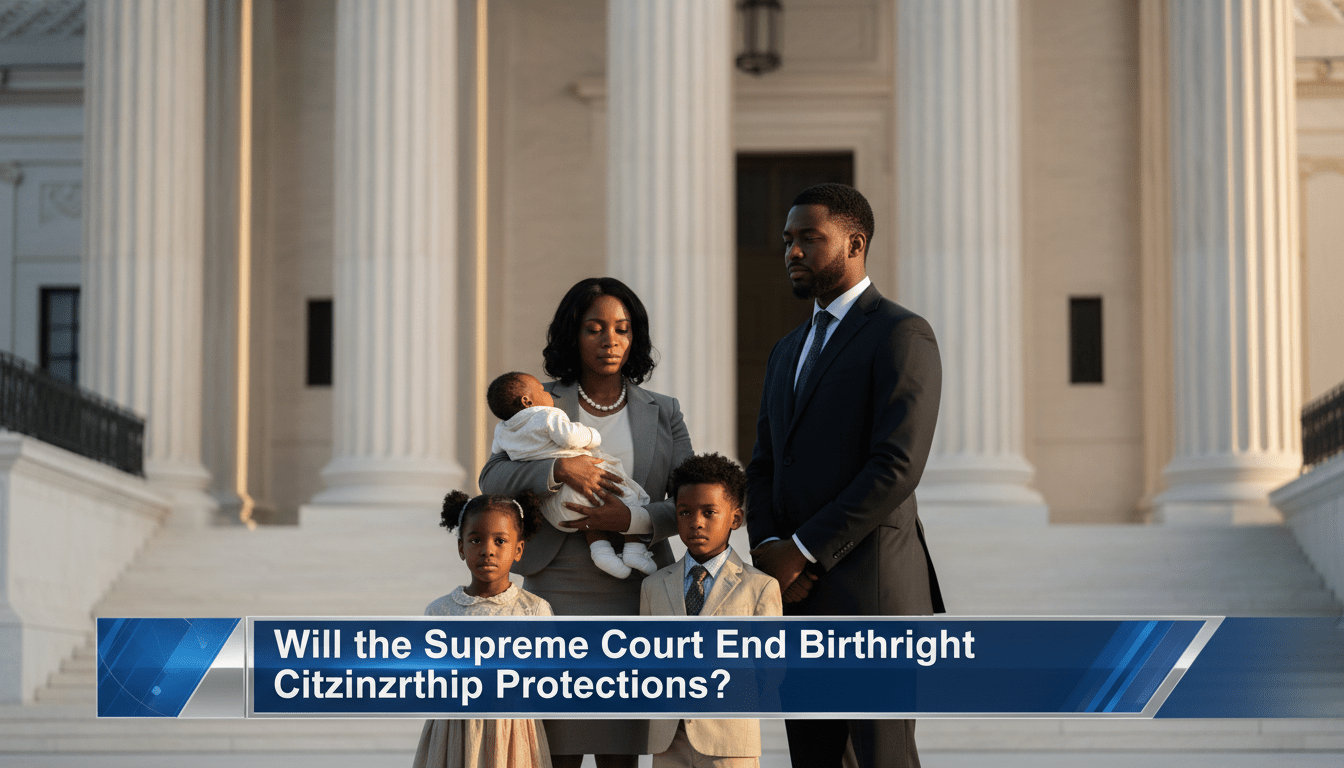
The United States Supreme Court stands at a historical crossroads today. As oral arguments begin in the case of Trump v. Barbara, the future of the American polity hangs in the balance. This legal battle targets the long-standing rule that anyone born on American soil is automatically a citizen. For over a century, this principle has served as a cornerstone of American identity. Now, a 2025 executive order from President Trump seeks to dismantle this foundation (brennancenter.org, ogletree.com).
Civil rights advocates warn that this move could create a permanent underclass of residents. This issue is particularly pressing for the Black diaspora and the Haitian community. Thousands of children could lose their right to belong to the only country they have ever known. The outcome of this case will decide if the 14th Amendment remains a shield for the vulnerable or if it will be redefined to exclude those whom the nation once promised to protect (acluaz.org, haitianbridgealliance.org).
The Fight for the Soil: A History of Belonging
The concept of birthright citizenship is known legally as jus soli, which translates to the right of the soil. This principle was not always the law of the land in the United States. In 1857, the Supreme Court issued the infamous Dred Scott v. Sandford decision. That ruling declared that Black people could never be citizens of the United States. This dark chapter in American law established a racial hierarchy that the nation eventually sought to destroy (constitutioncenter.org, archives.gov).
After the American Civil War, the nation entered a period of transformation. Congress passed the Civil Rights Act of 1866 to grant citizenship to all persons born in the United States. However, leaders feared that future politicians might try to repeal this law. To prevent this, they ratified the 14th Amendment in 1868. This amendment was designed to ensure that post-civil war reconstruction efforts would include a permanent guarantee of citizenship for formerly enslaved people and their descendants (nationalcivilwarmuseum.org, constitutioncenter.org).
The first sentence of the 14th Amendment is known as the Citizenship Clause. It states that all persons born or naturalized in the United States are citizens. This was a direct rebuttal to the Dred Scott decision. It was meant to put the question of citizenship beyond the reach of shifting political winds. Historically, this clause has acted as a vital protection against the creation of a caste system (theusconstitution.org, archives.gov).
Babies born annually in the U.S. who could be denied citizenship under the new order.
Source: Migration Policy Institute (2025)
Undoing a Century of Legal Certainty
The current legal challenge is an attempt to overturn a precedent that has stood for 128 years. In 1898, the Supreme Court ruled in the case of United States v. Wong Kim Ark. Wong Kim Ark was born in San Francisco to Chinese immigrant parents. At that time, Chinese immigrants were legally barred from becoming naturalized citizens. When the government tried to deny him entry back into the country, the Court stepped in (constitutioncenter.org, oyez.org).
The Court ruled 6-2 that the 14th Amendment applied to almost everyone born on American soil. The only exceptions were children of foreign diplomats or enemy combatants. This ruling established that the status of the parents does not dictate the citizenship of the child. It confirmed that the United States follows the jus soli tradition rather than a blood-based system. This bedrock principle has allowed millions of children of immigrants to integrate fully into American society (northwestern.edu, scotusblog.com).
President Trump’s Executive Order 14160 seeks to bypass this history. The administration argues that the 14th Amendment has been misinterpreted for over a century. They claim that “subject to the jurisdiction thereof” implies a requirement of political allegiance. This would mean that only children of citizens or permanent residents would qualify for birthright citizenship. Critics argue that a president cannot change the Constitution through an executive order. Such a change would normally require a lengthy constitutional amendment process (brennancenter.org, ogletree.com).
The Meaning of Jurisdiction and Allegiance
The legal debate centers on four specific words in the 14th Amendment: “subject to the jurisdiction.” There are two main ways to interpret this phrase. The traditional view is the geographical or territorial interpretation. This means that if a person is physically present in the United States and must follow its laws, they are under its jurisdiction. This includes being subject to arrest and prosecution for crimes (constitutioncenter.org, theusconstitution.org).
The administration is pushing for a consensual or political interpretation. This view suggests that jurisdiction requires a mutual agreement between the individual and the state. Under this theory, people who are in the country without legal permission do not owe permanent allegiance. Therefore, their children would not be “subject to the jurisdiction” of the United States in a way that confers citizenship. This interpretation was historically used to exclude Native Americans who owed allegiance to their own tribes (northwestern.edu, constitutioncenter.org).
Legal scholars from the NAACP Legal Defense Fund point out the dangers of this narrow view. They argue that it creates a class of people who are bound by American laws but are denied the protections of citizenship. This would effectively resurrect the legal status that Black people held before the Civil War. It would place the government in the position of picking and choosing who belongs to the national polity based on political or racial criteria (acluaz.org, substack.com).
Haitian Families in the Crosshairs
The Haitian community in the United States faces a unique and terrifying threat if the Court upholds the executive order. Many Haitian families have come to America seeking refuge from political instability and natural disasters. For these families, birthright citizenship is the only thing that provides their children with legal security. Without it, these children could become stateless (haitianbridgealliance.org, haitianbridgealliance.org).
Statelessness occurs when no country recognizes a person as a citizen. This is a dire situation because a person without citizenship cannot get a passport or travel legally. They often lack access to public education, healthcare, and legal employment. In the Haitian community alone, an estimated 150,000 children rely on birthright protections. If those protections disappear, these children will live in a permanent legal shadow (haitianbridgealliance.org, ecoi.net).
Establishing Haitian citizenship is not a simple task for those born abroad. Haiti follows a system of jus sanguinis, or citizenship by blood. This requires parents to provide Haitian birth certificates and other documentation to the Haitian government. However, many refugees fled their homes with nothing. They cannot easily obtain records from a country that has suffered from widespread record destruction (irb-cisr.gc.ca, ecoi.net).
Projected Growth of Unauthorized Population (Millions)
Ending birthright citizenship would lead to a massive increase in people without legal status.
Data: Center for Migration Studies
The Ghost of the Dominican Republic
Advocates point to the Dominican Republic as a warning of what could happen in the United States. In 2013 and 2014, the Dominican Republic retroactively revoked birthright citizenship for people of Haitian descent. This decision affected generations of people who had been born and raised in the country. Suddenly, they were told they were no longer citizens of the place they called home (haitianbridgealliance.org, haitianbridgealliance.org).
This crisis resulted in approximately 200,000 people becoming stateless overnight. These individuals lost their ability to vote, attend university, or get married legally. They faced mass deportation to Haiti, a country many of them had never even visited. The social and economic impact of this policy was devastating for families. It created a humanitarian disaster that persists to this day (haitianbridgealliance.org, irb-cisr.gc.ca).
The parallels to the current situation in the United States are clear and frightening. By challenging the 14th Amendment, the administration is moving toward a similar blood-based system of belonging. This shift often targets specific ethnic or racial groups. It ignores the reality that many families have been part of the American fabric for years. Revoking citizenship creates a fractured society where neighbors are treated as outsiders (haitianbridgealliance.org, acluaz.org).
The Reality of the Legal Maze
For Haitian refugees, providing proof of parental citizenship is nearly impossible. A massive earthquake in 2010 destroyed the Haitian National Archives and many local registry offices. This means that millions of records were lost forever. In rural parts of Haiti, many births were never even registered because of the high costs and long travel distances (irb-cisr.gc.ca, ecoi.net).
This lack of documentation creates a legal maze that few can navigate. Without official records from Haiti, parents cannot prove their lineage to the satisfaction of new, stricter American rules. Even when documents are found, they are often scrutinized or rejected. The current executive order places a heavy burden of proof on families who have already suffered significant trauma (ecoi.net).
Furthermore, the environment is ripe for fraud and exploitation. Many refugees have fallen victim to forgers who sell fake birth certificates. These families do not realize the documents are fraudulent until they try to apply for official services. This situation leaves them vulnerable to both criminal predators and government enforcement. The legal maze is designed in a way that makes success nearly impossible for the most marginalized (irb-cisr.gc.ca).
Beyond Haiti: The Black Diaspora at Risk
While the Haitian community is a major focus, the executive order impacts many other Black immigrant groups. Refugees from Somalia, Ethiopia, and Nigeria are also in danger. Many of these countries have strict jus sanguinis laws similar to Haiti. If their children are not recognized as Americans, they may have no other claim to citizenship anywhere else (substack.com).
This policy forces families into a state of “administrative invisibility.” When a child is born but not recognized by the state, they cannot access vital benefits. This includes Social Security, Medicaid, and even basic birth certificates in some jurisdictions. This systemic exclusion prevents families from achieving the stability needed to contribute to their communities. It creates a cycle of poverty and legal uncertainty (acluaz.org, ogletree.com).
Advocates warn that this is part of a larger trend that threatens all Black Americans. If the government can question the belonging of one group based on their lineage, it sets a dangerous precedent. This power could eventually be used to target any group that is deemed politically unpopular. The history of the United States shows that when citizenship is made conditional, Black people are often the first to lose their rights. This battle is about maintaining the resilience of families against government overreach (acluaz.org, substack.com).
Protecting the Shield of the 14th Amendment
The 14th Amendment is often described as a shield for the vulnerable. Its primary purpose was to end the caste system that had defined America since its founding. By ensuring equal protection and due process, it provided a legal framework for the Civil Rights Movement. Weakening the Citizenship Clause would inevitably weaken these other protections as well (constitutioncenter.org, archives.gov).
The amendment was intended to nationalize the Bill of Rights. This made sure that individual states could not take away the basic rights of any citizen. If citizenship becomes a matter of presidential interpretation, the foundation of all civil rights is at risk. The government could theoretically demand proof of “legitimacy” from people whose ancestors were brought to the country illegally during the slave trade. This would reopen old wounds and create new injustices (nationalcivilwarmuseum.org, theusconstitution.org).
Historians note that thousands of enslaved people were brought to the U.S. illegally after the slave trade was banned in 1808. A restrictive view of jurisdiction could be used to question the status of their descendants. The 14th Amendment was written specifically to prevent this kind of historical interrogation. It was meant to be a clean break from the past, ensuring that everyone born here started on equal footing. Protecting this shield is essential for the future of democracy (constitutioncenter.org, archives.gov).
Public Opinion on Birthright Citizenship (2025)
Source: Pew Research Center
Visualizing the Future of the American Polity
The potential consequences of ending birthright citizenship are staggering. Research from the Migration Policy Institute shows that the unauthorized population would grow significantly. By 2045, the number of people without legal status would increase by 2.7 million. By 2075, that number could reach 5.4 million. This would create a massive population of residents who live, work, and pay taxes but have no legal voice (ogletree.com).
The economic impact is also a major concern for experts. Those who have benefited from birthright citizenship contribute trillions of dollars to the economy. A study by the Center for Migration Studies estimates their contribution at $7.7 trillion over a century. These individuals add millions of workers to the labor force and support the Social Security system. Removing them from the formal economy would hurt everyone (ogletree.com).
Public opinion on the issue is deeply divided, reflecting the split on the Supreme Court. Half of American adults believe children of undocumented immigrants should be citizens. The other half disagrees, often citing concerns about border security or national resources. This division highlights the importance of the Court’s role. It must decide whether the Constitution’s meaning changes with political trends or remains a fixed promise (ogletree.com).
The People Behind the Lawsuit
The case before the Supreme Court is not just about abstract legal theories. It is about real people like “Barbara,” the primary plaintiff. Barbara is a pseudonym for a Honduran asylum seeker who was pregnant when the executive order was signed. She joined the lawsuit because she feared her child would be born into a world without a country. Her story represents the human face of this legal struggle (oyez.org).
Other plaintiffs include “Susan,” a student from Taiwan, and “Mark,” who is applying for permanent residency. These families represent the diversity of those affected by the order. They are not just people at the border; they are students, workers, and long-term residents. They all share a common fear: that their children will be denied the rights they have worked so hard to secure (oyez.org).
These families are seeking to preserve access to vital benefits. For Barbara’s child, citizenship means access to healthcare and the ability to grow up without the fear of deportation. The lawsuit argues that the president’s action has caused immediate harm and uncertainty. By using pseudonyms, the plaintiffs highlight the climate of fear that this policy has created within immigrant communities (oyez.org).
What Happens to the Children Today?
As the legal battle continues, the status of children born after January 20, 2025, remains uncertain. The executive order directed agencies to stop recognizing these children as citizens. However, federal courts have stepped in to pause the order. A nationwide injunction was initially issued to block the policy while the case was heard. This has allowed many families to continue receiving documents for now (trentonmonitor.com, ogletree.com).
Despite the court orders, many parents report significant delays and confusion. Some passport applications are being placed “in progress” for long periods. Different states and agencies are sometimes providing conflicting guidance. This has created a stressful environment for new parents who are trying to secure their children’s future. The legal uncertainty has made it difficult for families to plan for the long term (oyez.org).
The Supreme Court recently limited the power of lower courts to issue “nationwide” injunctions. This means that enforcement might vary depending on where a family lives. However, a preliminary injunction for the specific group involved in the lawsuit is still in place. Agencies are currently barred from enforcing the order against this certified class of people. A final ruling from the Supreme Court is expected by the summer of 2026 (ogletree.com, oyez.org).
Ultimately, the Supreme Court must decide what kind of nation the United States will be. Will it remain a country where citizenship is a birthright, or will it shift toward a system of exclusion? The answer will define the lives of hundreds of thousands of children. It will also determine if the 14th Amendment still stands as a testament to equality. As the world watches, the justices hold the future of the American polity in their hands (acluaz.org, constitutioncenter.org).
About the Author
Darius Spearman is a professor of Black Studies at San Diego City College, where he has been teaching for over 20 years. He is the founder of African Elements, a media platform dedicated to providing educational resources on the history and culture of the African diaspora. Through his work, Spearman aims to empower and educate by bringing historical context to contemporary issues affecting the Black community.
